
In This Post:
Presenters:

Matt Serel
CEO & Co-Founder

AJ Diaz
CCO & Co-Founder
Substance Use Disorder (SUD) is one of the most expensive and complex challenges facing employers, health plans, and care management teams today. Organizations are still focusing the majority of their investment on treatment itself while overlooking what happens after discharge. That’s the period when employees are often at the highest risk of relapse. So, what really happens to patients when they leave care? The reality is that treatment alone is rarely enough to sustain long-term recovery.
According to Accountable, relapse rates in traditional treatment models can range from 40% to 60% after discharge. Without ongoing support, accountability, and connection, many individuals return to substance use within months of completing care. This growing challenge is exactly what the webinar was all about, hosted by Accountable co-founders Matt Serel and AJ Diaz. They shared insight into how peer-led recovery coaching, remote monitoring, and extended engagement are helping employers reduce behavioral health costs while improving long-term outcomes for members.
About Accountable
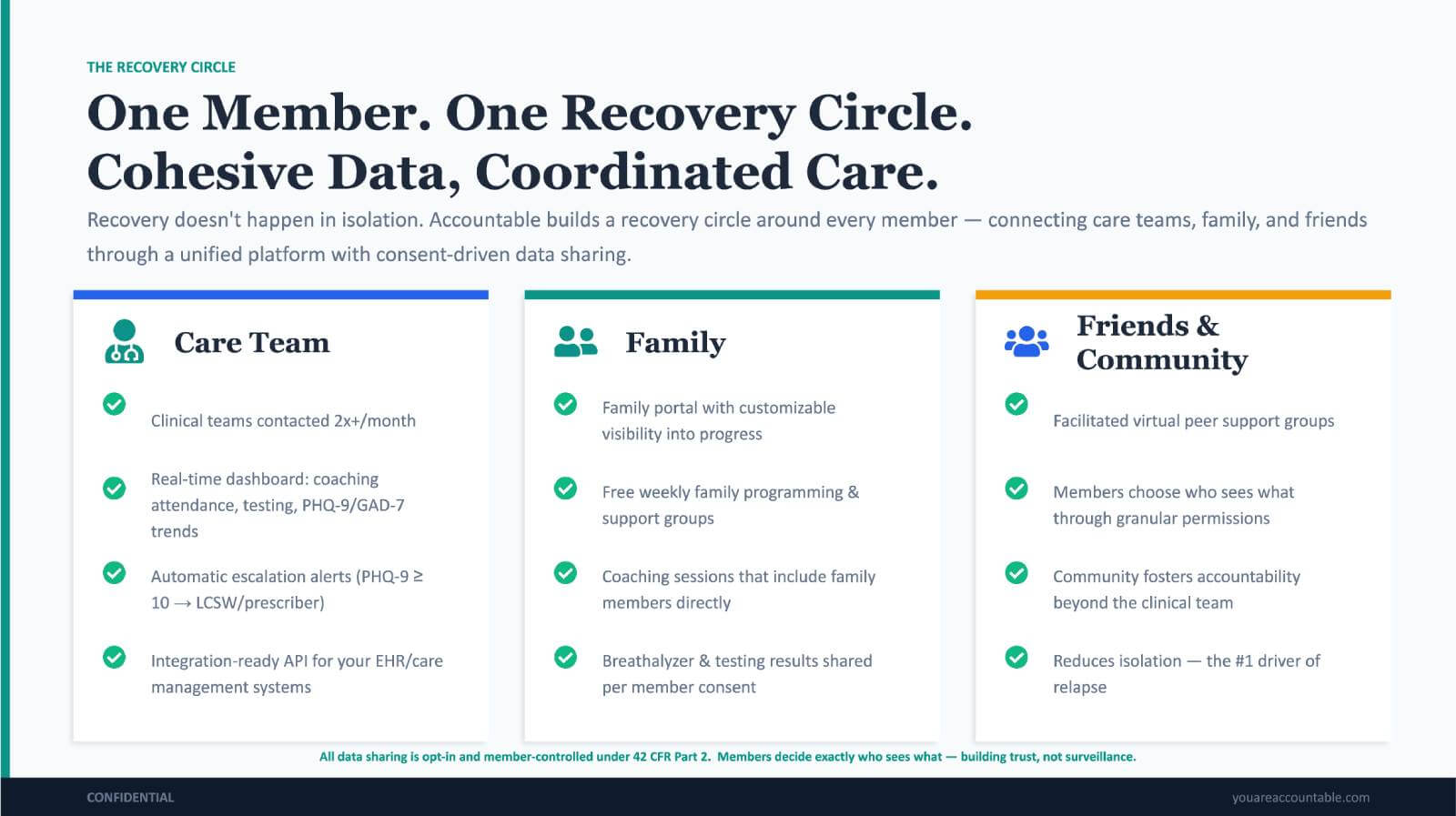
You Are Accountable, also referred to as Accountable, is a fully integrated solution to the most expensive and least-managed part of substance use disorder: the long recovery tail after acute treatment, where relapse and re-admission quietly drive cost.
Delivered as a virtual platform nationwide, Accountable pairs every member with a certified peer recovery specialist for weekly video and always-on text support, layered with daily AI-enhanced breathalyzer monitoring and remote toxicology across 70+ substances, plus navigation across the full recovery continuum.
It’s built to complement an employer’s existing health plan and EAP rather than replace them — a connective layer with no overlap, no duplicated spend, and minimal administrative lift. The result: members see about half as many relapses (based on five years of our data versus industry baselines), which translates into substantial savings, and 9 of 10 would recommend the program.
The Real Cost Driver Is Re-Utilization
One of the most important ideas discussed in the webinar is that the biggest financial leak in SUD care often comes after treatment ends. These expenses are frequently driven by relapse and re-utilization rather than the original treatment episode itself.
Employers and health plans spend heavily on detox programs, residential treatment, emergency department visits, and repeat inpatient admissions. As Matt shared his experience, it was easier to stay in recovery when he was in a residential treatment program. Once he graduated from the program and was back home, that’s when it became much harder. So how do we support people in that first year?
When structured support disappears, many individuals lose the accountability, peer connection, and guidance that helped them remain stable during treatment.
Discharge is not the finish line. It’s the beginning of the highest-risk recovery window.
This creates a revolving door of care. After residential treatment, we see people gain short-term stabilization. When discharged from the program, they feel isolated, and that brings them back to relapse and readmission.
For employers, this cycle can quickly become one of the largest drivers of behavioral health spending. Accountable’s data shows that a single readmission episode can cost between $25,000 and $50,000.
Instead of focusing solely on acute intervention, many organizations are beginning to realize that sustained recovery support may deliver a stronger long-term return on investment.
Why Extended Support Matters
Traditional behavioral healthcare models often provide structured treatment for 30 to 90 days. But recovery does not operate on a fixed timeline.
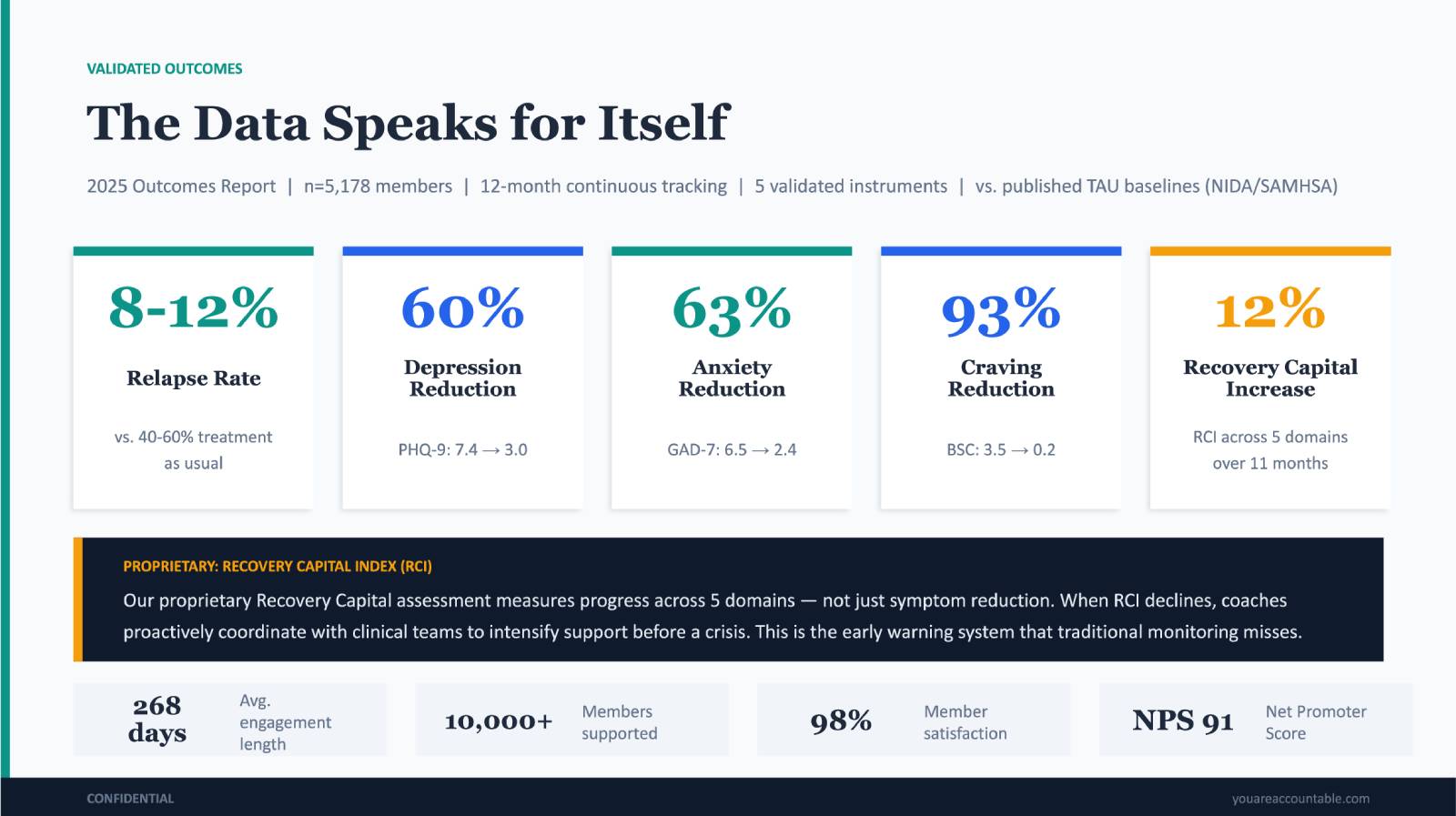
Accountable’s model focuses on extending support through the highest-risk recovery period with peer recovery coaching, virtual engagement, monitoring tools, and coordinated care. Their average member engagement lasts 268 days. That is far longer than the duration of traditional case management programs.
The company describes its platform as “the missing layer” between treatment discharge and sustainable long-term recovery. The platform is designed to strengthen and extend the clinical treatment with care coordination with clinical teams, one-on-one virtual coaching, and real-time text support. Then there’s family programming and recovery tracking tools, and continuous PHQ-9 and GAD-7 monitoring.
The 50% Reduction and 8x ROI Model
One of the most compelling parts of the webinar is the measurable financial and clinical impact Accountable reports from its model.
According to their outcomes data:
- Members experienced a 50% reduction in return to higher levels of care
- Relapse rates dropped to 8 – 12% compared to traditional treatment baselines of 40 – 60%
- Depression scores decreased by 60%
- Anxiety scores decreased by 63%
- Cravings were reduced by 93%
From a financial perspective, Accountable reports an ROI range of 3 – 4x across broad populations and up to 8x among high-utilizer populations with repeated treatment episodes.
The economics are significant because the program itself costs approximately $500 per month, a fraction of the cost of another residential admission or emergency intervention.
Why Peer Coaching Works Differently
Accountable coaches are not simply clinicians following scripts. Every coach is a certified peer specialist who has personally experienced recovery. This creates a level of trust and relatability that many traditional care management models struggle to achieve – this drives enhanced engagement within a population. For individuals leaving treatment, feelings of shame, isolation, and distrust can become major barriers to engagement. Peer coaches help bridge that gap because they understand recovery from firsthand experience.
The organization also emphasizes matching coaches to members based on background, substance type, recovery goals, and cultural fit. This personalized contributes to significantly longer engagement periods. Accountable SUD engagement programs report average engagement lengths exceeding eight months.
Longer engagement matters because recovery outcomes improve when members remain connected, supported, and visible to care teams over time.
Technology That Supports Accountability Without Surveillance
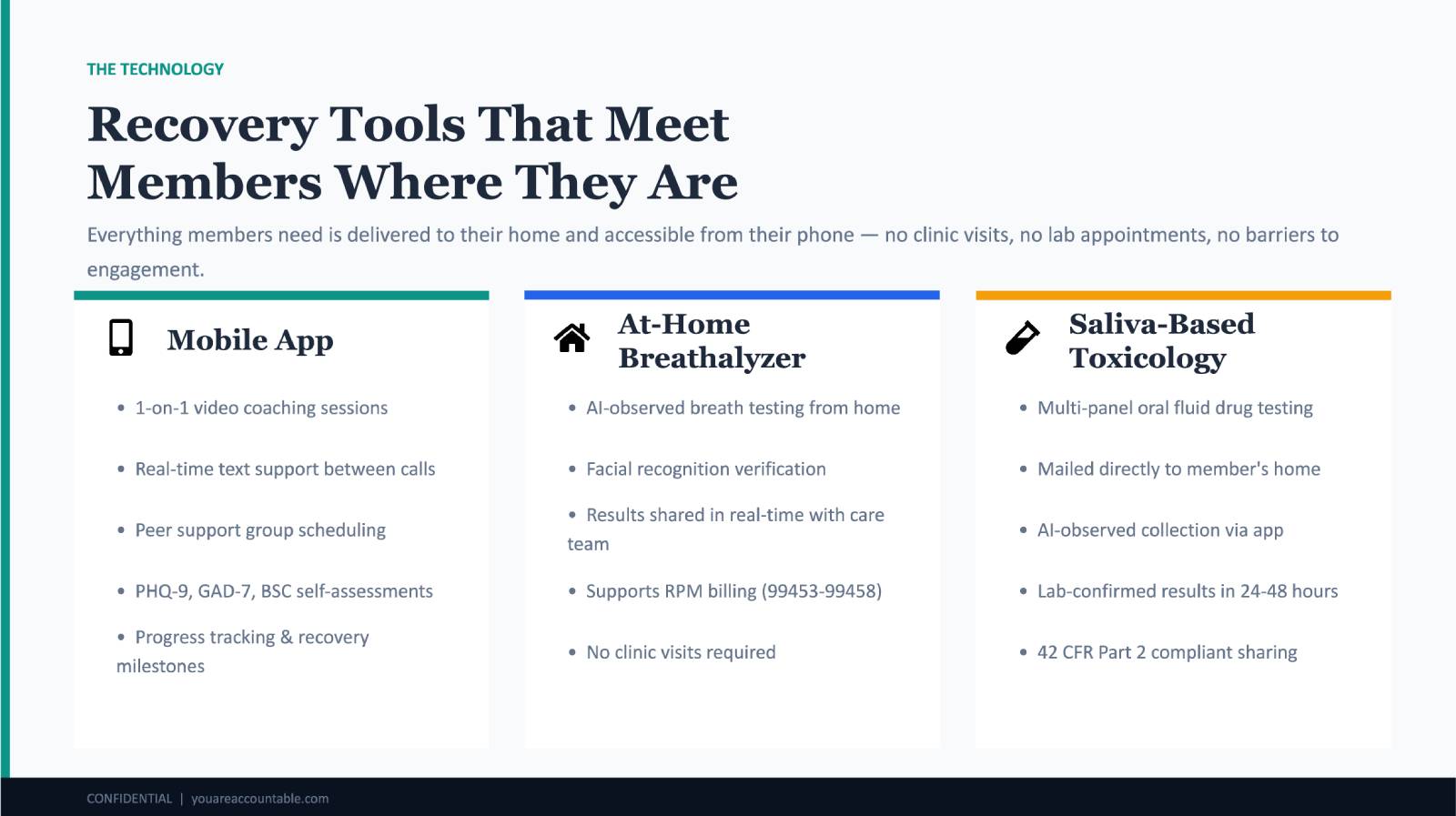
Accountable’s platform is fully virtual and nationwide, eliminating many common barriers such as transportation, scheduling conflicts, or geographic limitations.
Members can access:
- Video coaching
- Text support
- Peer groups
- Self-assessments
- Recovery tracking tools directly from their phones.
The platform also incorporates remote monitoring tools such as AI-observed breathalyzer testing and saliva-based toxicology screening.
Importantly, Accountable emphasizes that data sharing is consent-driven and compliant with 42 CFR Part 2 protections. Members choose exactly who can view their information, which helps maintain trust and avoid the feeling of surveillance.
Operationalizing Recovery Support Within Existing Benefits
For employers and health plans, implementation is often one of the biggest concerns when considering new behavioral health solutions.
Accountable integrates into existing benefit ecosystems without requiring entirely new infrastructure. The platform can function as a vendor solution, an in-network benefit, a care management extension, or as a recovery navigation layer.
Accountable also uses existing reimbursement pathways such as:
- H0038 peer support billing
- Remote Patient Monitoring (RPM) codes
- Principal Illness Navigation-Peer Support (PIN-PS) pathways
This flexibility makes the model easier for employers and health plans to operationalize within current benefit structures.
Get in touch with Accountable today!
Behavioral healthcare conversations are increasingly moving beyond crisis intervention and acute treatment alone. Employers are recognizing that long-term recovery support may be one of the most effective ways to reduce repeat claims costs while improving employee wellbeing.
The webinar ultimately reinforces a powerful idea: treatment is essential, but treatment without sustained recovery support leaves a critical gap.
By combining peer-led coaching, continuous engagement, remote monitoring, and coordinated care, organizations like Accountable are attempting to transform recovery from a short-term intervention into a measurable long-term strategy.
For employers, brokers, and health plans searching for ways to reduce SUD-related spending while supporting better member outcomes, the conversation is about helping people stay connected, supported, and engaged long after treatment ends.
Talk to Accountable to see how the SUD-related platform fits into your benefits strategy. youareaccountable.com
In case you missed it: Log in to access the full Meet A Vendor Presentation!
Not a subscriber? Request access.
Did you find this article interesting?
Don’t keep this knowledge to yourself – share it on your social media channels and spark engaging conversations!