In This Post:
Presenters:

Bryce Rausch
Head of Partnerships
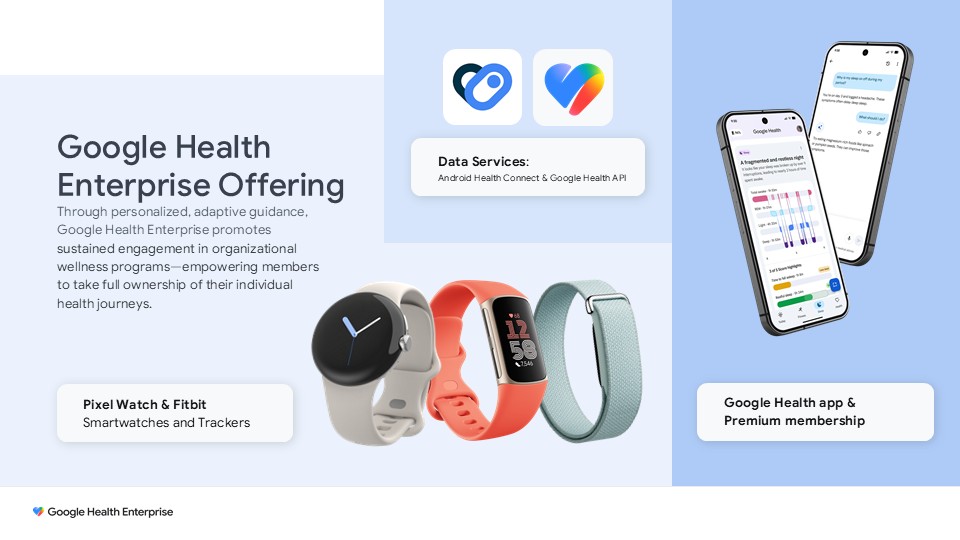
How many times have we heard the word engagement since the beginning of this year? It’s because one of the biggest challenges is no longer simply offering employees access to wellness resources, but how to keep people engaged long after a program launches. Google Health Enterprise brings health and wellness experiences together through a recognizable ecosystem that combines the Google Health app, personalized Google Health Coach1, Fitbit and Pixel Watch devices, and health data services.
The recent webinar was all about engagement, and its critical role in health initiatives. Bryce Rausch, Head of Partnerships for Google Health Enterprise, talked about driving sustained, long-term engagement. He showed how their new ecosystem, powered by Google Health Coach and Fitbit Air2, can help achieve moving from passive tracking to active, daily engagement with health and wellness. He went through the new app and the new wearable and provided a refresher on the Google Health Enterprise business as well.
About Google Health Enterprise
Google acquired Fitbit in 2021 and restructured its consumer health approach, consolidating all consumer-facing products under Google Health. It is a digital health solution that helps organizations improve health outcomes across their population.
The Fitbit app is now the Google Health app. Fitbit and Pixel wearables still pair and work with the app as they did before, rebuilding the entire app from the ground up into this new experience. All that’s needed to convert to this experience is a Google account and using the Google Health app.
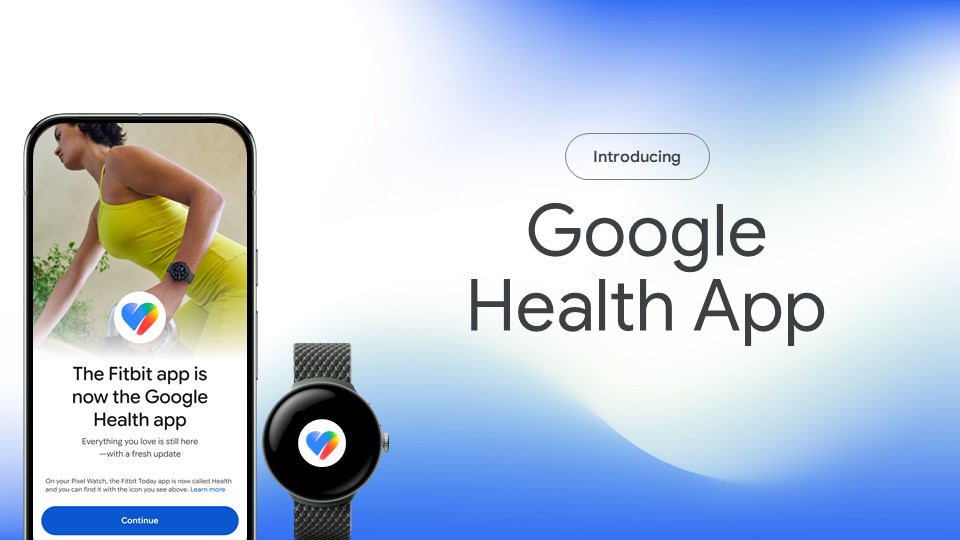
Google Health App New Features
Now that the Fitbit app has become a Google Health App, users have received new features that have been long awaited:
- It syncs all sorts of data from many of the places that matter most, like Nike, MyFitnessPal, Headspace, and devices like Apple Watch, Garmin, Oura, and Whoop.
- Integrates medical records where users can now upload procedures, allergies, medicines, immunizations, and control what providers can see and how long they get to see3.
- Integrates personal records that are described as generating a QR code that the other member just has to scan, and they’d be able to access that.
Google Health App users control their data. Google publicly committed to not using Google Health data for Google Ads, so you can rest assured that they keep this commitment.
Users can choose whether or not to allow their data to be used for AI training or additional data collection – and opt out of those features at any time.
Personalization Makes Engagement More Relevant
One of the most notable elements of the Google Health ecosystem is Google Health Coach1, described as a personalized health coach built with Gemini, and it can function across different areas such as fitness, sleep, and broader health and wellness guidance.1
That adaptive approach can make wellness guidance more realistic. Instead of forcing an employee to follow a rigid workout schedule, the coach can build a personalized plan around flexible weekly targets. If an employee’s schedule changes, the plan can be adjusted by incorporating an active recovery day.
This is important because real life rarely follows a perfectly structured wellness plan. Employees have busy workdays, family responsibilities, travel, unexpected commitments, and changing energy levels. A system that can adapt to those realities may be more likely to remain useful than one that treats every user the same.
What is certainly seen inside Google Health Premium app experience is that users can interact with their Google Health Coach. It is a seamless and natural place for users to have this interaction, asking a lot of questions that will not be asked in other circumstances, while life happens, and they end up missing out on some information that could’ve been really helpful if they had easy access to it in the moment in which they were focused on it.
Fitbit Air: Making Tracking Less Intrusive
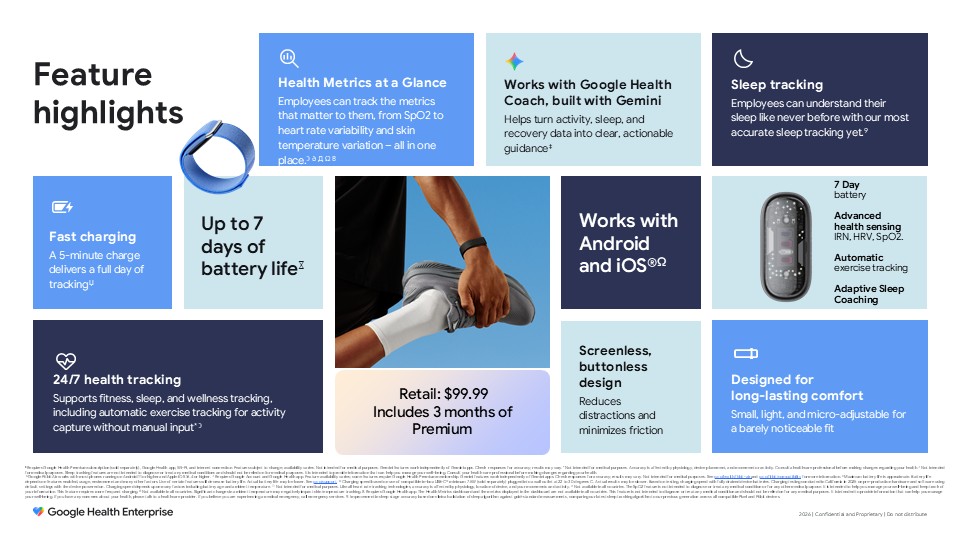
The wearable component of the offering is equally important. Google Fitbit Air is positioned as a lightweight, screenless, buttonless wearable designed to reduce digital distractions and minimize friction. It provides 24/7 health tracking while remaining small, light, and micro-adjustable for comfort.
Its feature set includes activity tracking, sleep tracking, heart rate variability, oxygen saturation, skin temperature variation, automatic exercise tracking, and other health metrics. The device is designed to work with Google Health Coach, helping connect passive tracking with personalized guidance.3
That combination is significant. The less effort required from an employee to capture information, the easier it can be to maintain consistent engagement. Fitbit Air’s automatic activity recognition, for example, can capture activity without requiring manual input. Its screenless design also reduces the temptation to turn the wearable itself into another source of digital distraction.
The device offers up to seven days of battery life, and the presentation states that a five-minute charge can provide a full day of tracking.4, 5
Google Health Enterprise as one Ecosystem
A wellness strategy is only as inclusive as its accessibility. Organizations with diverse workforces recognize that not every employee uses the same type of smartphone. That’s why Google Health Enterprise emphasizes compatibility across Android and iOS, with Google Fitbit Air supporting most phones running Android 11 or higher and Apple iOS 16.4 or higher.2
That cross-platform approach can help remove a significant technical barrier, meaning less concern about designing an engagement strategy around a single mobile operating system. A workforce can participate using different personal devices while accessing the broader ecosystem.
Google Health Enterprise can support areas such as physical activity, digital fitness, meditation and mindfulness, sleep improvement, stress management, nutrition logging, health coaching1, and biometric tracking. That’s where consolidation can have implications beyond the employee experience. A more unified ecosystem could simplify the overall benefits landscape and give employees a more consistent experience.
This will give employers the potential to evaluate whether multiple overlapping point solutions are actually creating value or just creating complexity.
Get in touch with Google Health Enterprise today!
The technology itself is not an outcome, but rather a support for behaviors and interventions that can contribute to better health. That’s why engagement is so important.
A wearable device sitting unused in a drawer cannot support an employee’s journey to wellness. An app opened once and forgotten cannot provide sustained guidance. The opportunity lies in creating an experience that employees will find useful enough to return to, and simple enough to incorporate into their daily lives.
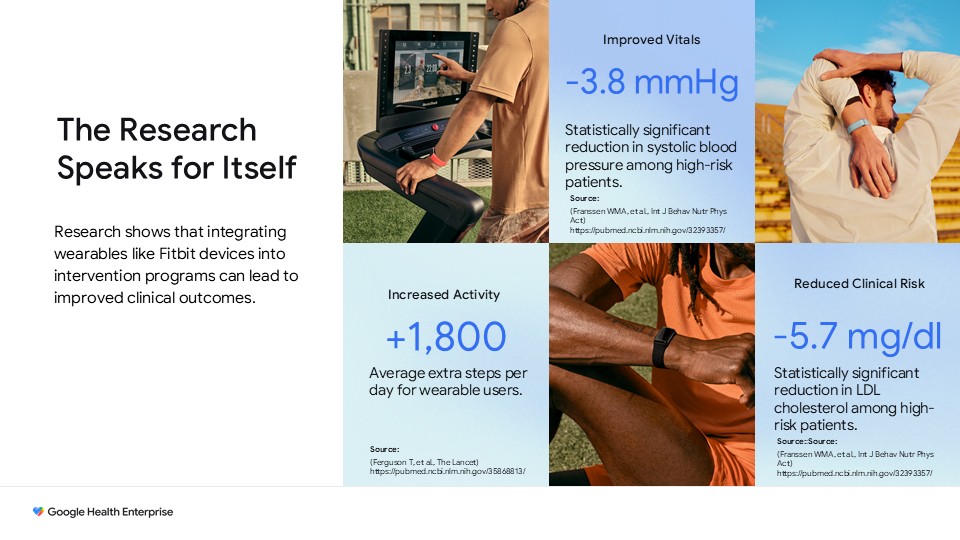
A systematic review and meta-analysis of 37 randomized controlled trials showed that Fitbit-based interventions resulted in an increase in daily step counts by 950, an increase in moderate to vigorous physical activity by 6 minutes per day, and a reduction in body weight by 3.3 pounds.6
Google Health Enterprise positions its ecosystem around precisely that idea: combining personalized guidance, wearable technology, health data, and a familiar digital experience to make engagement more sustainable over time.
Тhe future of employee wellness may depend more on how effectively benefit solutions help employees take ownership of their health journey.
For more information, contact:
Bryce Rausch – brycerausch@google.com
Footnotes:
- Requires Google Health Premium subscription (sold separately), Google Health app, and internet connection. Features subject to change; availability varies. Not intended for medical purposes. Gemini features work independently of Gemini apps. Check responses for accuracy; results may vary.
- Google Fitbit Air works with most phones running on Android 11.0 or higher and Apple iOS 16.4 or higher. Requires Google Account and Google Health app . Features availability varies; some features require Google Health Premium membership. See g.co/health/fitbit-air and g.co/fitbit/compatibility for more information.
- Individual results and experience may vary. Not available in all regions or languages.
- Maximum battery life is approximate and is based on testing conducted in 2025 on pre-production hardware and software, using default settings with a median Fitbit Air user battery usage profile across features. Battery life depends on features enabled, usage, environment and many other factors. Use of certain features will decrease battery life. Actual battery life may be lower.See g.co/fitbit/batteryfor more information on battery life.
- Charging speed based on use of in-box USB-C® at 22 to 30 degrees C. Actual results may be slower. Charging speed based on testing with fully drained device batteries. Charging testing conducted in 2025 on pre-production hardware and software using default settings with the device powered on. Charging speed depends upon many factors including battery age and ambient temperature.
- Source: Ringeval M, et al. J Med Internet Res. 2020;22(10):e23954. doi:10.2196/23954
In case you missed it: Log in to access the full Meet A Vendor Presentation!
Not a subscriber? Request access.
Did you find this article interesting?
Don’t keep this knowledge to yourself – share it on your social media channels and spark engaging conversations!