Wellness and Mental Health

What are the 5 Key Stages of Resilience Lifecycle Framework?

Why do some organizations adapt under pressure while others collapse? The explanation often comes down to preparedness, not luck.

In This Post:
Expert Contributors:
Picture of Sergiy Fitsak

Sergiy Fitsak

Managing Director, Softjourn

Picture of Susan Andrews

Susan Andrews

HR Consultant, KIS Finance

Picture of Jeffrey Zhou

Jeffrey Zhou

CEO & Founder of Fig Loans

In today’s business landscape, disruptions are not a matter of if, but when. Natural disasters, cyberattacks, supply chain failures – the list of potential crises is endless.

These unfortunate surprises already cost global companies over $400 billion each year, and reacting only after chaos strikes is no longer a viable strategy.

Yet, many firms remain a step behind. A PwC survey found that 70% of business leaders were confident in their ability to recover from a disruption, even though most admitted they lacked the foundational plans needed for true resilience.

So, how can companies become more resilient, and what are the 5 key stages of the resilience lifecycle framework?

What Makes Companies Resilient?

Resiliency is more than just survival, as truly resilient organizations don’t just bounce back; instead, they “bounce forward” by turning unwanted surprises into opportunities. 

Research shows that companies who foster “healthy, resilient behaviors” were significantly less likely to go bankrupt during volatile periods.

During the 2008 downturn, the most resilient 10% of companies actually increased earnings by 10%, while their peers saw earnings plunge by 15%.  

As Jeffrey Zhou, CEO & Founder of Fig Loans, explains, “Resilience sits at the heart of modern work. The organizations that thrive build cultures that bounce instead of snap when things heat up. Fast movers empower teams to decide fast, test ideas, and course-correct. Slow firms drown everything in approvals and fear. Speed beats perfection nine days out of ten.”

So, how can companies train to be more resilient? One practical roadmap for resilience is the Resilience Lifecycle Framework.

What Is the Resilience Lifecycle Framework?

The resilience lifecycle is a continuous process that guides organizations through preparing for, surviving, and improving after disruptions. 

Unlike traditional disaster recovery plans that only react after a failure, the lifecycle approach treats resilience as an ongoing capability to develop and refine. Amazon Web Services originally developed the framework for reliable IT systems, but it is now applied far beyond the tech sector.

Industry frameworks from regulatory bodies like the Basel Committee and consulting firms like McKinsey share common DNA. 

They all emphasize that operational resilience requires systematic preparation rather than emergency response plans. 

The Bank of England defines operational resilience as “the ability of firms to prevent, adapt, respond to, recover from, and learn from operational disruptions.”

Therefore, the framework has five key stages that build operational resilience across a business’s most valuable components – its people, processes, and technology.

So, what are the 5 key stages of resilience lifecycle framework?

Stage 1: Preparation – Anticipate and Plan

The journey to resilience begins before trouble strikes. Anticipation means looking ahead and asking the hard questions about what could go wrong. 

At this stage, leaders proactively identify potential risks, weak spots, and “what if?” scenarios across the business.

Key ways to anticipate risks include:

  • Risk assessments and scenario planning- Systematically review internal processes and external factors to pinpoint where the organization is most vulnerable. For example, what single point of failure could knock out your operations, and how might different disaster scenarios play out? 
  • Business Impact Analysis (BIA)- Identify which business functions and assets are truly mission-critical by analyzing the impact if they go down.
  • Environmental scanning- Monitor emerging trends and hazards in your industry and supply chain. Are there early warning signs that could signal trouble ahead?

By asking questions like “Where are we most vulnerable, and what could cause a breakdown?”, organizations lay the foundation for all subsequent resilience efforts.

Stage 2: Prevention – Mitigating Risks Before They Hit

If anticipation uncovers the cracks, the prevention stage is about reinforcing them before the dam breaks. 

During this phase, organizations fortify both technology and people. 

On a technical front, companies harden their infrastructure and processes to withstand shocks. This can mean updating cybersecurity protections, adding redundancy to systems, or installing backup power and network routes. 

If one data center or supplier goes down, a resilient operation has another ready to seamlessly take over. 

On the people hand, prevention involves training a resilience-minded workforce that is prepared for emergencies. Employees should know the protocols for various scenarios and have the skills to respond under pressure. 

In addition, organizations often invest in employee well-being through partnerships with wellness companies and mental health programs to build personal resilience.

Stage 3: Response – Acting Fast and Effectively in Crisis

Even the best preparation and prevention won’t avert every crisis. When a disruption occurs, how an organization responds in the heat of the moment makes all the difference.

The first priority in a response is mobilizing the right people and resources immediately. Effective organizations have pre-designated incident response teams and clear playbooks to follow.

Everyone knows who oversees what when the alarm bells ring, which prevents chaos and decision bottlenecks. 

Has your company assigned roles for who coordinates communications, who handles IT restoration, who assesses safety?  

This is also where having the right tools and information readily available matters. For example, an updated HRIS system with up-to-date employee contacts and backup personnel can save precious minutes when you need to alert staff or reassign tasks in an emergency.

Another crucial part of the response stage centers around communication – both internal and external.

When a crisis unfolds, leaders must communicate quickly, transparently, and compassionately. “During a messy restructuring I managed years ago, the companies that survived weren’t the ones with the biggest budgets but the ones where leaders actually talked to their teams, answered tough questions, and didn’t sugarcoat anything. People can handle bad news – what breaks them is silence,” explains Susan Andrews, an HR consultant at KIS Finance who has guided countless organizations through turbulent times.

While speed is critical, so, too, is empathy.

Leaders who can read the room, keep morale steady, and offer support will help their team stay focused on solutions rather than becoming overwhelmed by the challenges they’re faced with.

Stage 4: Recovery – Restoring Operations and Confidence

After the initial chaos of a crisis is controlled, the focus shifts to recovery.

The recovery stage is about restoring operations and confidence, but not simply reverting to the old normal. Instead, resilient recovery means rebuilding smarter and stronger. 

The recovery phase has several key components, including:

  • Assessing the impact- Determine the extent of damage or loss (financial, operational, reputational) to know what you’re dealing with
  • Prioritizing restoration- Triage which processes or services are most critical and fix those first
  • Reallocating resources- Shift teams, budgets, or tools to where they’re needed most in the recovery effort

However, the recovery stage isn’t only about technology and finances – it’s also about people. Crises can be exhausting and emotionally draining for employees – imagine engineers pulling all-nighters to get systems back, or customer service reps fielding angry calls for days on end. 

Good leaders acknowledge this strain and make sure to support their team through the recovery stage. 

Sergiy Fitsak, Managing Director at Softjourn shares, “In my experience, organizations that adapt quickly during crises are led by those who prioritize emotional intelligence. When the pressure is high, being able to read team dynamics and offer targeted support keeps people focused on solutions rather than overwhelmed by problems. This creates a resilient environment – team members feel supported and stay productive through uncertainty.” 

"In my experience, organizations that adapt quickly during crises are led by those who prioritize emotional intelligence. When the pressure is high, being able to read team dynamics and offer targeted support keeps people focused on solutions rather than overwhelmed by problems. This creates a resilient environment – team members feel supported and stay productive through uncertainty.”

Stage 5: Adapt & Evolve – Learning and Improving After the Crisis

The final stage is what truly separates a resilient organization from one that merely survives. 

This is also often the most overlooked phase – once things are back to normal, it’s tempting to breathe a sigh of relief and carry on as before. However, resilient organizations know that every disruption is a chance to improve

In this stage, leaders must take the hard-won lessons from the crisis and institutionalize them, so that next time they’ll respond even better.  

After normal operations are restored, resilient teams take time to ask: What did we learn? What can we do better next time?

Several key activities define the adapt & evolve stage:

  • Post-incident reviews- As soon as it’s appropriate, conduct a thorough debrief on what happened. What did we learn about our vulnerabilities? What went well in our response, and what didn’t? Involve people from all levels in these reviews to get a full picture. Document both the failures and the clever improvisations that emerged under pressure.
  • Update plans and protocols- Take those learnings and feed them back into your resilience plans – update risk assessments, revisit crisis playbooks, improve backup systems, or change policies. 
  • Continuous training and culture-building- Use the experience to coach employees and leaders. Maybe the crisis exposed a need for better communication training or highlighted star performers who can mentor others. Many companies run additional drills and scenario simulations after a major event, essentially turning the disruption into a case study for growth.

Ultimately, adaptation is a never-ending cycle. In practical terms, this stage loops right back into Stage 1; the lessons learned inform better anticipation of the next wave of risks.

Why the Resilience Lifecycle is Important for Your Organization

The business case for operational resilience grows stronger each year. 

One recent study found that 75% of organizations activated their crisis management teams in just one year.

Global businesses now operate in a reality where forces like geopolitical pressures, rapid AI advances, conflict-driven trade and supply chain shocks, and climate extremes have made persistent uncertainty the default operating mode.

As a result, Deloitte’s 2025 Global Boardroom Survey found that 86% of board respondents have increased activity to monitor risk, oversee growth strategies, and reinforce longer-term resilience.

Regulators are also responding to this uncertainty by making resilience a formal requirement, not just a best practice.

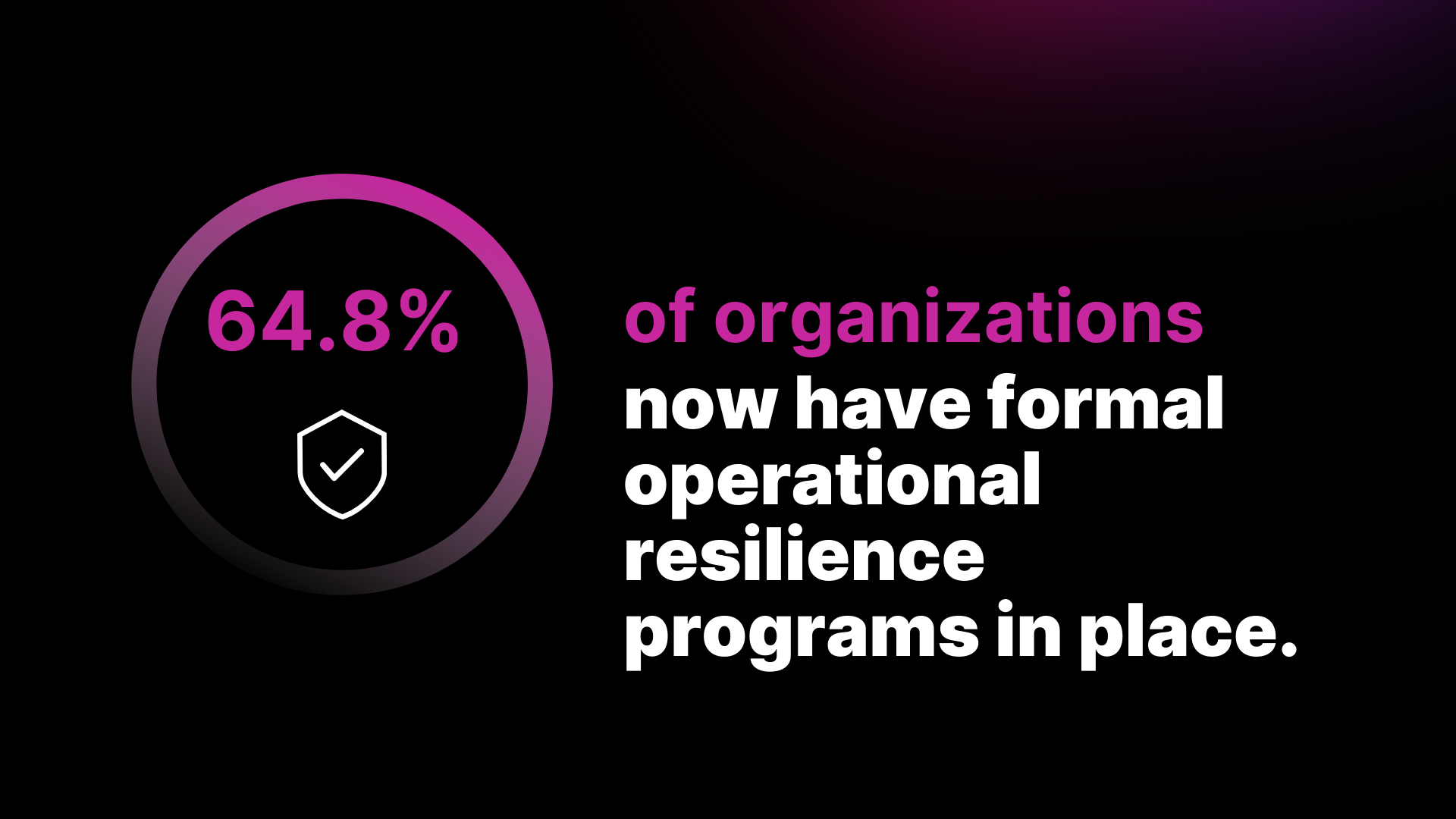
According to the Business Continuity Institute’s 2024 report, 64.8% of organizations now have formal operational resilience programs in place. The top reason that 67% of organizations cite as their primary driver for developing resilience programs is regulatory requirements. 

For example, EU DORA came into effect in January 2025, and UK firms already faced operational resilience compliance deadlines in March 2025.

Beyond compliance, resilient organizations outcompete peers during times of uncertainty.

McKinsey research shows that businesses using agile practices during the pandemic were 70% more likely to report performance gains.

Essentially, resilience has become the skill that separates healthy workplaces from fragile ones.

How to Integrate the Framework

Implementing the resilience lifecycle does not require a complete organizational overhaul. Start with a gap analysis to identify which of the five stages your organization currently lacks or underdevelops. Many companies excel at response but neglect preparation or learning entirely. 

Consider these practical steps:

  • Assign clear ownership for each stage- Each phase should have designated leadership accountable for its execution
  • Simulate disruptions quarterly- Running drills tests response and recovery plans under controlled conditions
  • Measure what matters- Define KPIs like Mean Time to Recovery and threat containment time to track resilience improvements
  • Invest in continuous learning- Build internal idea accelerators and fund scenario planning exercises
  • Prioritize psychological safety– Employees who feel supported and informed during crises recover faster and remain more engaged

Conclusion

Ultimately, the organizations that thrive in uncertainty are not the ones with the biggest budgets or the most elaborate risk plans. Instead, they are the ones that treat resilience as a living capability, continuously refined through experience.

Frequently Asked Questions

Still have questions about how the resilience lifecycle works in practice, or how to apply it beyond theory? The answers below summarize the most common points of confusion leaders face when turning resilience into an operational capability.

What Are the 5 Key Stages of the Resilience Lifecycle Framework?

The five stages are Preparation, Prevention, Response, Recovery, and Adapt & Evolve. Together, they form a continuous cycle that helps organizations anticipate disruption, reduce risk, respond effectively, recover faster, and improve after every event.

Is the Resilience Lifecycle Framework Only for IT Teams?

No. Although the framework originated in IT reliability, it now applies across operations, HR, risk, and leadership. Any organization can use it to protect critical services, strengthen decision-making under pressure, and reduce downtime.

How Is Operational Resilience Different From Business Continuity?

Operational resilience is broader. Business continuity focuses on keeping operations running and restoring services after disruption. Operational resilience includes prevention, adaptation, and learning, with a stronger emphasis on maintaining critical services through disruption, not just recovering afterward.

What Tools Help Organizations Implement the Resilience Lifecycle?

Implementation often involves a mix of risk assessments, scenario planning, workforce data, and communication systems. An updated HRIS system helps teams locate employees, communicate quickly, and reassign roles. Many organizations also partner with wellness companies to support workforce resilience before, during, and after disruption.

What Should Organizations Do First to Implement the Resilience Lifecycle Framework?

Start with a gap analysis across all five stages. Most organizations over-invest in response and under-invest in preparation and learning. Then assign ownership for each stage, run quarterly simulations, and set KPIs like recovery time and incident containment speed.

Written by Ivana Radevska

Senior Content Writer at Shortlister

Wellness Companies

Browse our curated list of vendors to find the best solution for your needs.

Stay Informed

Subscribe to our newsletter for the latest trends, expert tips, and workplace insights!

Related Posts

Mental Health Training for Employees

Mental Health Training for Employees

The current state of mental health is in dire need of improvement. Mental health training for employees emerges as a solution in the workplace, especially when it’s rooted in empathy and acceptance.