Why do We Hate HR?
HR should be one of the company’s most helpful and valuable departments. However, for most employees, that is not the case.
CEO, Pin.com
Founder, eLearning Industry Inc
Co-Founder, OysterLink
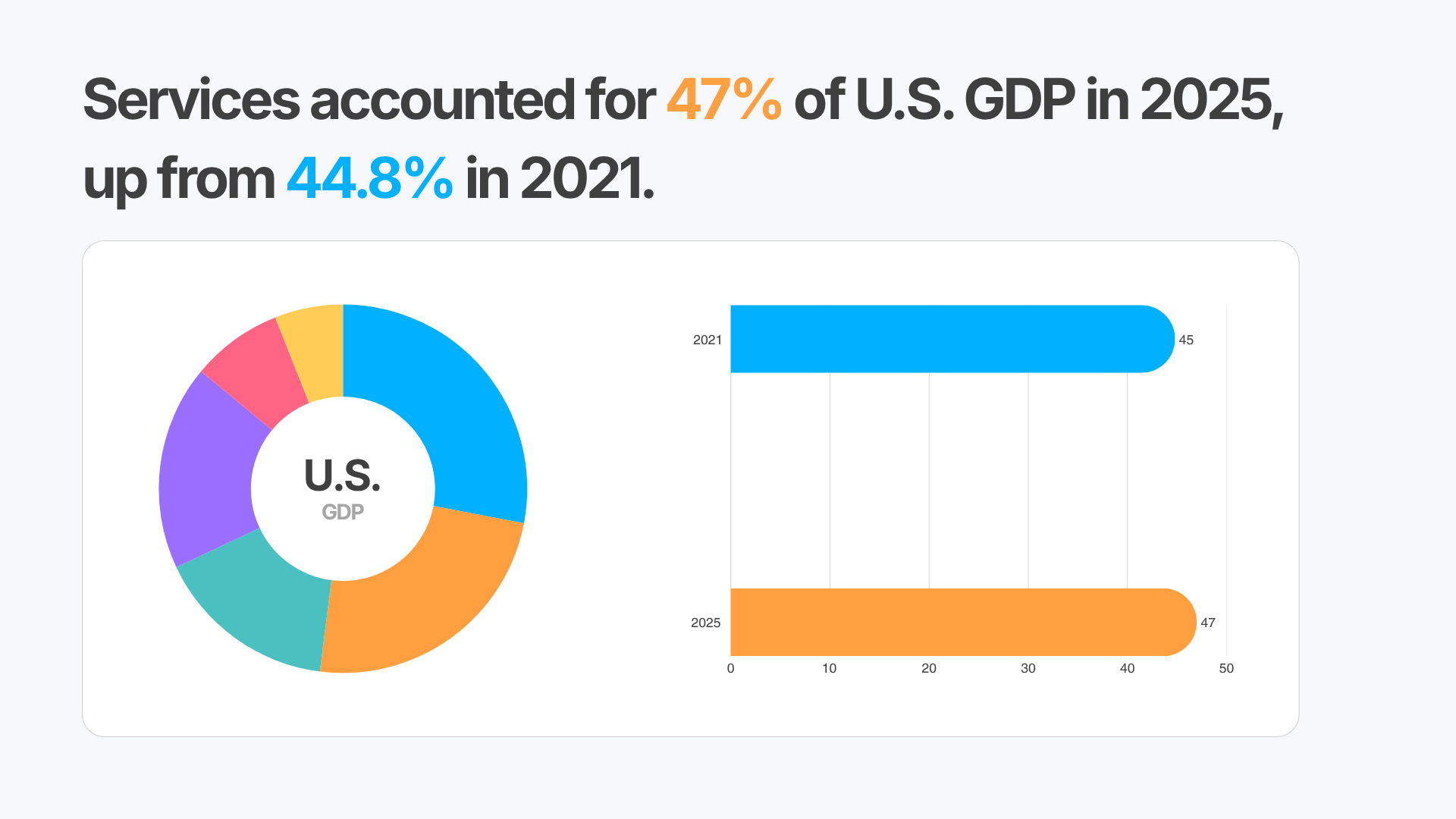
Americans spent their way through inflation, and most of that money went towards services. According to the Bureau of Economic Analysis, services accounted for 47% of U.S. GDP in 2025, an increase from 44.8% in 2021.
However, the workers behind that spending rarely share in the headline numbers. Pay in the services sector spans from minimum-wage counter work to six-figure advisory roles.
Therefore, understanding where the best paying jobs in other consumer services can be found requires looking beyond the generic category label and into the roles themselves.
The phrase “consumer services” usually conjures up images of checkout lines and tip jars. However, the category stretches far wider, even though the Bureau of Labor Statistics (BLS) has no single classification for it.
So, what are consumer services jobs, exactly?
In practice, the label covers all roles that deliver a product or experience directly to people rather than to businesses. The federal statistical system comes closest with a catch-all sector named “other services”, which includes salons, repair shops, dry cleaners, and funeral homes into one bucket.
The full subset runs from financial advising, property management, and travel planning to event coordination, personal care, and a growing list of experience-driven occupations. Some of these trades have existed for centuries, while others are less than a decade old.
Since the umbrella label of “other services” is broad by design, the pay inside it also scatters widely.
The Bureau of Labor Statistics puts the median annual wage for all U.S. occupations at $49,500 as of May 2024, and many frontline service roles fall below that line.
On the other hand, managerial and advisory positions in the same sector routinely earn $56,000 to $102,000, which means the gap between the sector’s floor and ceiling is wider than in most industries.
Milos Eric, co-founder of OysterLink, argues the deciding variable is not the job title at all, saying, “The relationship of paycheck to job title is less important than paycheck to your position in relation to the revenue side,” he notes. “Companies historically reward those who progress from executing the role to owning the role.”
In other words, proximity to money is what gets paid.
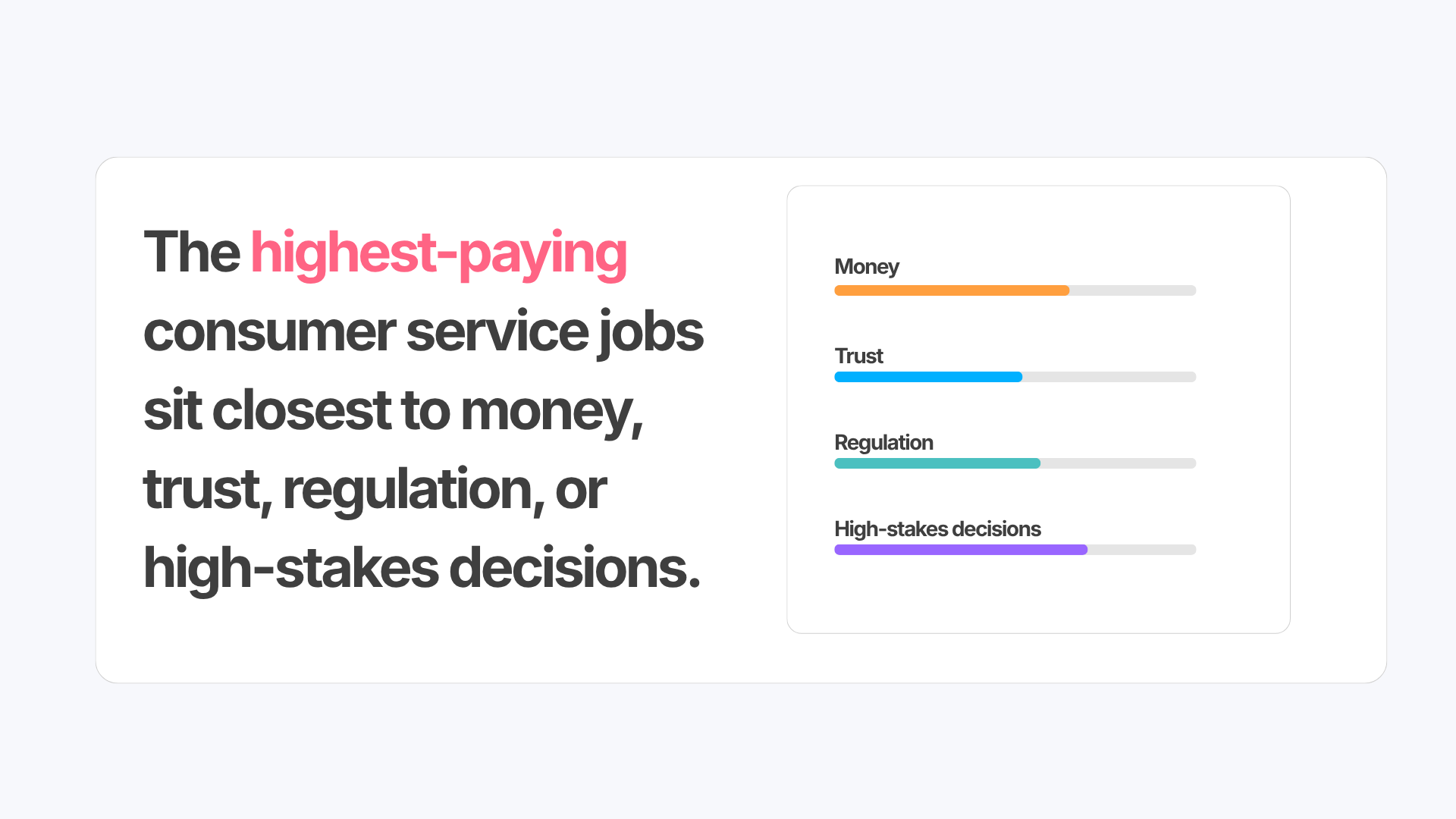
Typically, pay in consumer services rises when the job moves closer to a consequential life decision.
Buying a home, choosing insurance, planning retirement, or arranging elder care all carry real financial weight, and the professionals who guide those decisions tend to command higher salaries.
Similarly, roles that carry regulatory complexity or legal liability earn a premium, since licensure restricts the supply of people who can legally do the work.
The BLS reports that personal care and service occupations had a median annual wage of $35,110 in May 2024, well below the $49,500 median for all occupations.
However, that median includes front-line service work. As mentioned before, the best paying jobs in other consumer services fall into management, licensed advisory roles, or commission-based sales.
Steven Lu, CEO of Pin.com, sees the same pattern from a hiring perspective.
What do consumer services jobs pay at the upper end of the spectrum?
As with most jobs, the answer depends heavily on specialization, geography, and whether the role involves managing people, money, or both.
Below are the consumer-facing roles where median compensation significantly outpaces the national average.
No role in the category pays better, according to federal wage tables. The BLS reports a median wage of $102,140 for personal financial advisors as of May 2024, with the top 10% earning above $239,200.
Robo-advisors were supposed to make this profession obsolete a decade ago. Instead, employment is projected to grow 10% through 2034 because clients facing volatile markets still pay for human judgment and accountability. Employers have noticed the same trend, which is why workplace financial wellness programs for employees have become a mainstream benefit.
Funeral home managers earned a median of $76,830, roughly 55% above the national median for all occupations.
Entry barriers explain part of the premium, since most states require accredited mortuary education and board licensure. In addition, the emotional weight of the work thins the labor supply further.
An aging population locks in the demand for these services for decades to come, which makes the role one of the few in consumer services with built-in recession insurance.
Lodging managers earned a median of $68,130, with the highest 10% exceeding $126,990. Entry typically requires either a bachelor’s in hospitality management or several years of industry experience, but compensation climbs sharply with seniority. Given that hotels never close, the round-the-clock availability expected of managers factors directly into the wage premium.
Meeting, convention, and event planners earned a median of $59,440, with the top 10% surpassing $101,310. Surprisingly, a projected growth of 5% through 2034 outpaces the average for all occupations.
Video calls were expected to shrink the field after 2020, yet corporate gatherings returned because relationships still form faster in person. Conferences remain the highest-paying segment, as logistical and budgetary complexity scales dramatically with audience size.
Property, real estate, and community association managers earned a mean wage of $40.25 per hour, or roughly $83,710 annually, according to the latest BLS occupational wage data.
The role blends fiduciary responsibility with daily operations, and several states license community association work specifically. Elevated mortgage rates have also kept more households renting for longer, which expands the portfolios these managers oversee.
Preschool and childcare center directors earned a median of $56,270, with the top 10% above $96,400. A bachelor’s degree and early-childhood experience form the typical entry route, and many states add licensing or credential requirements on top.
Even with employment projected to dip 3% through 2034, the BLS expects about 5,500 openings each year, all of which are created by the need to replace directors who move on or retire.
Are consumer services a good career path, then? Economists have offered one durable reason for optimism since the 1960s – the Baumol’s effect.
William Baumol observed that wages in labor-intensive services rise alongside the wider economy even when productivity in those services barely moves, because employers must compete with faster-growing sectors for the same workers.
For example, a haircut costs more every year, even though it still takes twenty minutes.
For any person, however, the main career deciding factor is which side of the business they stand on. “The floor is real, but the ceiling is mostly hidden behind which side of the contact center you’re on,” says Steven Lu. “The analytical side scales, the seat-based side doesn’t.”
Christopher Pappas, founder of eLearning Industry Inc, frames the climb in commercial terms. “The best value comes when we connect strong service quality with real business results,” he says.
Will AI flatten wages in consumer services, or will it widen the gap between replaceable and irreplaceable roles?
The BLS projects a 5% decline in customer service representative employment from 2024 to 2034, as AI-powered chatbots and automated resolution tools absorb routine interactions.
At the same time, McKinsey’s research estimates that more than 70% of human skills remain applicable in both automatable and non-automatable work, suggesting that most workers will shift what they do rather than whether they work.
Klarna’s experience shows why this distinction matters. In 2024, the fintech boasted that its AI assistant was doing the work of 700 agents. A year later, the company resumed hiring humans after its CEO acknowledged that the cost-cutting push had weakened service quality.
Other consumer-facing brands have run into similar limits. Pizza Hut’s AI ordering system is now tied to a lawsuit alleging $100 million in damages, while Starbucks scrapped its AI inventory system after only nine months.
For consumer services, the lesson is not that AI has no place, but that its value depends on where it is applied. Companies that invest in HRIS systems and workforce analytics are increasingly finding that technology works best when it frees high-value staff from administrative tasks, not when it replaces them.
For pay, the likely result is a wider split inside the sector. Routine, script-based roles will face more pressure as employers automate ordering, scheduling, claims intake, and basic support.
Roles that require trust, discretion, problem-solving, or emotional intelligence should hold more pricing power because the human part of the work becomes harder to substitute.
The best paying jobs in other consumer services combine scarce credentials with the judgment to make high-stakes decisions on a client’s behalf. As AI absorbs the transactional work, the premium on human judgment will only grow, pulling the top of the salary scale further from the bottom across the sector.
Personal financial advisors top federal wage tables, with a median of $102,140 in May 2024 and a tenth of the field earning above $239,200. Due to the fact that most advisors charge a percentage of assets under management, established practitioners with mature client books routinely exceed the median by a wide margin.
Many entry positions do not, although the best-paid roles usually involve licensure or accredited training. Funeral home managers need mortuary education, while financial advisors need securities licenses. Management roles in hospitality and childcare generally expect a bachelor’s degree, though experience substitutes for formal education more often here than in most white-collar fields.
Routine roles are contracting, and the BLS expects customer service representative employment to fall 5% by 2034. Wages for positions built on judgment and accountability continue to climb, however, because clients still want a person answerable for high-stakes decisions. The likelier outcome is a sector that splits further, with judgment-based roles pulling away from routine ones.
Data fluency stands out, since the analytical roles behind the front-line scale in ways seat-based work cannot. Commercial awareness matters nearly as much, because understanding how service drives revenue separates executing a role from owning it.
Senior Content Writer at Shortlister
Browse our curated list of vendors to find the best solution for your needs.
Subscribe to our newsletter for the latest trends, expert tips, and workplace insights!

HR should be one of the company’s most helpful and valuable departments. However, for most employees, that is not the case.

Discover how small businesses and start-ups can benefit from free HRIS software in meeting core HR needs while also increasing the productivity of both managers and employees.

A company can only grow as fast as its workforce allows. In an economy defined by constant disruption, strategic HR staffing becomes an investment in long-term business success.

Explore why it is vital to have disciplinary action in place to deal with each inappropriate behavior professionally and legally.
We're working hard to make it easy for you. Sign up for news, trends and insights.