

Employee Benefits

Companies with Unlimited PTO

As employers become more open to flexible time-off policies, unlimited PTO is emerging as a clear signal of people-centered thinking. Many companies are already leading the way, but could this approach work for your team?
In This Post:
Expert Contributors:
Picture of Brandon Leibowitz

Brandon Leibowitz

Owner, SEO Optimizers

Picture of Christopher Pappas

Christopher Pappas

Founder, eLearning Industry Inc

Picture of Dong Wang

Dong Wang

Founder, Vanswe Fitness

Picture of Ken Chartrand

Ken Chartrand

CEO, Encore Business Solutions

Open vacation policies often spark curiosity and a healthy dose of skepticism.

Can employees really take as much time off as they need?

Companies with unlimited PTO, such as Netflix, Oracle, or GitHub, are proving that it’s possible.

However, success depends on far more than removing limits on vacation days.

From cultural alignment to thoughtful implementation, we examine the realities behind this increasingly popular employee benefit and its implications for companies reevaluating their leave policies.

What is an Unlimited PTO Program?

An unlimited paid time off (UPTO) program, also called open or flexible PTO, allows employees to take as much time off as needed, without a set limit, while still receiving their regular pay.

This approach typically replaces traditional vacation days, sick leave, or personal leave, offering workers greater control over their time away from work.

While there are no specific limits (as long as work responsibilities are met), some companies may establish guidelines to ensure that business operations continue to run smoothly.

The Evolution from Traditional PTO to Flexible Time Off

In the United States, paid time off is not a federal requirement, despite legislative efforts to make it so. As a result, employers offer it as a benefit, allowing them to structure their own policies as they see fit.

Traditionally, this meant allocating a set number of days for vacation or sick leave.

According to the Bureau of Labor Statistics, private sector employees are typically alloted seven sick days and 11 vacation days after one year of service.

While effective in providing structure, this model can feel limiting, especially as employees seek a greater work-life balance. It can also be economically inefficient, as findings show that workers don’t use an average of 6.5 days of their PTO annually.

Therefore, in the early 2000s, a shift to a more flexible model occurred, particularly among tech companies and startups, which recognized the value of offering greater autonomy to their workforce. 

For example, Netflix was one of the earlier adopters in 2003 and has been improving its policy ever since. 

Over the years, the model gained traction across industries.

A Willis Towers Watson (WTW) report indicates that, although most companies still rely on traditional approaches, there has been a significant shift towards flexibility. 

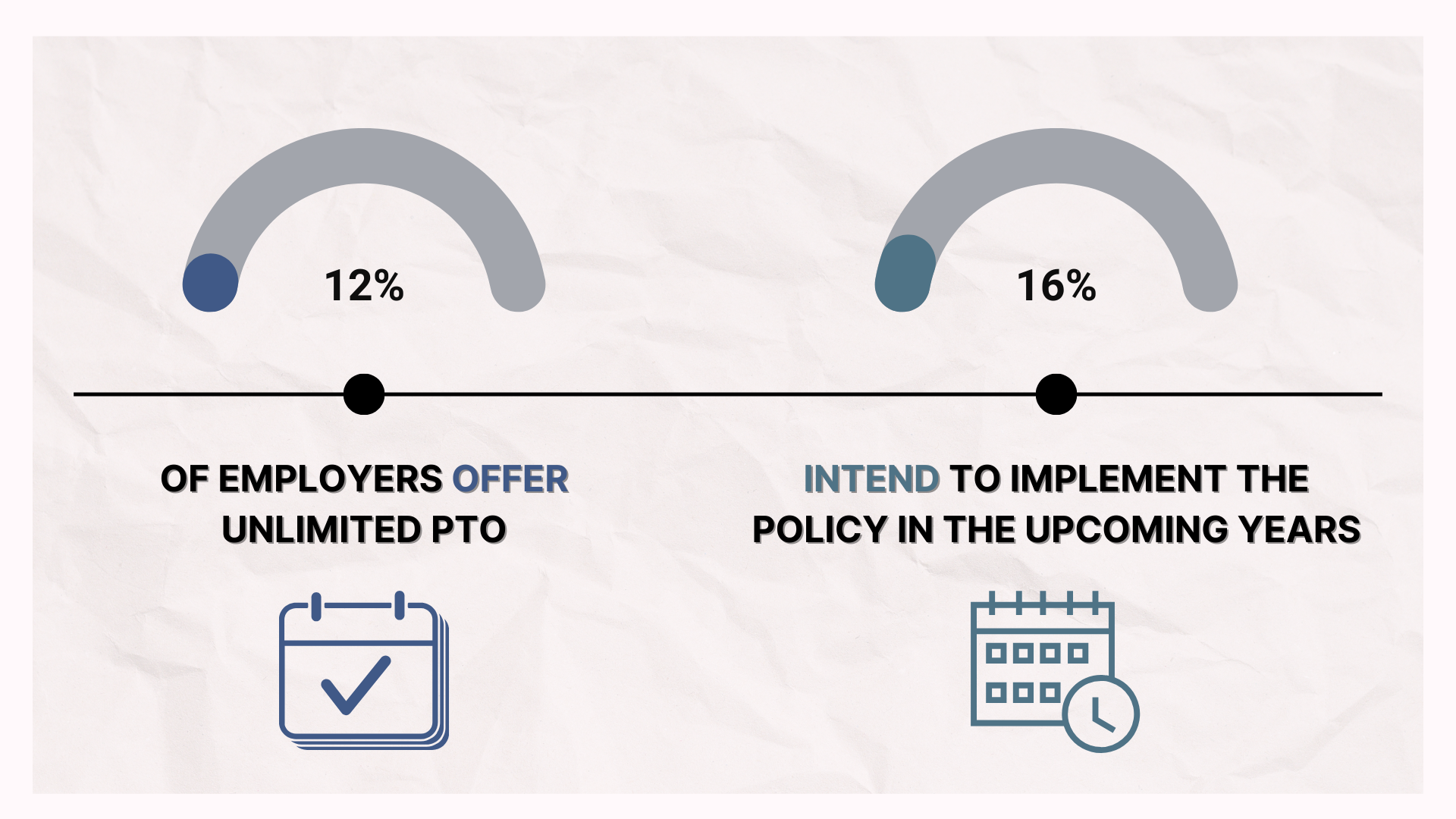
In fact, 12% of employers offer unlimited PTO, and 16% plan to implement the policy in the upcoming years.

As this shift unfolds, it becomes increasingly important for employers to understand how UPTO works and whether it can support their business.

How Unlimited PTO Policies Are Actually Structured

In theory, jobs with unlimited PTO provide employees with the flexibility to take time off as needed, without the constraints of a predetermined number of days.

In reality, these policies often come with clear guidelines around expectations for performance and accountability. Employees typically need to ensure their work is covered while they are away and maintain productivity.

Some companies may also set a minimum recommended time off to ensure workers use the benefit or impose limits on the “unlimited” days to prevent misuse.

For example, SHRM data indicate that employers unofficially cap it at three to six weeks. Their report also reveals that most employees still take about the same time off (16 days) as those with more traditional PTO policies (14 days).

These findings suggest that, with or without a cap, many still feel bound by informal expectations or company culture, leading them to take less time off.

Still, the pattern isn’t inevitable.

In fact, numerous companies have successfully implemented this benefit, showing what’s possible when policy and culture align.

15 Leading Companies with Unlimited PTO

As more employers rethink their leave structures, a growing number have already adopted unlimited time off as a core component of their talent strategy.

While the concept can vary in practice, the companies below stand out for setting the standards in flexible, people-centered benefits and serve as a strong example of how UPTO can work at scale.

  1. Netflix – One of the earliest adopters of unlimited vacation, Netflix doesn’t set a holiday or vacation schedule, but its policy framework may differ based on employee location and role
  2. Virgin Group – Following in the footsteps of Netflix, Virgin also offers unlimited paid time off for salaried employees, without prior approval
  3. HubSpot – They offer unlimited vacation for all employees and a month-long sabbatical for those who reach the 5-year mark at the company
  4. Oracle – Flexible vacation is available to eligible workers, which is part of a much larger policy that supports employee well-being
  5. GitHub – Wellness is one of GitHub’s priorities, as its benefits program offers flexible time away, along with five months of paid family leave, remote work, and more 
  6. Gusto – According to Comparably, Gusto’s PTO and vacation policy typically gives its employees unlimited days off a year
  7. Goldman Sachs – Senior staff (managing directors) at Goldman Sachs get flexible vacation with no fixed entitlement, while other employees typically receive 20-30 days annually
  8. Buffer – The company went from unlimited vacation, which was underused, to proposing a minimum vacation time of three weeks off per year, without a maximum limit 
  9. Dropbox – Glassdoor reviews show that Dropbox offers unlimited PTO and has favorable leave policies for sick days or maternity leave
  10. Grubhub – The company offers unlimited vacation time for exempt employees and a “generous time off policy” for non-exempt employees 
  11. Workday – Salaried workers get a flexible time-off policy, meaning they can take time off work whenever they need to; on the other hand, hourly employees get fixed PTO 
  12. Roku – As part of their trust-based culture, Roku doesn’t track vacation days, nor does it have official holidays; however, they expect employees to check and give notice before taking a vacation
  13. Evernote – For over a decade, Evernote has offered UTPO as well as a unique monetary incentive to encourage workers to take time off (at least five days)
  14. Bumble – Both U.S. and U.K. employees get unlimited paid time off, along with an annual company-wide week off for most employees
  15. Vimeo – Similar to Bumble, Vimeo, too, offers flexible PTO policies and a week-long annual company break 

Looking at these examples, it’s clear that this is not an isolated benefit, but rather part of a carefully designed benefits ecosystem that supports employee well-being. 

With this trend on the rise, unlimited PTO is becoming an increasingly common staple among companies offering the best benefits.

Benefits of Jobs with Unlimited PTO

Often marketed as an employee benefit, unlimited PTO is about more than getting extra time off. When implemented thoughtfully, it can reshape a company’s culture, attract and retain top talent, and enhance operations in ways traditional vacation policies cannot.

Talent Attraction and Competitive Positioning

One of the main benefits of jobs with unlimited time off is that they become a key differentiator in recruitment. Offering this level of flexibility demonstrates a commitment to employee well-being and work-life balance.

Unlimited PTO can be a strong talent magnet, especially when candidates are comparing companies that offer similar compensation. I’ve seen firsthand how the promise of flexibility immediately lowers stress for employees,” says Brandon Leibowitz, Owner of SEO Optimizers.

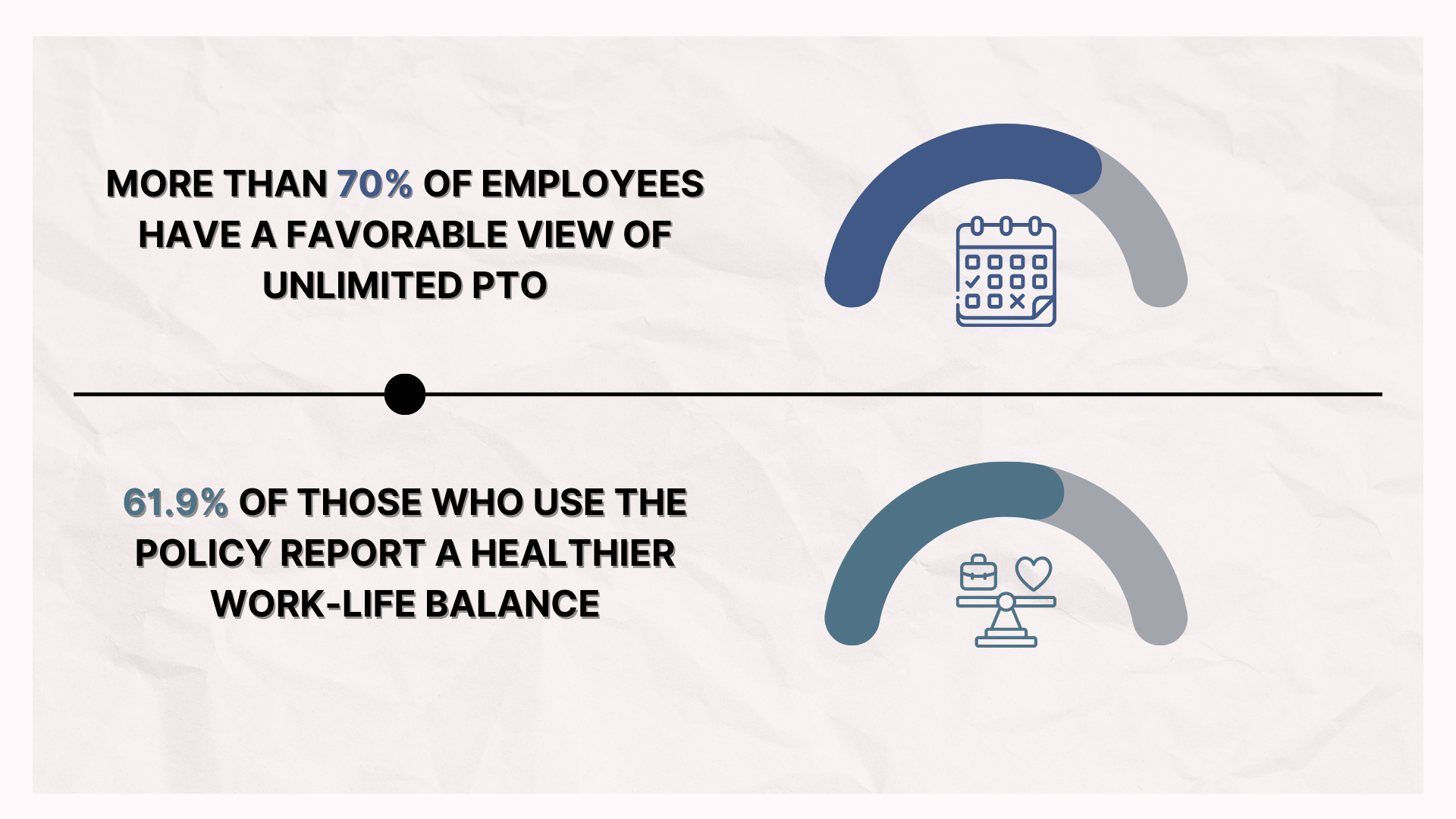
Research supports this, as a Joblist study found that nearly three out of four employees have a favorable view of an unlimited PTO policy, and another 61.9% report a healthy work-life balance.

The policy also appeals to job seekers who value autonomy and personal time. It also positions the company as a forward-thinking employer willing to adapt to the needs of a modern workforce.

Building Trust-Based Workplace Cultures

Companies with unlimited time off shift the employee-employer relationship from one of surveilence to that revolves around mutual trust.

According to Christopher Pappas, Founder of eLearning Industry Inc, this supports stronger workplace relationships because it encourages open talks about personal limits.

People feel safe to share when they need time away, which builds trust across the team. This creates healthy team habits and helps everyone return with a fresh mind and better focus. It also attracts people who value freedom and want to work without guilt,” says Pappas.

Research consistently shows that high levels of trust in the workplace can lead to improved outcomes, ranging from increased employee satisfaction to better team collaboration and employee-manager relationships.

Reducing Administrative Burden and Liability

Finally, one often overlooked benefit is the administrative simplicity of introducing unlimited vacation days. With fewer variables to manage, HR teams can focus on more strategic tasks while reducing the risk of errors in managing leave. 

Additionally, companies eliminate the liability of unused PTO, which can accumulate over time and become a financial or even a compliance burden, depending on the state.

Why Unlimited Paid Time Off Doesn't Always Work as Intended

Despite the many benefits, research on unlimited PTO policies reveals a paradox – employees with this benefit often take fewer vacation days than those with traditional fixed leave.

The reason why this happens was attributed to social pressure and uncertainty about what constitutes “acceptable” leave. 

As a result, workers may avoid taking days off, work longer to “earn” their unlimited leave, or compete with colleagues over who takes the least time off.

The research also reveals that specific conditions determine whether UTPO can benefit or harm the company:

  • Individual, such as work centrality or personality traits
  • Team, or team culture, interdependence, and whether recovery is valued
  • Company, including company culture, leadership style, workload levels, and whether the company tracks time off to ensure minimums are met

Speaking from experience, founder of Vanswe Fitness, Dong Wang, explains, “When we tested an unlimited PTO policy across our warehouse and support teams, almost no one actually took real vacations. People told me they didn’t know what was too much, especially during busy sales periods.”

Wang also agrees that unlimited PTO is more effective in certain circumstances.

It fits best in project-based, knowledge roles with predictable deadlines, and struggles where staffing levels are tight, and shifts must be covered.”

He adds that, “any version needs written examples, minimums, and manager training. The real goal is rest and fairness, not a trendy label on the policy.”

Overall, as research and practice demonstrate, jobs with unlimited time off may not automatically deliver their intended benefits. Thoughtful policy design, clear guidelines, and supportive systems are paramount for a UPTO plan to succeed in practice.

Designing and Implementing an Unlimited PTO Policy That Works

Introducing a new benefit in the workplace demands careful planning and management. The goal is always to strike a balance between employee needs and company goals.

With unlimited paid time off, this becomes even more important.

Implementing it in practice goes beyond just removing a cap on vacation days. It requires a complex policy that necessitates careful evaluation, clear expectations, and ongoing monitoring.

Essential Policy Components

The foundation for implementing any benefit that employees actually use is clarity. Therefore, a well-defined unlimited PTO policy should transparently communicate its application to all employees.

Brandon Leibowitz suggests clear guidelines:

Define what advance notice looks like, set expectations during busy seasons, and ensure managers proactively check workloads so no one feels guilty stepping away. 

This structure keeps the policy from becoming ambiguous.”

Without these components, the flexibility intended by the policy can instead turn to confusion or inconsistency.

Setting Expectations

Since UPTO removes the familiar structure of set vacation days, employees often require guidance on how to use it effectively and confidently. Without that direction, many end up taking less time off simply because they are unsure of what’s considered reasonable.

Unlimited PTO sounds great in theory, but it often feels less like a perk and more like a debt,” explains Ken Chartrand, CEO of Encore Business Solutions.

If consultants have quarterly or annual targets to hit, taking time off just forces their work into a smaller window and makes them feel like they have to sprint to catch up. 

They can’t enjoy a Tuesday off if they have to make it up later with overtime,” adds Chartrand.

Therefore, setting (some) expectations may solve this challenge without undermining PTO flexibility.

Rather than having hidden limits, leaders can outline what healthy use looks like, such as taking regular breaks throughout the year, planning time off with teammates in mind, or ensuring more extended absences align with workflow cycles.

According to Chartrand, a mandatory minimum is another solution.

Instead of policing who takes too much time, you can flag the people who take too little and sort out the problem they’re facing. 

If the workload is too heavy, it’s up to management to lighten it and make unlimited PTO actually viable.

If you don’t mandate at least three weeks off, your unlimited policy can become a competition to see who can work the most, or make people feel guilty for taking ‘too much’ time off. 

We realized that without a mandatory floor, the unlimited ceiling is just a nice idea that nobody feels safe enough to reach for,” Chartrand concludes.

Overall, setting some expectations gives workers a sense of footing while preserving the openness that makes unlimited PTO programs appealing.

“If you don't mandate at least three weeks off, your unlimited policy can become a competition to see who can work the most, or make people feel guilty for taking 'too much' time off. We realized that without a mandatory floor, the unlimited ceiling is just a nice idea that nobody feels safe enough to reach for."

Tracking and Transparency

Even without accruals or caps, PTO policies still require transparency and some level of oversight. 

Employees and managers should have visibility into time off so teams can plan around absences and projects to stay on track, but the goal isn’t to count hours or enforce limits. Therefore, companies need systems that will support such a structure.

Time and attendance software is well-suited for tracking absences and monitoring compliance in traditional leave programs. However, unlimited PTO works better with systems that focus on requests and coordination instead of hours-based reporting. 

Modern HRIS systems or standalone absence management tools allow employees to request leave, managers to coordinate schedules, and HR to observe usage patterns.

For a better understanding of the program’s efficiency, pairing these tools with employee engagement software enables companies to assess how well the benefit works for their team. If engagement increases, it can be a clear sign of a successful program implementation.

Tracking this data across multiple points supports fairness and can point out inefficiencies in the process that should be addressed and improved. However, if it consistently shows misuse of the benefit, companies should consider a different approach that better aligns with their operational efficiency.

Is Unlimited PTO Right for Your Company?

Offering unlimited paid time off to employees is not a fix-all solution. 

Its success depends less on the appeal of the benefit and more on how it aligns with the company culture, team dynamics, and leadership approach.

Companies with highly autonomous teams and strong trust-based cultures may see workers naturally using the policy, taking restorative time without oversight or pressure.

In contrast, those where workloads are uneven, and recovery isn’t modeled by leadership, may struggle or create burnout.

Unlimited PTO makes the most sense for outcomes-driven teams where performance is easy to measure; it’s less effective in roles requiring constant coverage, where a traditional bank of hours may be fairer and easier to manage,” adds Brandon Leibowitz.

Therefore, before adopting it, it’s helpful to evaluate internal norms and patterns. 

It’s also worth considering a hybrid approach, such as a generous but structured PTO, clear minimums, or leave frameworks that combine flexibility with specific guidance on usage.

For example, Dong Wang reveals how his company transitioned from an unlimited PTO model back to a defined policy with “a twist”, as he says, consisting of firm minimums and no-contact vacation rules.

Once people had a number and knew they were expected to use it, sick days and small mistakes actually dropped, and customer reviews mentioned fast, friendly support more often.”

Overall, the goal should always be to design a system that reflects the realities of your workplace, rather than adopting one simply because it’s trendy or “attractive” on paper.

“Unlimited PTO makes the most sense for outcomes-driven teams where performance is easy to measure; it's less effective in roles requiring constant coverage, where a traditional bank of hours may be fairer and easier to manage.”

Where Unlimited Paid Time Off Fits in the Evolving Benefits Landscape

Adopting flexibility over traditional benefits is an ongoing trend in the workplace.

From remote and hybrid work models to flexible hours and wellness programs, companies are rethinking what it means to support their employees. This shift reflects a growing recognition that workers’ needs are diverse and dynamic, requiring more adaptable approaches. 

Unlimited PTO aligns perfectly with this evolving landscape.

Although it’s not a universal solution, when designed thoughtfully, it can become an integral part of a company’s broader commitment to flexibility and employee well-being.

Frequently Asked Questions

Unlimited paid time off raises plenty of practical questions, especially for companies and employees new to this concept. The following FAQs break down the key points to help clarify how the policy works in practice.

How Does Unlimited PTO Work?

Companies with unlimited time off provide employees the freedom to take as many days off as needed, without a set limit, as long as they meet work expectations. 

Typically, there are no accruals, rollover days, or carryovers, and the policy often requires manager approval to ensure business continuity.

Will Unlimited PTO Lead to More or Less Time Taken Off?

Research shows that employees at companies with unlimited PTO often take the same amount or fewer vacation days than those at companies with traditional PTO policies. This is because workers may feel pressured not to take excessive time off or lack clear guidance about what constitutes “acceptable” leave.

Can Unlimited PTO Be Abused?

One of the drawbacks of an unlimited PTO policy is the potential for abuse if not managed properly. Clear structure and guidelines, including performance expectations and manager oversight, are crucial in preventing misuse. 

Most companies with unlimited PTO use approval systems and encourage employees to take time off in moderation to maintain work-life balance, without compromising business needs.

Does Unlimited PTO Lead to Better Productivity?

UPTO can potentially lead to improved productivity by giving employees more autonomy over their time off. When they feel trusted to manage their own schedules, workers are often more engaged and motivated. 

However, the overall impact largely depends on the company’s structure and the implementation efficiency, which requires clear expectations and communication.

Written by tamara jovanovska

Content Writer at Shortlister

Employee Engagement Software

Browse our curated list of vendors to find the best solution for your needs.

Stay Informed

Subscribe to our newsletter for the latest trends, expert tips, and workplace insights!

Related Posts