Workforce Technology

Hybrid Cloud Computing for Small Business

Most small businesses start with a cloud setup built for convenience, then realize over time that not every workload belongs in the same place.
In This Post:
Expert Contributors:
Picture of Arvind Rongala

Arvind Rongala

CEO, Edstellar

Picture of Joel Butterly

Joel Butterly

CEO & Founder, InGenius Prep

Picture of Anupa Rongala

Anupa Rongala

CEO, Invensis Technologies

Single-cloud setups are popular with small businesses for one simple reason – they are easy to manage. One vendor, one bill, and one dashboard can work well when workloads are still relatively straightforward.

However, that simplicity disappears once the business needs to expand. For many small businesses, hybrid cloud computing becomes the next step, which is the direction the wider market is already heading.

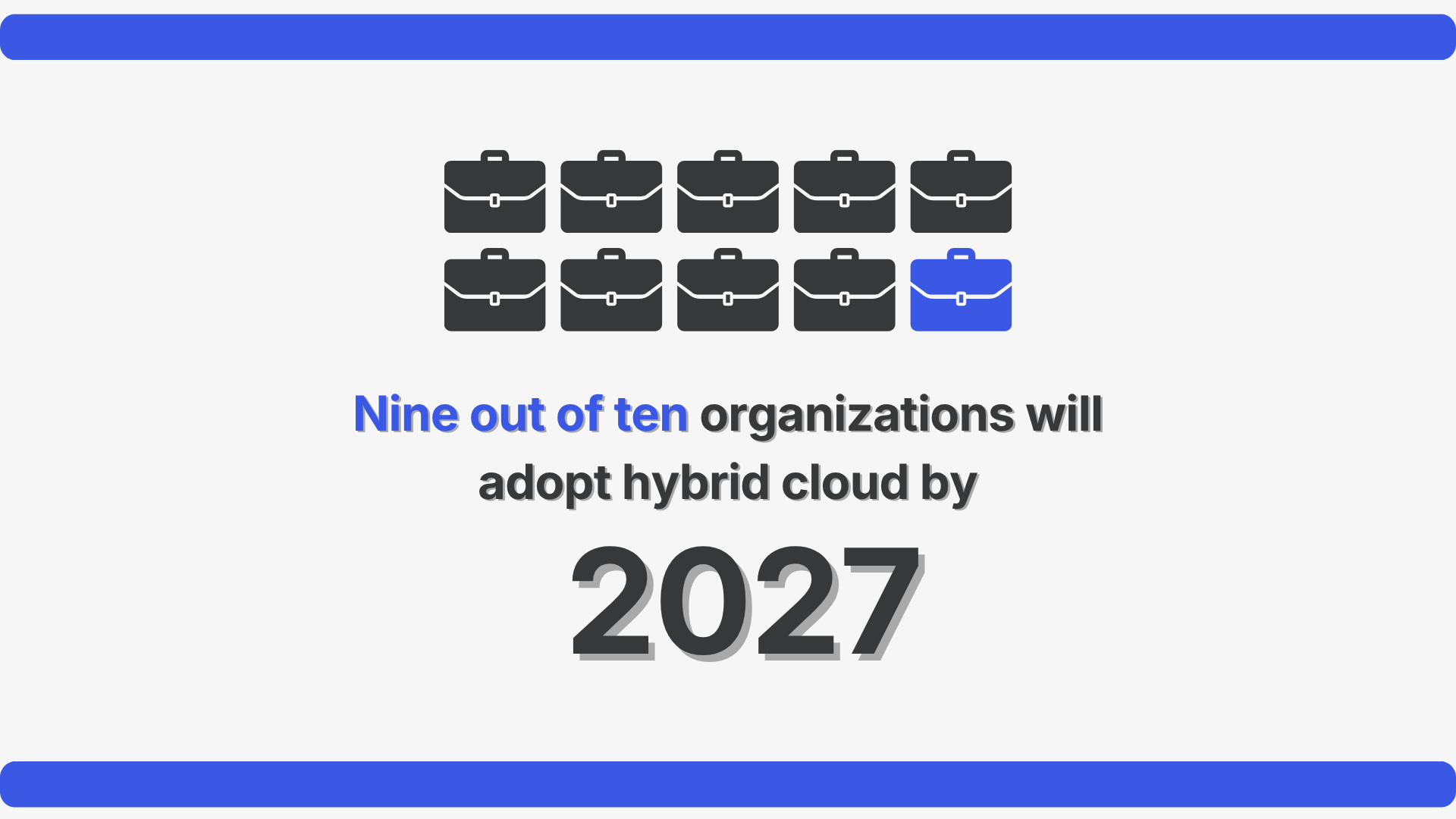
According to Gartner, 90% of organizations will adopt a hybrid cloud approach through 2027.

In this article, we cover what hybrid cloud means for small businesses, as well as when the switch makes sense financially.

The Cost Problem Small Businesses Run Into

In recent years, many businesses have experienced a phenomenon called cloud sticker shock, which refers to the moment a business opens its monthly cloud bill and finds the number far higher than anything the sales pitch suggested. 

In fact, Gartner research found that 69% of IT leaders reported cloud budget overruns in 2023. As a result, research shows that managing cloud spending is the top challenge facing organizations for the second year running, having surpassed even security concerns.

The timing is no coincidence, since cloud budgets ballooned during the pandemic when everything went digital, and the bills kept climbing afterward. 

By 2023, businesses were looking to cut costs, and cloud spending was one of the first items under review. Microsoft’s CEO, Satya Nadella, told employees that customers were starting to “optimize their digital spend to do more with less.”

For small businesses without a dedicated finance team, the path forward usually involves rethinking the IT architecture itself.

Anupa Rongala, CEO of Invensis Technologies, explains what pushes businesses beyond a single-cloud model.

"Many small businesses initially rely on a single cloud environment because it feels simpler and easier to manage. However, as operations scale, relying on only one deployment model often creates limitations around cost control, data security, and workload flexibility.”
Anupa Rongala
CEO, Invensis Technologies

What Hybrid Cloud Actually Means

In simple terms, hybrid cloud computing for small businesses means running some workloads on private infrastructure and others on public cloud, with both environments connected well enough to share data and shift capacity as needed. 

A hybrid architecture typically looks like this:

  • Private infrastructure for sensitive data, regulated workloads, and steady-state operations
  • Public cloud for elastic workloads, AI experimentation, and customer-facing applications
  • Orchestration layer that manages identity, security policy, and workload movement across both

One important distinction is that a hybrid cloud is defined by portability, not just coexistence.

If a business has an AWS environment and its own servers but no practical way to move workloads between them, that system is not operating as a hybrid cloud. Instead, they are simply separate systems owned by the same company.

Why Hybrid Adoption Is Reaching Smaller Businesses

In the corporate world, adoption of hybrid computing among enterprises is nearly saturated. The Flexera 2025 State of the Cloud Report found that 73% of organizations now operate with at least one public and one private cloud.

While large enterprises have already embraced hybrid at scale, small businesses are still catching up. 

Hybrid cloud computing for small businesses is now the fastest-growing segment of the market, with research published by GlobeNewswire in 2025 projecting that small and medium enterprises will grow their hybrid cloud adoption at a 15.2% compound annual growth rate through 2030.

Two forces explain the demand:

  • Managed service providers now package hybrid deployments for businesses without in-house IT teams
  • Regulatory pressure from GDPR and sector-specific rules makes single-public-cloud setups harder to defend

Benefits of Cloud Computing for Small Businesses

Rather than sharing familiar benefits of cloud computing for small businesses, it is more useful to look at what a hybrid cloud can do that a single-cloud model cannot.

1) Cost Predictability

As mentioned, one of the clearest advantages of hybrid cloud is tighter control over infrastructure spending. 

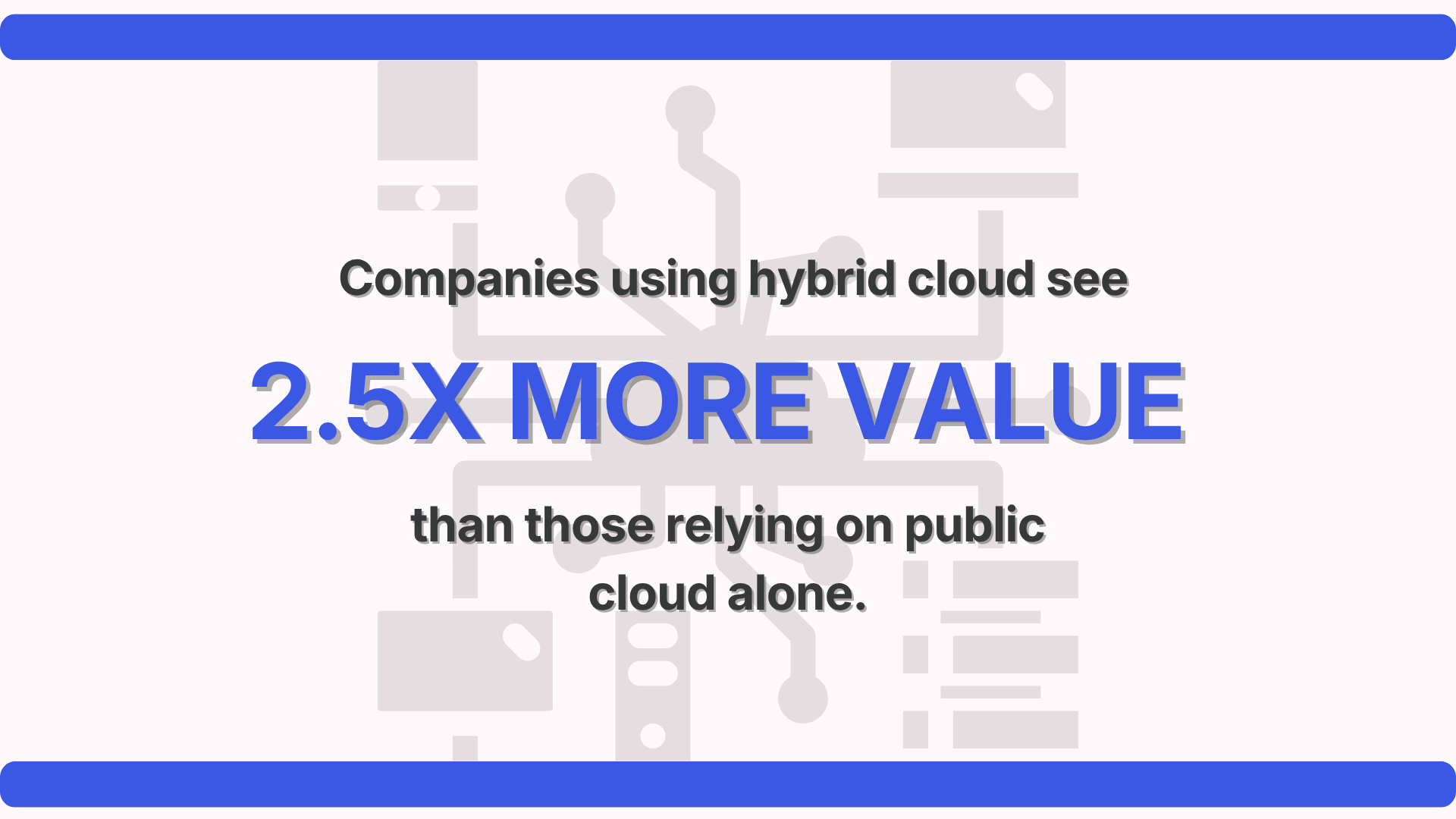
According to an IBM Institute for Business Value report, a hybrid cloud approach yields 2.5x more value than using a single public cloud alone, with some industries seeing multipliers as high as 20x.

So, how does this dual approach bring the cost down? 

Private infrastructure is best for workloads that stay roughly the same from month to month, since the cost is fixed and easy to plan around. Public cloud is better for workloads that spike and dip, because the business only pays for what it uses. 

Therefore, splitting workloads this way means a small business stops overpaying for capacity it rarely needs. 

For example, a retailer running inventory and point-of-sale on fixed infrastructure can absorb Black Friday traffic on public cloud without over-provisioning the whole year for two weeks of peak demand. The same pattern applies to travel businesses, event-based services, and any operation with predictable peak cycles.

2) Regulatory Control

For certain regulated industries like healthcare, financial services, and any organization operating across GDPR jurisdictions, hybrid is often less a preference than a requirement.

Regulators have started backing these compliance obligations with hefty fines. In May 2023, Ireland’s Data Protection Commission hit Meta with a €1.2 billion GDPR fine, the largest ever issued, specifically for transferring EU user data to US-based servers on the basis of Standard Contractual Clauses. 

In practice, this decision forced every European business running workloads on US-headquartered public clouds to re-examine where their data truly sits. 

With hybrid computing, the answer is simpler: any sensitive data sits on infrastructure the business fully governs, while public cloud handles workloads where residency rules are looser.

3) Vendor Leverage

Another benefit is that a business with portable workloads has more negotiating power at contract renewal. If a provider knows the company can shift infrastructure elsewhere, pricing discussions tend to look different.

Furthermore, that leverage can also affect the service relationship. Businesses with credible alternatives may get more attention on support, escalation, and account management than customers who are effectively “locked in.” 

For small businesses, that flexibility can matter as much as the direct savings, since better responsiveness and stronger negotiating power are hard to get through scale alone.

4) Integration Across Systems

Hybrid setups also resolve one of the frustrations of modern operations, which is data that refuses to talk across environments. For teams coordinating cloud-based HRIS systems with on-premise payroll tools, the integration layer matters as much as the infrastructure itself. 

The same principle applies to CRM, finance, and operations HR tools. A business with its CRM in the public cloud and its financial system on-premises needs those two to share data reliably, and hybrid architectures build that integration at the infrastructure level.

As Arvind Rongala, CEO of Edstellar, notes, hybrid cloud lets businesses “balance security, performance, and cost efficiency” in ways a single cloud cannot.

5) Scalability Without Overbuilding

Scalability is one benefit that sounds generic until a business needs it. 

Hybrid setups let the business scale specific workloads on public cloud without rebuilding the underlying architecture, which means a marketing campaign that unexpectedly goes viral does not crash the order system.

In contrast, when demand drops, public cloud workloads scale back down, and the business stops paying for unused capacity. 

Pure on-premises setups cannot do this, and pure public cloud setups end up paying for the elasticity even when it is not being used.

Why AI Workloads Are Pushing More Businesses Toward Hybrid

The rapid adoption of AI in the workplace is forcing many organizations to rethink whether a single-cloud setup is still practical.

The Flexential 2025 State of AI Infrastructure Report found that 90% of organizations are deploying generative AI, with 48% running those workloads in hybrid environments and 60% using private cloud for at least some AI work.

In many cases, AI is revealing the limits of single-cloud setups faster than any other workload.

The Inference Cost Problem

Training an AI model is expensive, but it is usually a one-time or limited event. Inference, on the other hand, happens every time an employee or customer uses an AI feature, which means the cost keeps accumulating long after the model is built.

According to Deloitte Insights, some organizations reach a tipping point at which on-premises deployment becomes more economical than cloud services once predictable AI workloads account for 60% to 70% of the total cost of acquiring equivalent on-premises systems.  

For small businesses with frequent, predictable AI usage, that cost dynamic can make a hybrid setup more economical than keeping those workloads entirely in the public cloud.

Data Sovereignty and AI Training

The second reason AI is pushing hybrid adoption is data sovereignty. 

When a business trains or fine-tunes an AI model on its customer data, the question of where that data sits and who has access to it becomes a regulatory concern.

SUSE research found that nearly three in five organizations have adopted hybrid cloud strategies specifically to balance AI performance with governance and control.

For businesses that see their proprietary data as a strategic asset, handing it to a public cloud provider’s AI service is increasingly not an option.

Therefore, for a small business experimenting with AI, the hybrid split usually looks like this:

  • Public cloud for early experimentation, off-the-shelf models, and low-volume inference where data sensitivity is limited
  • Private infrastructure for training or fine-tuning on proprietary data, and for high-volume inference that would be prohibitively expensive on a pay-per-token API

Signals a Business Is Ready to Switch

When considering a move to hybrid cloud, readiness has less to do with company size and more to do with workload complexity. Three indicators matter most:

  1. Data volumes are growing faster than the current provider can scale affordably
  2. Compliance requirements now cover customer data the business collects
  3. Performance is degrading in ways that single-cloud tuning cannot fix

When two of those three appear at the same time, hybrid usually pays for itself within the first year.

Arvind Rongala says, “When those pressures emerge, hybrid cloud becomes less of a technical upgrade and more of a strategic foundation for long-term digital resilience.”

For businesses with physical operations, edge computing adds a fourth signal. Manufacturing lines, logistics fleets, and retail point-of-sale systems generate data volumes that public cloud alone cannot process fast enough.

Joel Butterly of InGenius Prep points to the kind of architecture this requires, saying, “The need for edge computing calls for the adoption of hybrid infrastructures for businesses managing decentralized physical operations.”

As he explains, that can mean using “private micro-servers at the physical edge of the network to handle robotic telemetry with no latency,” while shifting summarized batch data to the public cloud for long-term storage.

On a Final Note

Hybrid cloud computing for small businesses has moved from a specialist’s choice to a mainstream one, largely driven by rising cloud costs, tighter regulation, and the infrastructure demands of AI workloads.

Hybrid cloud solutions for small businesses now offer a workable middle path between the control of private infrastructure and the elasticity of public cloud, and the market data suggests most growing businesses will end up there within the next few years.

Frequently Asked Questions

What Is the Difference Between Hybrid Cloud and Multi-Cloud?

Multi-cloud means using more than one public cloud provider, such as AWS and Azure simultaneously. Hybrid cloud combines at least one public cloud with a private environment, whether on-premises or a private cloud. The two often overlap, and many businesses end up with both.

Can a Small Business Run Hybrid Cloud Without an In-House IT Team?

Increasingly, yes. Managed service providers now offer packaged hybrid deployments that handle orchestration, security policy, and cost monitoring for businesses without dedicated IT staff.

How Long Does a Typical Hybrid Migration Take?

A small business migration usually takes between three and nine months, depending on the number of workloads and the maturity of existing infrastructure.

Written by Ivana Radevska

Senior Content Writer at Shortlister

HRIS Systems

Browse our curated list of vendors to find the best solution for your needs.

Stay Informed

Subscribe to our newsletter for the latest trends, expert tips, and workplace insights!

Related Posts

Why is Attendance Tracking Crucial?

From improved scheduling to increased productivity – explore why implementing an effective time-tracking and attendance system can be vital in the workplace.

Top 10 Performance Management Applications

From enhanced feedback to goal tracking, discover the tools reshaping employee performance. Elevate your workforce with performance management applications for a thriving, high-performing team.