In This Post:
Presenters:

Seth Turner
Founder and Senior Advisor
Today’s workforce is more diverse than ever. Four generations, with different backgrounds, can experience leave and workplace accommodations in remarkably different ways and navigate the process differently. That diversity creates tremendous opportunities, and it also presents new challenges for HR teams. Personalized leave management is becoming an increasingly important part of a competitive benefits strategy. It requires flexible, scalable solutions that meet employees where they are.
That’s exactly what Seth Turner, Founder and Senior Advisor at AbsenceSoft, explored in this webinar. He showed how HR teams can better meet employees where they are while maintaining consistent processes behind the scenes. Insights presented highlight how generational differences influence why employees request leave or accommodations, where processes create frustration, and how technology can help organizations deliver a more consistent, accessible experience. A scalable leave strategy that meets diverse workforce needs.
About AbsenceSoft
AbsenceSoft is trusted by companies of all sizes and across every industry to deliver personalized employee experiences, improve efficiency, and ensure compliance. As a leading provider of leave and accommodations management SaaS solutions, they deliver scalable, easy-to-use, and configurable software to easily and efficiently manage 200+ statutory policies like FMLA, ADA, and PWFA.
AbsenceSoft’s platform streamlines and automates leave and accommodations processes, ensuring compliance with federal and state regulations while elevating the employee experience. They are widely recognized for their top-tier customer service and robust customer community engagement.
Four Generations, One Workforce, Different Needs
Employees across generations report being comfortable asking for support. However, the type of support they need can vary significantly. When a company has more generational diversity on the team, that doesn’t mean they need to intake differently for this. Having a consistent way to intake and a consistent way to gather information is probably the most important piece, because they want to handle it from a compliance standpoint.
As Seth stated, they are starting to see some of their clients in the way they communicate change, just depending on whether it’s a leave type or an employee type. The difference in the generations is in those mental health leaves that require a different process to manage them than maybe a surgery or some of the things we see in those other generations. The process differs a little bit based on the leave type less than the who’s taking it.
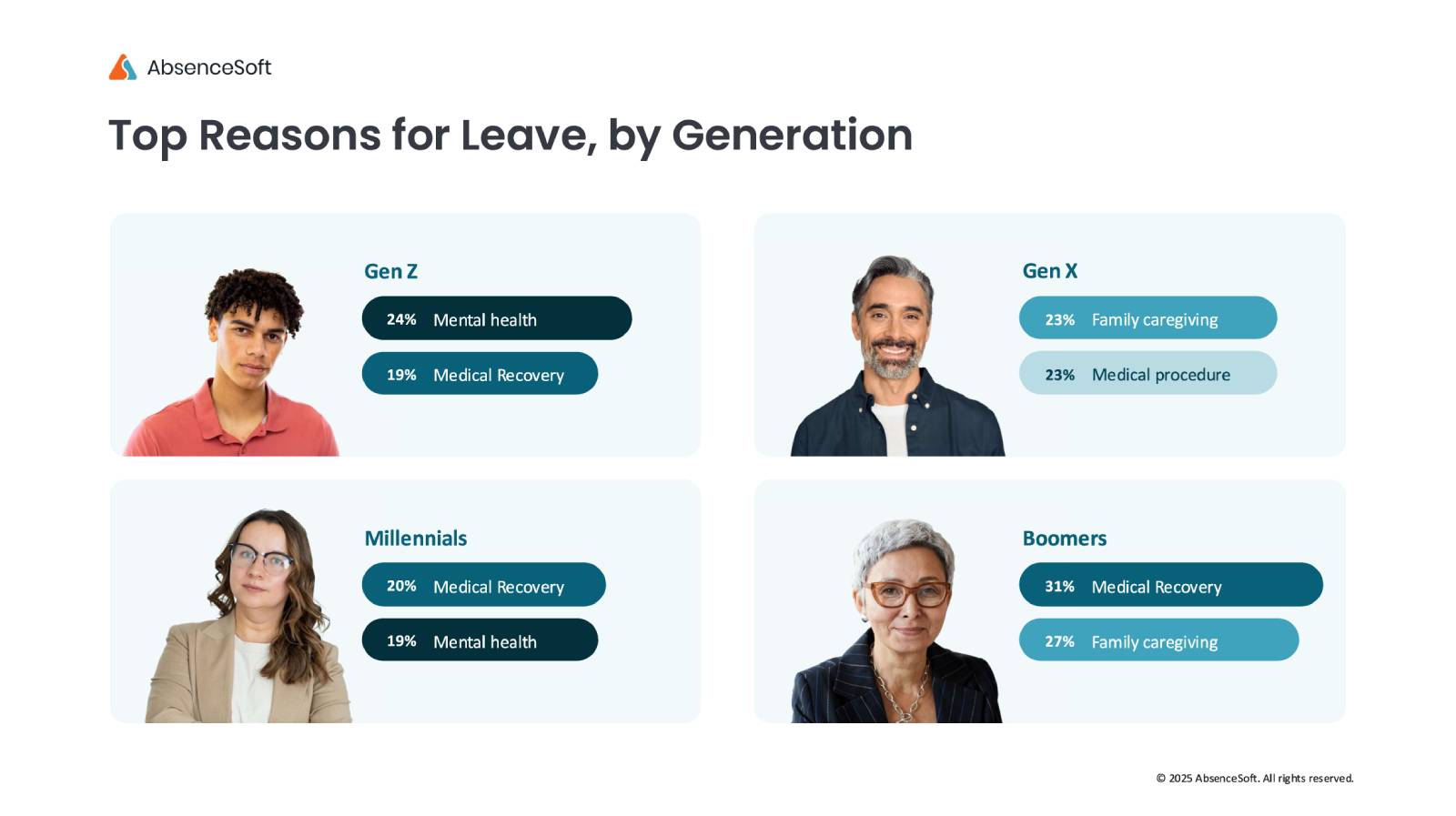
For example, among Gen Z employees, mental health is a leading reason for taking leave, accounting for 24% of reported reasons, followed by medical recovery at 19%. Millennials most commonly cite medical recovery at 20%, followed by mental health at 19%. For Gen X, family caregiving and medical procedures each account for 23%. Among Baby Boomers, medical recovery is the leading reason at 31%, followed by family caregiving at 27%.
These differences matter because leave isn’t simply an administrative event. It often occurs during periods when employees are dealing with significant personal, medical or family circumstances. An employee recovering from a medical procedure may need a very different kind of support than an employee taking leave for mental health reasons. Similarly, an employee caring for a family member may have different scheduling and communication needs than someone recovering from an illness.
Employees may enter the leave process for different reasons, but all expect the process to work.
Accommodation Needs Are Just as Diverse
The same generational differences appear when employees request workplace accommodations. Mental health and neurodiversity are particularly important considerations among younger workers, while medical recovery, chronic conditions and disabilities represent significant accommodation needs across the workforce.
The data presented by AbsenceSoft shows that the reasons employees request accommodations vary by generation, reinforcing the importance of flexibility rather than relying on a standardized approach. However, some cut across generations, such as flexible schedules and remote work, which are popular across age groups. That combination creates an interesting opportunity for employers. Organizations don’t necessarily need four completely different leave and accommodation programs. They need flexible processes capable of responding to different employee circumstances while maintaining consistency, compliance and transparency.
The Return-to-Work Experience
One of the most overlooked parts of the leave journey is what happens after the leave ends. Returning to work can be challenging. Employees may return with very different concerns depending on the circumstances surrounding their absence. When a younger employee returns from parental leave, they may feel exhausted and still adjusting to a major change at home, while an older employee returning after medical leave may be navigating new physical limitations.
A structured return-to-work process can help employers stay connected with employees before they come back. Technology can support this by automating notifications, coordinating communications with managers and other relevant teams, generating required forms or medical certification packets, and tracking return-to-work dates and remaining leave entitlements. The goal isn’t to automate the human relationship out of the process, but to take repetitive administrative work off HR’s plate so teams can focus more attention on employees.
Technology Can Create a More Consistent Employee Experience
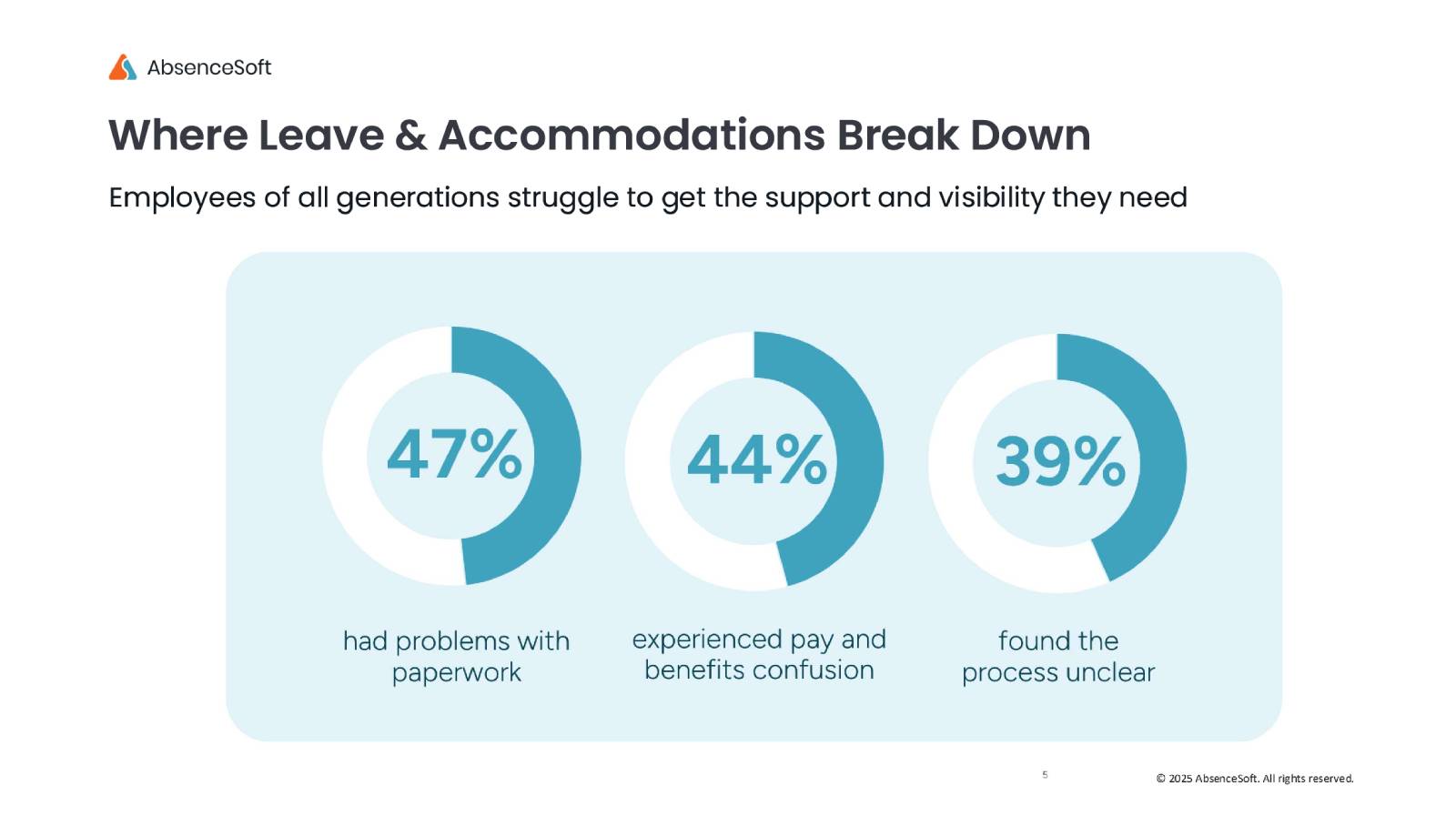
Having a policy on paper is only part of the equation. Employees can struggle with the actual experience of requesting leave or an accommodation. According to AbsenceSoft, the specific frustrations may differ, but the broader problem is shared. The process can become difficult to navigate when employees need help, particularly for mental health, which can create delays and disappointment.
Confidentiality is another critical factor. Employees need to trust that sensitive information will be handled appropriately. On the other side, employers need processes that support compliance and protect confidential information. For HR teams, these challenges can create a difficult balancing act. They must manage complex regulations, documentation, eligibility requirements, communications and internal coordination and also providing employees with a human experience.
That’s where technology can help. A self-service leave intake process allows employees to request leave from any device at any time and guides them through the information required to initiate a case. Requests can then be centralized in a single platform, giving HR teams greater visibility into each case.
By integrating with HR systems of record, organizations can base decisions on current employee data while accounting for different locations, entitlements and company policies. Automated communications can then keep employees informed throughout the process, and that can make a meaningful difference. Email and text notifications, digital forms, centralized document storage and automated workflows can reduce the back-and-forth that often makes leave administration frustrating for both employees and HR professionals.
Get in touch with AbsenceSoft today!
The right combination of thoughtful program design, efficient processes, and technology can help HR teams support employees more effectively while improving visibility, consistency, and operational efficiency.
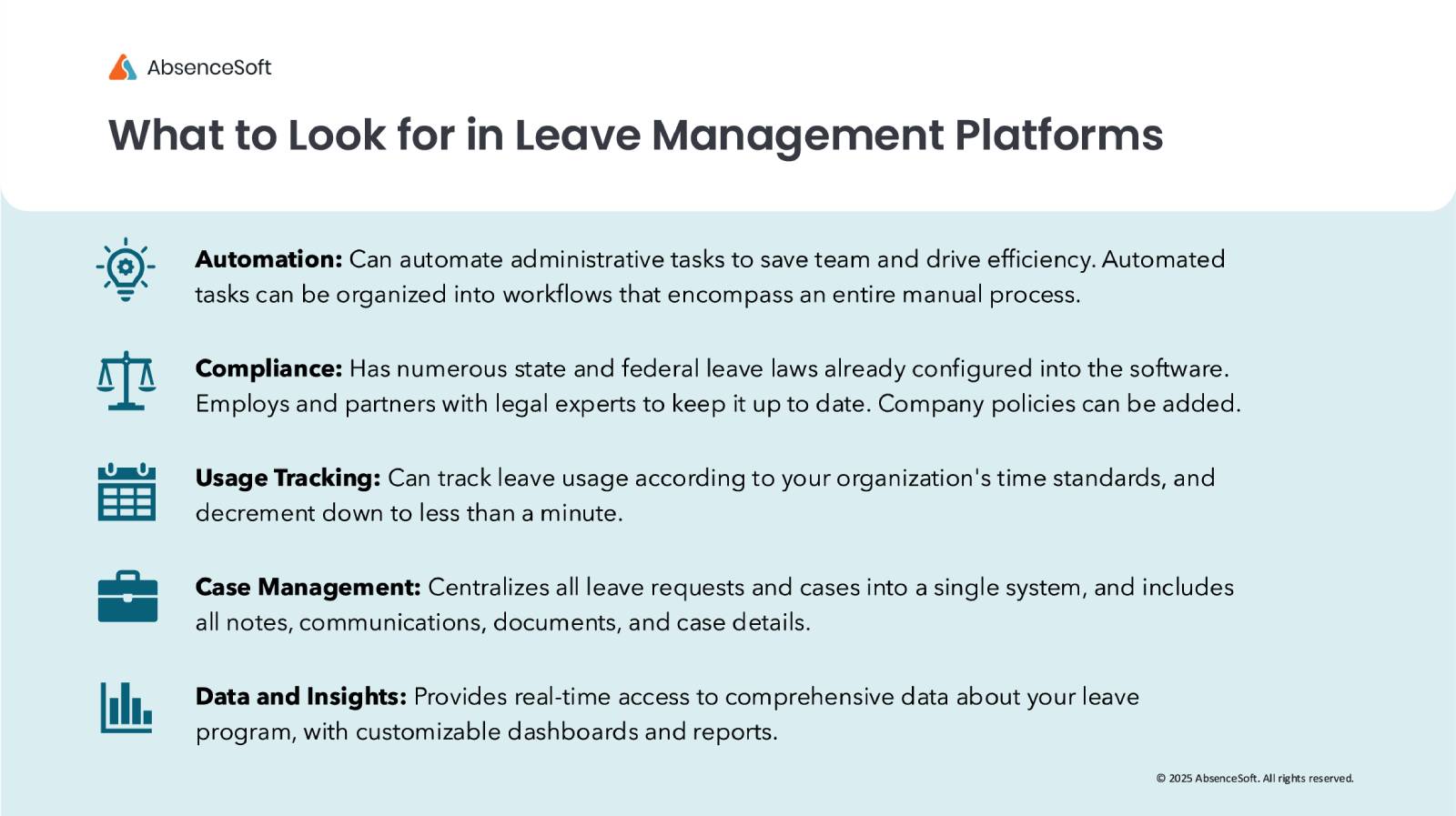
To help move away from fragmented, manual processes toward a more coordinated approach, when evaluating the leave management technology, organizations should consider the following capabilities:
- Automation
- Compliance capabilities
- Usage tracking
- Case management
- Data and insights
The goal should be to build systems flexible enough to accommodate generational differences within the workforce.
For employers, the opportunity is about creating a technology-enabled approach to standardize what should be, such as compliance, documentation, case management, and tracking, while still providing employees with a more personalized experience where they can ask for support, understand what happens next, maintain trust throughout the process, and return to work feeling supported.
For more information, contact:
In case you missed it: Log in to access the full Meet A Vendor Presentation!
Not a subscriber? Request access.
Did you find this article interesting?
Don’t keep this knowledge to yourself – share it on your social media channels and spark engaging conversations!