
In This Post:
Presenters:

Bianca Camacho
Manager, Strategic Alliances

JD Volz
Strategic Alliances Manager
For years, the goal of workplace mental health benefits has been to expand access and to ensure employees get the care they need. Access to care is essential, and it’s only the first step. Even as mental health benefit utilization rises, employee performance, engagement, and overall well-being continue to decline. Many organizations are still seeing declining employee focus, reduced productivity, and ongoing retention challenges. Outcomes aren’t following. This disconnect is what Lyra Health defines as the “Performance Paradox.”
According to Lyra Health’s 2026 State of Workforce Mental Health report, there has been a 67% year-over-year increase in serious mental health conditions. This shift requires more than availability and a more strategic, outcomes-driven approach to mental health benefit design.
With Bianca Camacho, Manager, Strategic Alliances at Lyra Health, and JD Volz, Strategic Alliances Manager at Lyra Health, at our last week’s webinar, we learned that Lyra Health’s approach focuses on closing the gap between access and outcomes, helping organizations move from reactive support to proactive, effective care. They offered guidance how to design mental health benefits that truly hold up recovery, productivity, and retention.
About Lyra Health
Lyra Health transforms mental health from a standard benefit into a strategic advantage. Their mission is powered by the belief that everyone deserves quick, easy access to high-quality mental healthcare.
An independent study of 500 benefits leaders and 7,500 employees across six countries found that access to mental health care alone is no longer enough if employees cannot reach the right level of high-quality care when they need it.
It’s time to close the gap between access and outcomes.
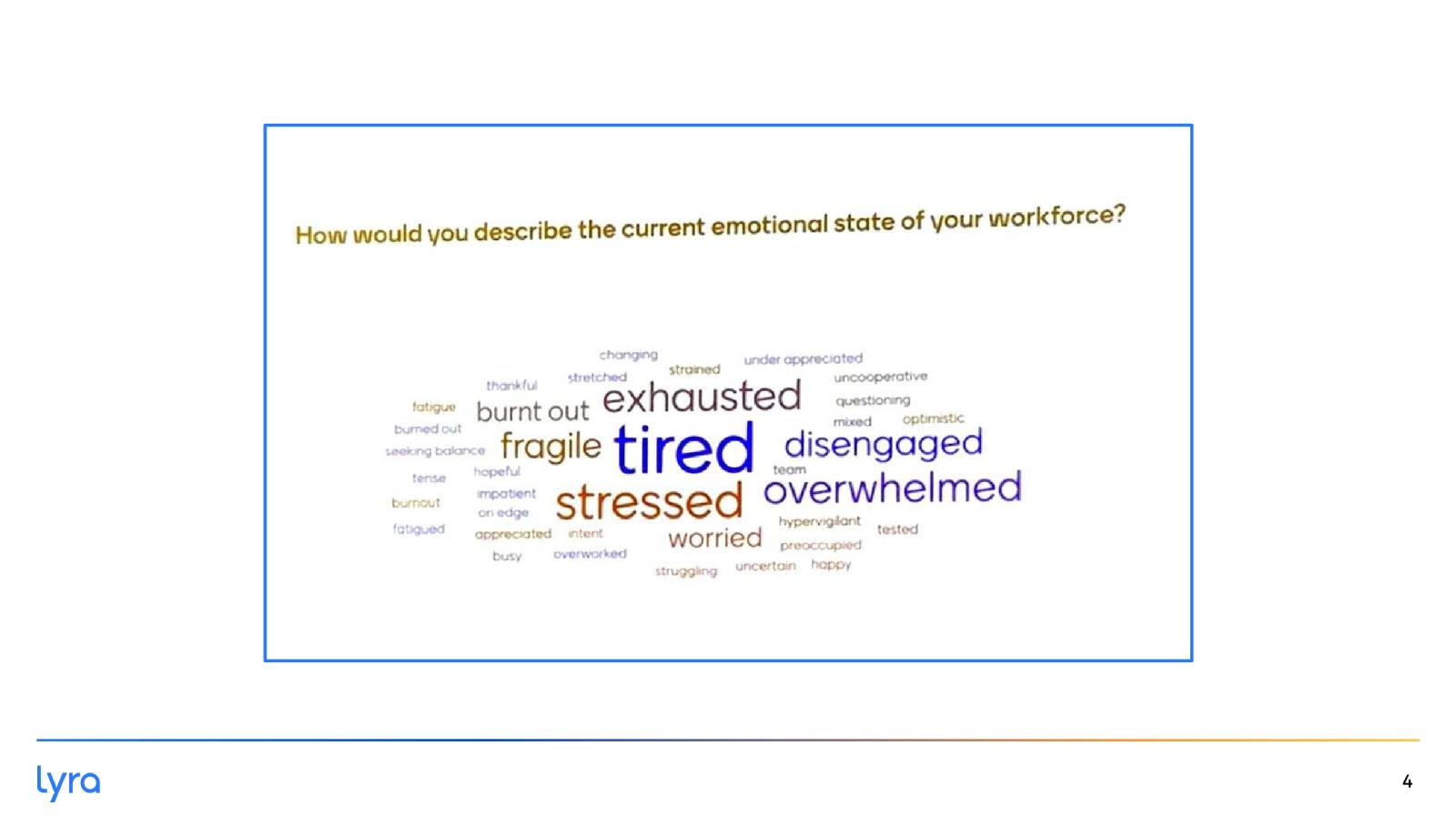
The State of Workforce Mental Health
What Bianca shared with us was a recent insight gathered from hundreds of benefits leaders and thousands of employees across multiple countries, revealing a sobering picture.
Discharge is not the finish line. It’s the beginning of the highest-risk recovery window.
Many struggle to stay focused, maintain productivity, and manage daily stressors. This creates a dual pressure: employees feel overwhelmed upstream, while employers bear the cost downstream.
Employers are being challenged to move toward delivering meaningful outcomes, such as faster recovery, improved functioning, reduced absenteeism and stronger retention.
The “Maintenance Treadmill” Problem. Where the System Breaks Down
As mental health needs evolve, so must the solutions. Employees often encounter significant friction when trying to get the care they need. In fact, many employees report cycling through multiple providers or treatment approaches without meaningful improvement. Instead of guiding employees toward clinical recovery, many systems keep individuals in ongoing, indefinite care cycles. This trial-and-error experience leads to frustration, disengagement, and prolonged recovery.
For employers, when sessions continue, outcomes remain unclear or unmeasured. This leads to higher costs without better outcomes. And it looks like employers are essentially paying for activity instead of progress. Without visibility, organizations cannot determine if their investments are delivering value. This lack of accountability perpetuates inefficiency. So, what organizations should be asking is:
- Can providers handle high-acuity conditions?
- Is care evidence-based and outcome-driven?
- Are employees matched to the right level of care quickly?
- Is there continuity throughout the care journey?
Without these elements, even well-intentioned programs may fall short.
A Strategic Shift: Designing for Outcomes
To bridge the performance paradox, organizations must shift from an access-first mindset to an outcomes-first strategy.
This means rethinking how mental health benefits are structured, delivered, and evaluated. Mental health benefits are no longer just about individual employees. Support for families, especially children and teens, is becoming a critical component of workforce well-being and retention. When employees struggle to find appropriate care for their families, it directly impacts focus and productivity, absenteeism, job satisfaction, and retention decisions.
Leading organizations are beginning to adopt more intentional plan designs that:
- Steer employees toward high-quality, evidence-based care
- Align financial incentives with better outcomes
- Integrate services across outpatient and inpatient settings
- Provide full visibility into clinical and financial performance
Rather than offering every option equally, these models prioritize value over volume. One of the most effective ways to improve outcomes is by guiding employees to high-performing providers.
Every mental health care is created differently. Variability in provider quality can significantly impact recovery timelines, engagement levels, and overall costs. So, by building/partnering with curated networks of top-tier providers, employers can reduce unnecessary or prolonged treatment, improve recovery rates, enhance the overall member experience, and lower total healthcare and disability costs.
Importantly, this approach does not eliminate choice. It enhances it by ensuring that the available options are effective.

Flexible Benefit Designs for Different Needs
What JD shared is that Lyra is providing better care by getting people into more effective care. Once they are in, there’s more to expect by getting them in some more effective models of the new plan designs as JD shared.
Organizations have different priorities, workforce needs, and risk tolerances. That’s why flexible benefit designs are essential. Some employers may choose:
- Lyra Tier 1: High-quality care with a low copay. It sits alongside existing plans, using incentives to guide utilization.
- Lyra EON: Exclusive outpatient network. Transition to exclusive outpatient networks, ensuring all members receive therapy and psychiatry services that meet defined standards.
- Fully carve out behavioral health, integrating outpatient and inpatient care under a single, accountable system
Each approach represents a step toward greater alignment between cost, quality, and outcomes.
Measuring What Matters
Another key insight from the webinar is the measurable value. A critical component of modern benefit design is data visibility. When employees receive the right care at the right time, organizations can reduce long-term disability claims, lower leave-related costs, accelerate recovery, and strengthen overall workforce performance. Employers must be able to answer key questions:
- What is the total cost of mental health care per employee?
- Are employees improving clinically?
- How long does recovery take?
- Where are the inefficiencies or “leaks” in the system?
Organizations that invest in robust analytics can identify trends, adjust strategies, and continuously improve their approach.

Get in touch with Lyra Health today!
The mental health landscape in 2026 demands a new approach. The future of workforce mental health is about delivering better outcomes. When employees receive the right care at the right time, the impact extends far beyond cost savings. It leads to stronger engagement, improved productivity, and a healthier, more resilient workforce.
Employers who successfully bridge the performance paradox will be those who:
- Move beyond surface-level access
- Focus on measurable outcomes
- Prioritize high-quality care
- Design benefits with intention and accountability
By embracing strategic benefit design, organizations have the opportunity to transform mental health from a cost center into a driver of performance and well-being.
Invest in mental health, and invest it wisely.
For more information, get in touch with the Lyra team at:
In case you missed it: Log in to access the full Meet A Vendor Presentation!
Not a subscriber? Request access.
Did you find this article interesting?
Don’t keep this knowledge to yourself – share it on your social media channels and spark engaging conversations!