
Monthly Industry Pulse

Should Employers Contribute to Trump Accounts?

Corporate America's biggest names are already writing $2,500 checks into savings accounts for their employees' children.
In This Post:

Trump Accounts began accepting contributions on July 4, 2026, exactly one year after the One Big Beautiful Bill Act created them. 

Dozens of employers, including Charles Schwab, Uber, Visa, and many others, have already pledged contributions for their employees’ children.

Here is how employer contributions to Trump Accounts work, when employees can fund the benefit instead, and what the latest guidance means for employers.

What Is a Trump Account?

Trump Accounts function like long-term savings accounts for an employee’s child

Legally, they are a type of traditional IRA for children created under new Section 530A of the tax code. The account is opened in the child’s name, and the funds belong to the child.

Until the child reaches adulthood, a parent, guardian, or other authorized adult manages the account on the child’s behalf. At that point, control of the account passes to the child.

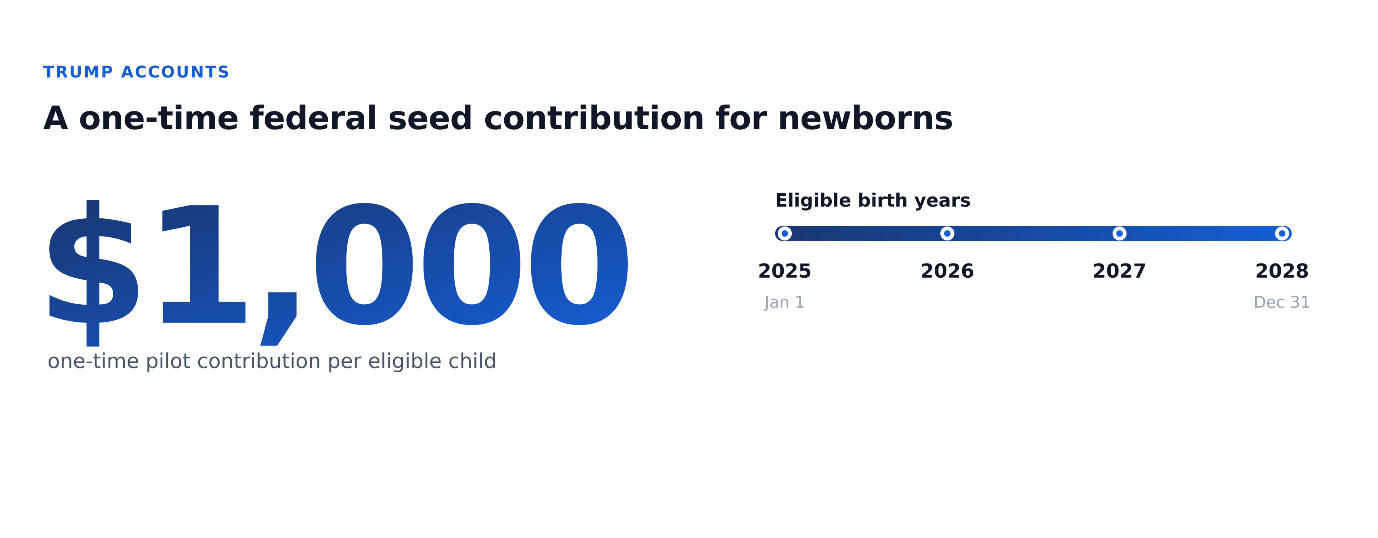
Children born between January 1, 2025, and December 31, 2028, are eligible for a one-time $1,000 pilot contribution from the federal government. An older minor may still qualify for a Trump Account, but would not receive that federal pilot contribution.

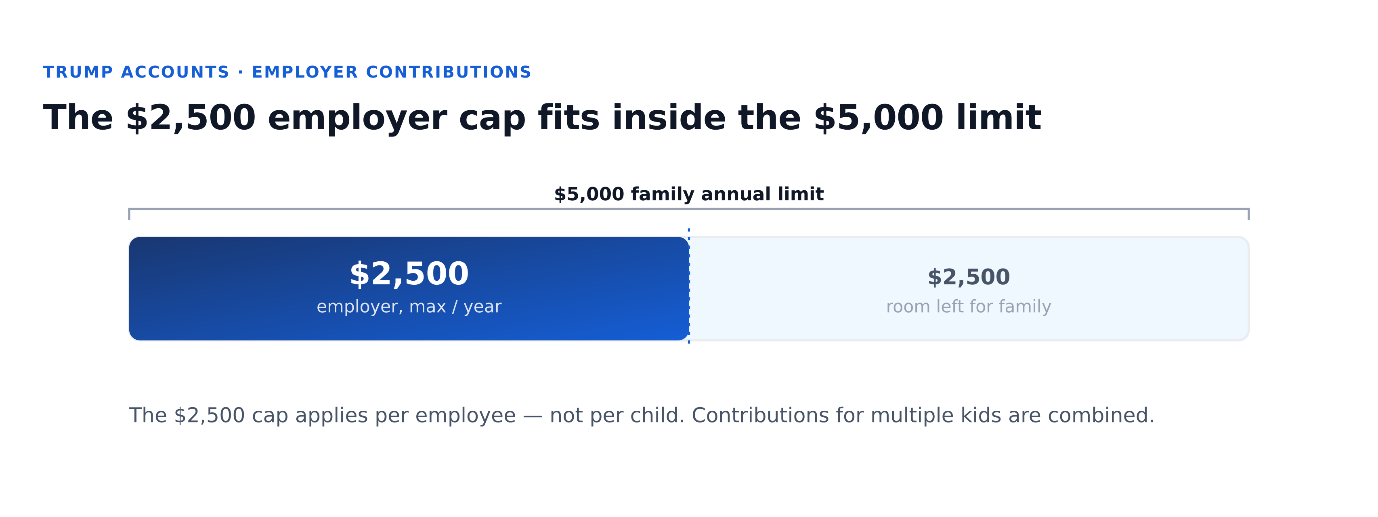
Non-exempt contributions are capped at $5,000 per year, indexed for inflation after 2027. The federal $1,000 pilot deposit and certain state or charitable contributions are not subject to that limit.

During the account’s growth period, funds generally must be invested in qualifying low-cost index mutual funds or exchange-traded funds that primarily track U.S. companies. 

Withdrawals are generally prohibited during this period. 

The exceptions are narrow:

  • The trustee can return excess contributions that push past the annual cap.
  • The full balance can move to another Trump account through a trustee-to-trustee transfer.
  • The balance can roll into an ABLE account, but only in the calendar year the child turns 17.
  • Funds can be distributed if the beneficiary dies.

The special childhood rules end at the beginning of the calendar year in which the beneficiary turns 18, after which traditional IRA rules generally apply.

How Employer Contributions Work

Employers are not required to contribute. However, those who choose to participate must follow several federal requirements:

The employee pays no income tax on the contribution today. However, like an IRA account, the money is taxed later, when it is withdrawn.

The ERISA Question

For months, the biggest employer worry was ERISA – the federal law that governs pension plans and brings fiduciary duties and heavy reporting with it.

On June 17, 2026, the Department of Labor released a technical document concluding that Trump Accounts and employer contribution programs will generally not be treated as employee pension benefit plans under ERISA. 

The reasoning is that the account belongs to the child, not the worker, and money flows in from families, the government, philanthropists, and employers alike.

Which Companies Have Already Pledged?

Treasury reported that more than 50 companies had committed support by the July 4 launch.

Most pledges match the government’s $1,000 pilot deposit. JPMorgan Chase and Bank of America announced matching contributions for eligible employees’ children in January.

Charles Schwab, BlackRock, Wells Fargo, Coinbase, Chipotle, Comcast, Intel, Nvidia, Uber, and Steak ‘n Shake have made similar commitments.

Some pledges reach beyond payroll. 

Visa is building a platform that lets cardholders deposit credit card rewards directly into their accounts, in addition to offering them in its U.S. benefits package. Micron committed a one-time $250 seed deposit for children in the seven states where it operates.

Corporate support is growing alongside participation. 

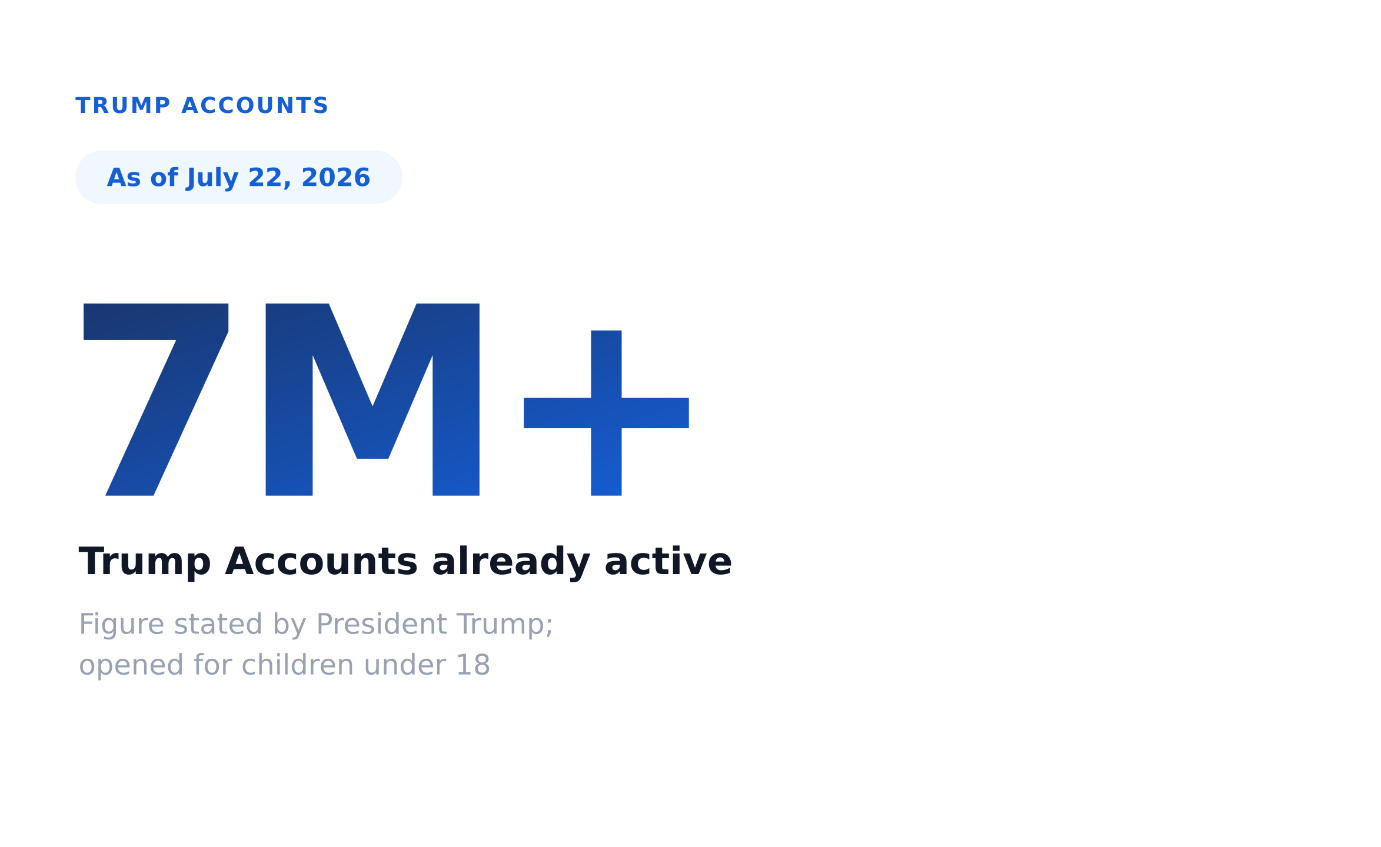
As of July 22, more than 7 million Trump Accounts were already active, according to President Trump.

The Case for Contributing

The argument for contributing begins with the workers’ financial situation.

In PwC’s 2026 Employee Financial Wellness Survey, 59% of workers said they are stressed about their finances, and 53% reported less than $5,000 in emergency savings. 

Bank of America’s workplace research found 76% of employees believe the cost of living is outpacing their income.

Employers have responded with more financial support. Roughly 70% ran some form of financial wellness initiative in 2025, up from 59% a year earlier, according to Employee Benefit Research Institute data. 

A Trump Account contribution fits into that budget line as a family-facing option, sitting alongside retirement matches and dependent care support rather than replacing them. 

Organizations already comparing financial wellness programs may see the contribution as a low-cost extension of an existing strategy.

The Case for Waiting

Still, early momentum is not the same as a universal fit. The benefit will not be equally relevant to every employee.

Workers without eligible dependents may receive no immediate value from an employer contribution program. This does not make the program unsuitable, but employers should consider how it fits within the overall benefits package.

Execution is the second hurdle. 

An employer cannot fund an account that does not exist; opening one is the family’s responsibility through IRS Form 4547 or the online application at trumpaccounts.gov. 

Someone must also own the process, whether it is handled by a payroll provider or a dedicated HR department, and much of that infrastructure is being designed in real time. 

Liquidity is another consideration. 

As mentioned before, money generally cannot be withdrawn during childhood, even in the case of financial hardship. 

Employees facing immediate pressures may place greater value on benefits they can use now, though this preference should be measured rather than assumed.

So, Should Employers Contribute?

For employers with meaningful employee interest, a sustainable budget, reliable administrative support, and a compliant design, a Trump Account contribution is worth considering. 

Even small employer contributions to Trump Accounts could add a family-focused element to the benefits package without requiring the employer to manage the underlying investments.

Other employers may reasonably wait. Uncertainty about employee demand, unresolved payroll questions, or budget constraints are valid reasons to monitor the program before adopting it.

Ultimately, the decision should be informed by a practical review of employee needs, administrative responsibilities, legal requirements, and the employer’s broader benefits strategy.

Written by Ivana Radevska

Senior Content Writer at Shortlister

Financial Wellness Programs

Browse our curated list of vendors to find the best solution for your needs.

Stay Informed

Subscribe to our newsletter for the latest trends, expert tips, and workplace insights!

Related Posts