

Monthly Industry Pulse

Workplace Surveillance Laws in the United States

Employee monitoring is everywhere, from email logs to biometrics. However, leaders must carefully decide what is necessary for safety and productivity and what constitutes a privacy violation.
In This Post:

Employers today have more tools than ever to track work, from productivity meters to engagement analytics and even surveillance.  

As companies lean into AI-driven insights and digital oversight, HR leaders face a complex question: Where do legal obligations end and ethical considerations begin?

For these reasons, understanding workplace surveillance laws is essential in today’s digital-first workplace.

In this article, we explore the federal and state regulations shaping how companies can monitor employees – what’s allowed, what’s changing, and what leaders need to get right.

What is Workplace Surveillance?

Workplace surveillance refers to any method an employer uses to track or record worker activities. 

In 2025, this extends far beyond traditional security cameras. Modern workplace monitoring creates a digital footprint of nearly every employee action, from the websites they visit to their physical location throughout the workday.

While these tools can boost security or productivity, they also raise some privacy concerns.

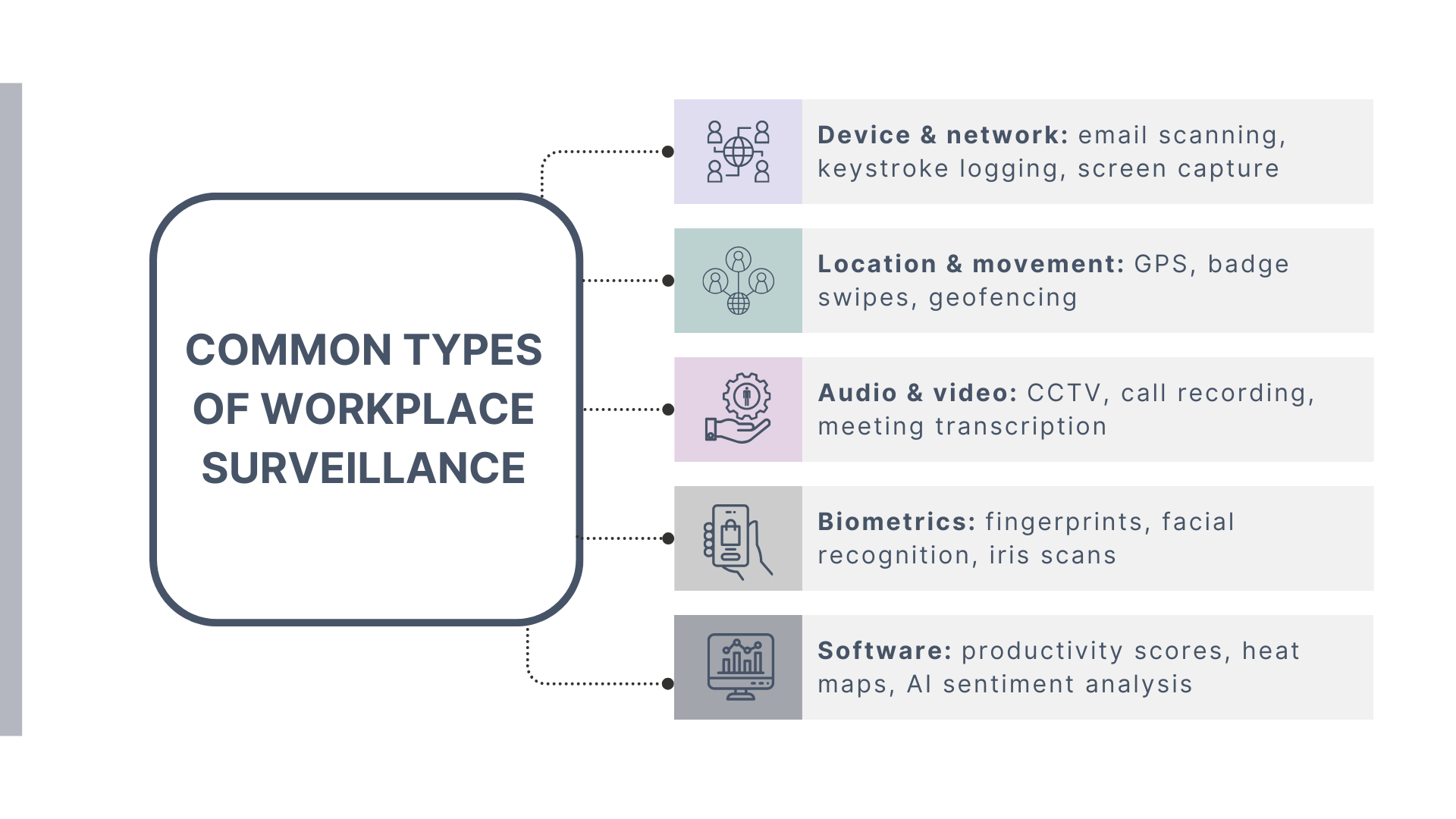
Common Types of Workplace Surveillance

Device and network: email scanning, web traffic logs, screen capture, keystroke logging, DLP tools.

  • Location and movement: GPS on vehicles or phones, badge swipes, geofencing.
  • Audio and video: CCTV, call recording, meeting transcription.
  • Biometrics: fingerprints, facial recognition, voiceprints, palm or iris scans.
  • Employee monitoring software: productivity scores, heat maps, insider threat detection, AI models that evaluate tone or sentiment.

Federal Law: ECPA and Privacy Basics

The ECPA of 1986 remains the primary federal law governing workplace surveillance, though it predates most modern technology.

The Wiretap Act and Stored Communications Act generally forbid unauthorized interception of emails, phone calls, and other electronic communications. 

In practice, however, ECPA allows two key exceptions for employers:

  • Employers can monitor if employees provide explicit consent (typically through employment agreements or employee handbook acknowledgments). 

Example: “By using company equipment, you acknowledge that all communications may be monitored for security and quality purposes.”

  • Monitoring is permitted for legitimate business needs when employees have notice. 

Legitimate purposes: Quality control, security, compliance, training.

Questionable purposes: General curiosity, personal vendettas, union-busting.

Employers typically don’t violate the ECPA when monitoring company-owned devices or networks. 

However, the law enters a gray zone when personal devices access company systems or when monitoring extends beyond work hours.

Other Federal Guardrails

  • Anti-discrimination: The EEOC has warned that AI and wearable-based monitoring can create disparate impact or ADA risks if used in employment decisions. 
  • Labor: The National Labor Relations Act (NLRA) protects employee rights to organize, and the NLRB has warned that surveillance used to intimidate or retaliate against union activity is illegal.
  • Consumer and trade practices: The FTC has stated that unfair or opaque worker surveillance can trigger enforcement under its unfairness and deception authority, and it is exploring rules on commercial surveillance.

State Laws on Workplace Surveillance

While the ECPA sets minimum standards, many states layer on additional protections.

Some states have “just cause” or “good cause” bills to put more limits on how monitoring is used. One approach is to require advance notice of electronic monitoring.  

For example, New York mandates written acknowledgment at hire and a posted notice that phone, email, and internet use may be monitored. Connecticut and Delaware have similar notice regimes. 

Other states go further. 

Eleven states have explicit privacy rights in their constitutions, which often shape how courts judge workplace monitoring: Alaska, Arizona, California, Florida, Hawaii, Illinois, Louisiana, Montana, New Hampshire, South Carolina, and Washington.

Courts in these states have used those provisions to scrutinize intrusive practices and limit unreasonable boss surveillance, though the extent to which they reach private employers differs by jurisdiction and context. 

In other states, monitoring is largely unrestricted. 

Texas, for example, allows employers to monitor at will, assuming no other law is broken. In Illinois, while there’s no general monitoring ban, the Biometric Information Privacy Act (BIPA) strictly limits the collection of fingerprints, facial scans, or iris data unless the worker consents. 

In short, the U.S. system is a patchwork. Protection largely depends on the state, the tool, and how courts interpret privacy.

Legislative Changes in Workplace Monitoring

Lawmakers are moving fast to address algorithmic surveillance and new data streams.

Recent and Proposed Federal Legislation

In Congress, the bipartisan Stop Spying Bosses Act was introduced in 2023 (Senate S.262) and 2024 (House H.R.7690). 

The Act targets the rise of automated monitoring and would require employers (with 10+ employees) to disclose any surveillance to workers – including what data is collected, how it’s used, and whether it influences promotions or raises.

Most importantly, the Stop Spying Act bans specific uses of surveillance. It forbids collecting health or disability information that isn’t directly job-related and even forbids watching workers when they’re off-duty.

The bill would also create a new “Privacy and Technology Division” at the Department of Labor, staffed with tech and privacy experts, to enforce these rules. 

Its companion bill, the No Robot Bosses Act, would also forbid employers from making significant employment decisions based solely on automated systems.

It is worth noting that Congress is also considering legislation to govern electronic monitoring in warehouses specifically. 

These bills are not yet law, but they signal federal lawmakers’ intent to update old privacy laws for the AI era.

State-Level Trends

Recent state initiatives follow similar lines. 

In Maine, legislators just passed a bill (LD 61), which will become law unless vetoed. This new law will ban secret monitoring unless employees are warned first. 

It also forbids bosses from forcing employees to install GPS or data-collection apps on their personal phones. Maine also mostly bans cameras or audio devices in an employee’s private home, vehicle, or property.

Many states are revising their employee privacy laws, too.

About half of U.S. states now restrict employers from prying into personal social accounts. That means no asking for passwords, no forcing applicants to pull up profiles during an interview, no pressuring them to change privacy settings, and no requiring them to add a manager or recruiter as a contact.

Some statutes target specific social platforms, while others cover broader “online accounts,” which can include personal email or retail logins.

Best Practices for Employers

Workplace surveillance isn’t inherently good or bad – it’s a tool that can protect or harm depending on implementation. 

However, given this evolving landscape, HR leaders and business executives should thoughtfully evaluate their surveillance practices. 

Here are a few action steps to consider:

  • Notify and document – Update your handbook and policies so employees (and applicants) know exactly what is tracked. Put all monitoring notices in writing, from cameras to screen-monitoring software.
  • Limit scope – Use surveillance only for legitimate purposes (safety, security, performance metrics). Don’t monitor people in private spaces or for activities like union organizing or unrelated health matters. 
  • Be prudent with technology – Evaluate any new tool before you buy. For example, if you track vehicles or install geofences, ensure you have a clear business need.
  • Communicate openly – Inform teams why monitoring is used. Make sure leaders know to explain, for instance, that cameras in a warehouse are for safety and theft-prevention, not spying on employees.
  • Regular training -Train supervisors and HR staff on legal dos and don’ts. In large organizations, consider routine audits of your surveillance practices against the latest rules.
  • Get expert advice – Laws change fast, so it’s wise to consult HR compliance specialists or external counsel to review your policies and contracts.

Ultimately, surveillance that cannot be clearly justified will not survive scrutiny from regulators, courts, or your own employees.

Moving Forward

Regulation will tighten as technology advances, work patterns change, and employee advocacy grows.

Over three-quarters of Americans favor state and federal regulations to control how surveillance technology is used in the workplace. 

Regulation isn’t a question of if, but when and how fast

Organizations that proactively adapt their practices now will avoid costly compliance changes later.

Written by Ivana Radevska

Senior Content Writer at Shortlister

Employee Monitoring Software

Browse our curated list of vendors to find the best solution for your needs.

Stay Informed

Subscribe to our newsletter for the latest trends, expert tips, and workplace insights!

Related Posts