
Pay Transparency in 2025
What happens when salary ranges go public? Discover how transparency laws are changing the workplace in 2025 – and what’s next.


CMO of Event Tickets Center

President of Archival Designs
Dress codes used to be simple.
Suits were meant for serious business, while sneakers were meant for casual wear.
Today, the lines are not so clear.
Between remote work, multigenerational style shifts, and viral aesthetics like the “office siren,” “old money,” or “finance bro” looks, defining what’s appropriate has never been more difficult.
In a modern work culture of flexible dress codes, does what we wear still matter?
The answer, as this article will explore, is yes.
In fact, navigating inappropriate workplace attire has become more challenging and important than ever, both for businesses and their employees.
In the past, workplace dress codes were straightforward and simple. Suits, ties, and polished heels were the standard in many workplaces.
Today, most offices across the U.S. have a relaxed approach, with only 3% of workers reporting wearing a suit to work, according to a Gallup survey.
However, the recent changes in dress expectations have also created ambiguity and inconsistency.
Where is the line between relaxed and “too relaxed”?
When did casual Fridays turn to casual every day?
Most importantly, does it even matter what you wear to work?
Does what we wear make that much of a difference?
Surprisingly, research and experience say yes. Clothing choices directly affect both how others perceive us and even how we perform.
Psychologists refer to it as “enclothed cognition” – the influence clothes have on our thoughts and behaviors.
In one experiment, people who put on a lab coat (believing it was a doctor’s coat) became noticeably more attentive and careful on tasks.
The simple act of dressing more formally or “professionally” can help us become more focused and confident.
We also can’t ignore the fact that how we present ourselves can anchor other people’s perceptions of us.
A candidate walking into an interview in a well-fitted suit immediately signals preparedness and an understanding of professional norms, before they’ve said a single word.
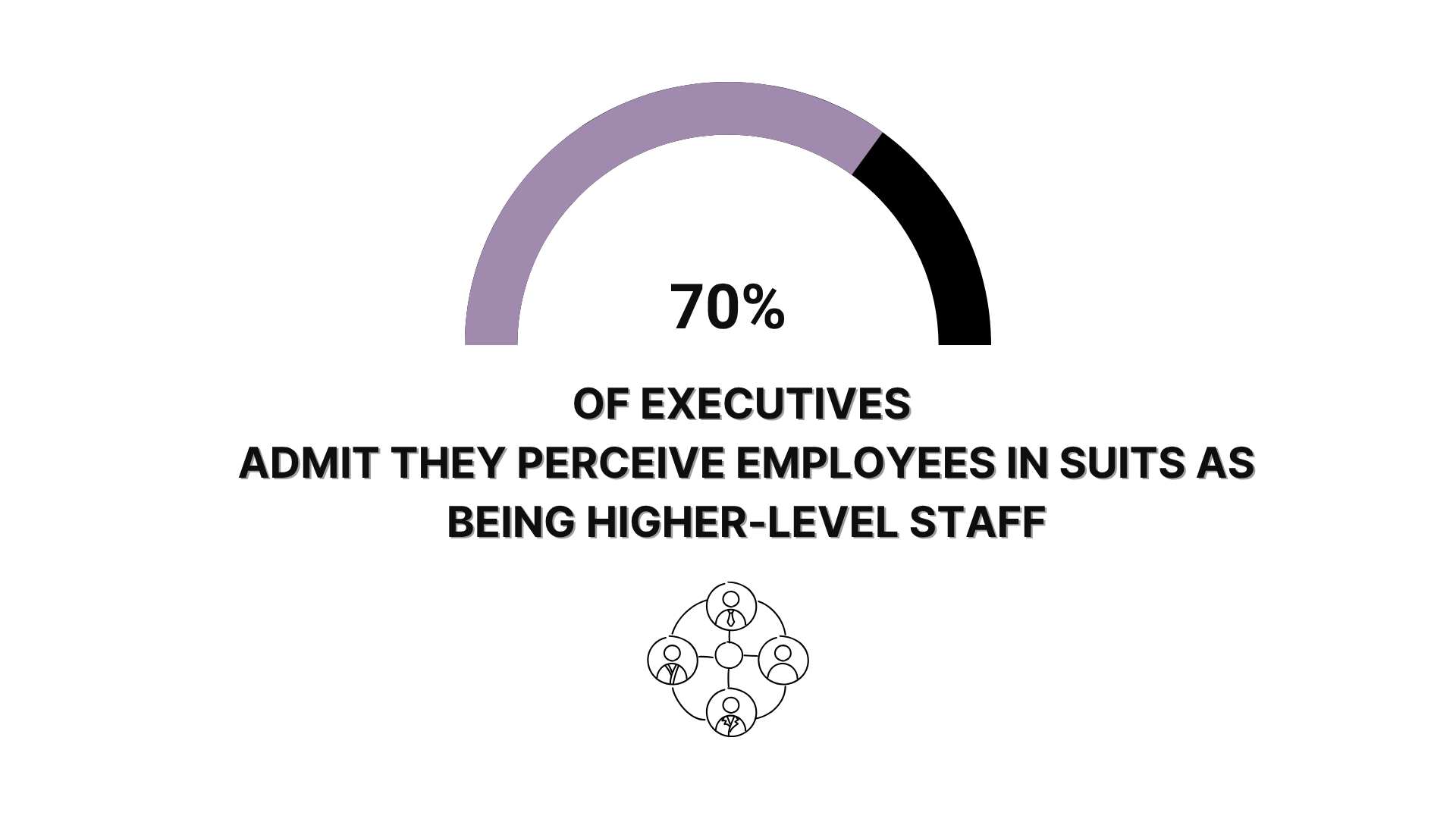
In fact, a survey found that 70% of executives admit they perceive employees in suits as being higher-level staff, and 60% say those employees are taken more seriously.
It’s not the suit itself that magically grants ability, of course, but it’s that others interpret it as a sign of professionalism and credibility.
Now, this doesn’t mean that everyone must always wear a three-piece suit, but it does mean that attire still matters, perhaps more than ever, with the current relaxed work standards.
What’s the worst that can happen if a company or an employee violates the dress code?
The costs can be surprisingly high.
On the surface, an inappropriate outfit might “only” result in a private meeting with HR or an embarrassing moment.
But consider the broader impacts: professionalism can suffer, paired with diminished credibility and lost opportunities.
Take, for example, a viral LinkedIn post from a California cybersecurity executive who criticized a sales rep’s hoodie and cap on a video call.
It gathered a lot of attention and showed how unclear dress code expectations can quickly escalate into reputational damage and workplace tension.
The risks don’t end with a damaged reputation. Poorly written or unevenly enforced dress policies can open the door to legal trouble.
Discrimination claims are increasingly tied to outdated or selectively applied appearance rules. One ongoing $3 million lawsuit involves a fast-food chain accused of firing a Black employee because his hairstyle allegedly violated company policy, a policy critics say wasn’t equally enforced.
Ultimately, failing to set and maintain appropriate attire standards can affect the bottom line.
If appropriate dress is still important, why do inappropriate outfits keep popping up at work?
Headlines about employees being sent home, heated forum discussions, and viral posts from frustrated managers or puzzled coworkers all debating what qualifies as appropriate workplace attire continue to appear.
Several root causes stand out.
For starters, workplace fashion expectations are vastly different across generations.
Many younger professionals today place a high value on personal expression and authenticity.
Gen Z employees have grown up in a progressively more casual world and often reject the notion that competence is equated with wearing a suit.
Meanwhile, some older managers may view this as unprofessional or disrespectful.
For example, Starbucks, known for its relatively young workforce, recently implemented a stricter dress code and faced immediate backlash.
Last month, over 2,000 Starbucks baristas across 120 U.S. stores went on strike to protest a new dress code policy.
The updated rules required a plain black shirt and denim or khaki pants, with Starbucks leadership arguing the change was to present a consistent brand image to customers.
However, younger workers want the freedom to “dress like themselves,” whereas corporate policies (often crafted by older executives) still emphasize uniformity and formality.
This is a perfect example of a generational divide in expectations.
The relaxation of dress codes didn’t happen overnight.
It has been a gradual evolution driven by the tech industry’s influence and, more recently, the pandemic, when around 27.6 million Americans had to work from home.
When your commute is from the bedroom to the home office, it’s tempting to prioritize comfort over formality.
In fact, nearly half of remote workers admit they don’t adhere to any defined dress code at home. Many employees got used to working in ultra-casual clothes, and as companies call people back to the office, there’s resistance to giving up that comfort.
Surveys confirm this, as 79% of hybrid workers say they now dress differently because of their flexible work arrangements.
Employers, for their part, have been loosening up, between 2018 and 2024, the share of companies with strict formal dress codes dropped from 30% to just 4%.
Fast forward to today, casual attire has become a sort of bargaining chip to entice staff back on-site.
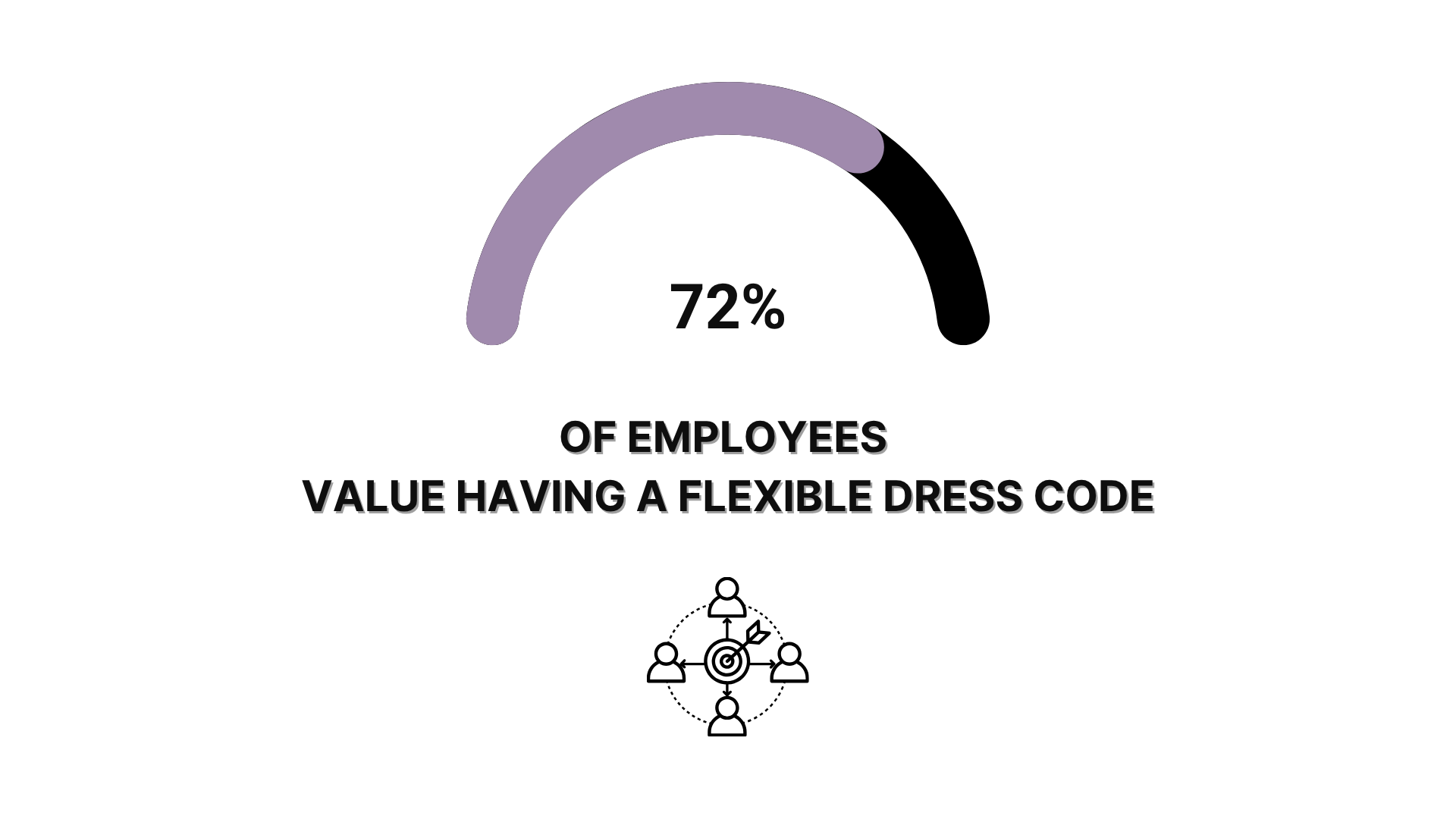
One study found that 72% of employees value having a flexible dress code, and 24% said they’d be more likely to return to the office if they could wear whatever they want.
Even more shocking is that a quarter of workers surveyed said they would take a pay cut in exchange for a relaxed or no-dress-code policy.
Clearly, the remote work era has made flexibility in attire not just a perk but, for many, a priority.
Another root cause of attire problems is the dress code policy itself – or lack thereof.
Some organizations simply haven’t updated their guidelines to reflect modern norms.
Understandably, executives have plenty on their plates, and fashion may not seem like a top concern. Still, when policies don’t spell out specifics, employees are left to interpret rules on their own.
A company may still have a vague rule from a decade ago that “business casual is expected,” but what does that mean in 2025?
A recent UK survey highlighted how this lack of clear guidance creates anxiety and mistakes.
As many as 82% of workers said they would benefit from having a clear dress code, yet 43% reported they’ve never received any guidance from their employer on what to wear.
Over half of the respondents admitted that terms like “smart casual” are confusing.
Without clear guidance, new hires, especially those from different cultural or lower socioeconomic backgrounds, can feel that these unwritten dress expectations are a barrier.
Ambiguity in dress codes can even exacerbate issues of employment discrimination and bias.
For instance, that same UK study found that a majority of Black candidates worry that “dressing like themselves” or wearing their natural hair will result in discrimination at work.
In a time when ethics in the workplace and inclusion are crucial, dress codes should not leave room for bias, discomfort, or unequal scrutiny.
What exactly counts as “inappropriate workplace attire”?
While every office culture differs slightly, HR experts generally agree on a few big prohibitions in a typical American office setting.
Common workplace attire violations include:
Beachwear or sleepwear – Flip-flops, tank tops, swim trunks, or pajamas are almost never acceptable in the office.
One challenge is that terms like “business casual” or “smart casual” mean different things at different companies.
Dress codes exist on a spectrum from formal to super casual.
“Business professional” is the most formal standard in a typical office, outside of black-tie events.
In industries like finance, law, or executive management, business professional dress may still be expected daily or for important meetings. The key is looking polished and traditional.
If you’re told an event or workplace is “business professional,” it’s better to be slightly overdressed than risk showing up too casually.
Business casual is a step down from full suits and gives more comfort while still looking professional.
It has become extremely common, with over 40% of U.S. workers currently dressing in a business casual way, yet it still causes debate.
In short, business casual is professional but relaxed.
You have more freedom with colors and patterns, such as a striped shirt or a pop of color in a blouse. However, the overall look should still be neat and office-ready.
“Smart casual” is arguably the most confusing category, as it falls somewhere between business casual and true casual. Many modern workplaces, especially creative or tech companies, use smart casual to describe their dress code.
In practice, it might mean you can even wear jeans or sneakers, as long as the overall outfit looks intentional and polished.
The smart in “smart casual” implies you should look sharp, not sloppy, even if you aren’t in traditional office wear.
For example, a neat pair of dark jeans with a blazer and blouse could be considered smart casual, and so could a sweater, khakis, and clean white sneakers.
The tricky part is that smart casual really depends on context. A plain T-shirt with a jacket might be alright at a startup, but not at a consulting firm.
So, if an employer uses this term, don’t hesitate to ask for more specifics.
Dress codes aren’t just for the physical office.
In the age of virtual meetings, knowing how to dress for a video call is now part of professional etiquette.
While video calls do tend to be more casual, you still need to look put-together from the camera’s perspective.
The general advice is to dress at least from the waist up as you would in the office, especially if clients or executives will be on the call.
It’s crucial to also think about your background; while not exactly attire, it’s part of your on-screen image. A clean, neutral background or a professional virtual backdrop works best.
It’s worth noting that what counts as appropriate attire can depend heavily on your industry or role.
Workplace rules around clothes aren’t just about culture, but they can also be about safety, uniformity, or legal compliance.
For example, in manufacturing, construction, or lab environments, casual dress might be dangerous.
You can’t have someone wearing open-toed sandals or dangly jewelry on a factory floor or in a hospital lab where it could cause injury or contamination.
Many jobs require personal protective equipment (PPE), such as steel-toed boots, hard hats, or flame-resistant clothing. In these settings, “inappropriate workplace attire” isn’t just unprofessional – it’s a safety hazard.
Certain industries also require uniforms or strict branding requirements. Examples include airline pilots and flight attendants, police officers, nurses, and retail and fast-food employees.
The purpose of these uniform policies is to present a consistent image to customers, and their standard look builds trust and recognizability.
Dressing inappropriately for work can have real consequences for both the employee and the workplace.
Fair or not, your wardrobe choices directly affect how colleagues, bosses, and clients perceive your credibility. If you consistently look disheveled, coworkers may wonder if that lazy approach extends to your work.
For example, imagine a team leader who enters a client meeting wearing a wrinkled T-shirt and cargo shorts, while the rest of the team is in business casual.
The clients might question the company’s seriousness or the leader’s judgment.
Over time, that employee might find themselves edged out of high-visibility opportunities because higher-ups prefer someone who “gives a good impression.”
This isn’t just an assumption: studies cited by The New York Times have found that something as simple as a teaching assistant dressing formally led students to perceive them as more intelligent and competent than a casually dressed TA.
Whether we admit it or not, we all have unconscious biases that equate certain attire with capability.
Inappropriate workplace attire damages the wearer’s image and can also create distractions for the whole team.
People might whisper, gossip, or find it hard to concentrate on work because of the uncomfortable environment.
There’s also the scenario of managers being forced to intervene, which itself causes a distracting ripple effect.
When 44% of senior managers say they’ve had to talk to an employee about inappropriate attire, that conversation not only takes time and awkward energy, but it also often becomes office news.
If someone is sent home to change (as one-third of managers admit they have done), the whole team usually becomes aware of it, and their attention from work changes to “did you hear what happened?
Simply put, a person’s attire should not be the most talked-about thing in the office on any given day.
Clothing expectations may not be listed on a job description, but they can influence your career trajectory in subtle and not-so-subtle ways.
There’s an old career advice: “Dress for the job you want, not the job you have.”
Fashion alone won’t earn you a promotion, of course, but it can be a signaling mechanism of your ambitions and attitude.
Consistently dressing a cut above can signal that you take your role seriously and see yourself as a potential leader.
On the other hand, consistently dressing down when those around you are in business casual might send a message that you’re checked out or don’t see yourself moving up.
Surveys have found that a sizable number of employers admit to holding someone back due in part to how they dress at work.
An office is a social environment, and outliers in attire can affect group cohesion.
If most of a team adheres to a certain dress expectation and one member constantly ignores it, it can come off as a lack of respect and result in annoyance or even conflict.
Coworkers might start wondering, “Why does our manager let him get away with that?”
Such inconsistent enforcement of dress expectations can feed into concerns around nepotism in the workplace.
How can companies reduce dress code issues without over-policing employees?
It starts with letting go of outdated assumptions that equate formality with professionalism.
As Ben Kruger, CMO of Event Tickets Center, notes, “A future-proof attire policy breaks away from the illusion that formality equals professionalism. It focuses on results, respects cultural and personal identity, and trusts employees to dress with purpose.”
This shift in thinking requires education, dialogue, and, above all, trust.
HR leaders should partner with managers to unpack what professionalism looks like in their context and co-design policies that are clear without being controlling.
The real risk isn’t casual clothing – it’s inconsistent enforcement and unclear standards.
Many companies now use HR software to distribute policies and even interactive learning modules. A quick e-learning segment or slideshow on appropriate attire can go a long way.
As JoAnne Loftus, President of Archival Designs, says, “A fair, future-ready dress code respects individuality without compromising the company’s image. Comfortable employees are confident ones, and that confidence is reflected in both their work and how clients perceive us.”
One of the best ways to prevent problems with inappropriate workplace attire is to craft a dress policy, but what does an effective policy look like in 2025?
Here are a few key elements and best practices:
1) Be Specific about Expectations
Vague terms like “business casual” or “appropriate attire” should be supplemented with examples. For instance, spell out that “business casual for us means collared shirts, blouses, slacks or knee-length skirts, and closed-toe shoes; jeans are OK on Fridays only. No shorts or flip-flops.” List a few dos and don’ts.
2) Address the Why
Explain the rationale for the policy.
Employees are adults – if you treat them as such and explain, “We deal with high-net-worth clients, so we need to present a certain image,” or “Safety regulations require long pants on the factory floor,” people are more likely to cooperate.
3) Consistency and Fair Application
Enforce the dress code uniformly across all levels.
Nothing breeds cynicism and allegations of favoritism in the workplace faster than a rule that only applies to some.
It’s also wise to outline how it will be enforced – for example, “If an employee’s attire is not in compliance, their manager will discuss it with them privately. Repeated issues may result in being asked to go home and change, or other disciplinary action.”
4) Keep it Updated
Revisit the policy every couple of years.
Styles evolve, and your business may change too. For example, if your office is mostly remote now, add guidance about video call attire. An outdated code that no one follows is worse than no code at all.
5) Communicate and Educate
Don’t just leave the dress code in a handbook.
Roll it out in onboarding for new hires or discuss it in a team meeting. Some companies do seasonal reminders, for example, “As summer approaches, a friendly note on what’s considered beachwear vs. office wear.”
The idea is to keep everyone aware in a positive, preventative way so that personal confrontations are rare.
Some of the most successful companies today rely on trust rather than on rigid dress codes.
At Netflix, the official guidance is refreshingly simple: “Act in Netflix’s best interest.” There’s no detailed policy, just trust in good judgment. Goldman Sachs relaxed its rules years ago, reminding employees that “all of us know what is and is not appropriate for the workplace.”
BCG follows a “dress for your day” approach – what you wear depends on what your schedule looks like.
So, what does the future of workplace attire look like?
If the past is any indication, continued evolution and flexibility.
We’re unlikely to see a full return to the ultra-formal “Mad Man” style workplaces of the 1960s, but that doesn’t mean sweatpants will become the universal office wear either.
Instead, many experts predict a future where dress codes are shaped by context, not control.
A future where trust, purpose, and professionalism matter more than policy length or fabric choice.
Senior Content Writer at Shortlister
Browse our curated list of vendors to find the best solution for your needs.
Subscribe to our newsletter for the latest trends, expert tips, and workplace insights!
What happens when salary ranges go public? Discover how transparency laws are changing the workplace in 2025 – and what’s next.
When we talk about human rights violations, we often picture distant places with dictatorial regimes. But the truth is, human rights concerns aren’t confined to remote corners of the globe.

Elevate your business with insights from impactful customer review statistics.
The “lazy girl jobs” movement isn’t about laziness at all. It’s about drawing a line between self-care and overexertion.
We're working hard to make it easy for you. Sign up for news, trends and insights.