Fair Workplace Practices

Strategic Questions to Ask at an Internship Info Session

For many candidates, the journey to full-time employment begins at the first internship info session, through the interactions that transpire.
In This Post:
Expert Contributors:
Picture of Joel Butterly

Joel Butterly

CEO & Founder of InGenius Prep

Picture of Matthew Crook

Matthew Crook

General Manager, PeopleHR Evo

Picture of Milos Eric

Milos Eric

Co-Founder, OysterLink

Picture of Joern Meissner

Joern Meissner

Founder & Chairman, Manhattan Review

Every intern hears the same advice: “Come prepared with questions.” So, candidates show up with the same five prompts that every other applicant Googled on the way there. What’s the company culture like? What does a typical day look like? Do interns typically receive full-time offers?

These aren’t bad questions, but in an era of abundant online info, showing a baseline interest in a company isn’t enough to stand out.

With intern offer rates down to 62%, the lowest in five years, and entry-level postings falling 29%, each interaction now carries materially higher stakes.

Therefore, the questions to ask at an internship info session are the earliest and clearest signal of whether a candidate has done real preparation or is just filling a seat.

So, what should candidates be asking, and what should HR teams be listening for?

The Importance of Informational Interview Questions

Internships no longer offer a guaranteed path into an industry. 

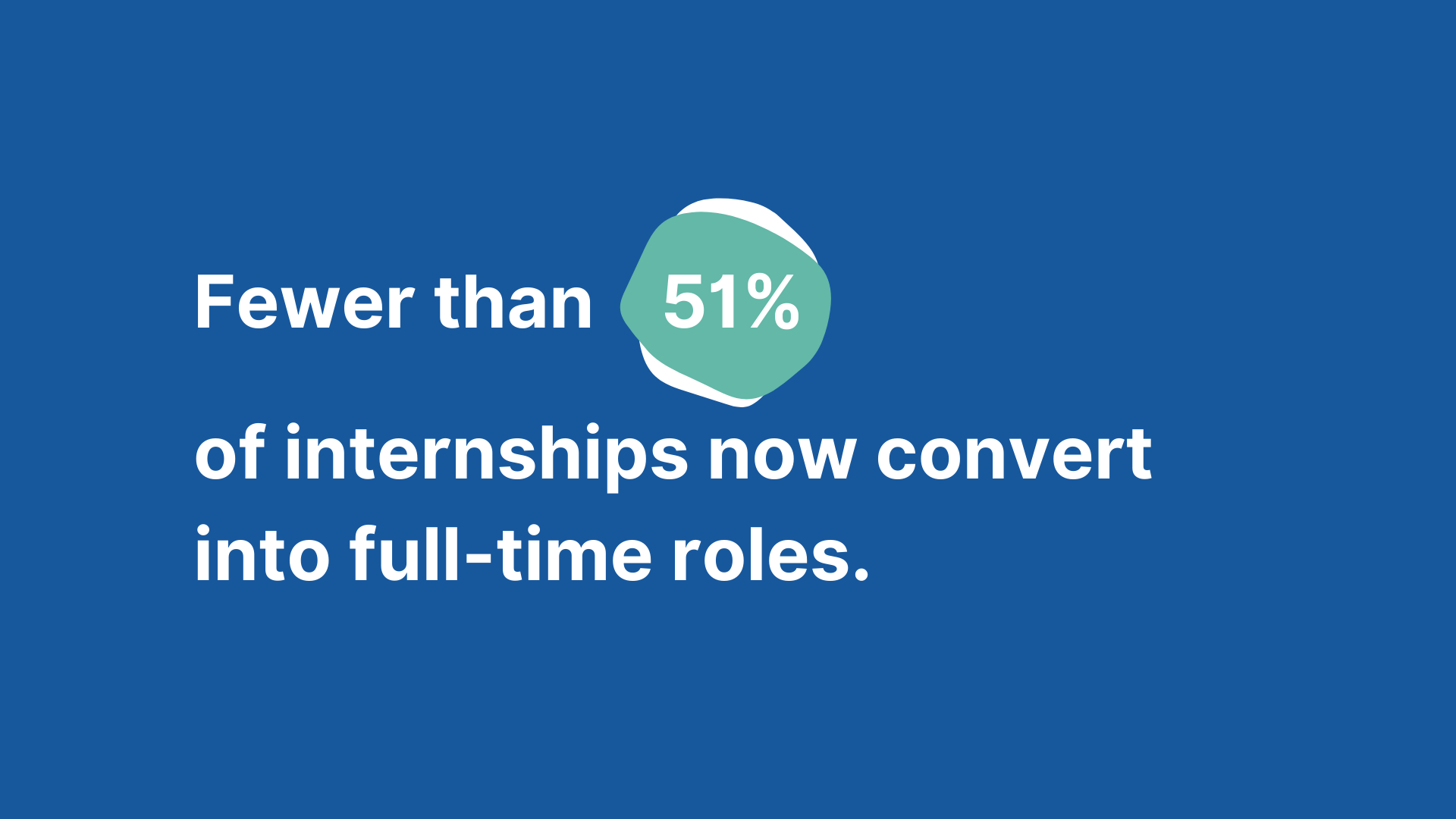
In fact, internship statistics show that the overall conversion rate for interns fell below 51% in the most recent cycle, even as acceptance rates remained healthy. Fewer offers are extended, and the distance between an internship and a full-time role has widened.

Still, for many candidates, the journey to employment begins at the first internship info session through the interactions that transpire.

Why Info Sessions Shape Early Judgments

Princeton psychologists Janine Willis and Alexander Todorov discovered that humans form impressions of trustworthiness and competence in as little as one-tenth of a second, which is faster than it takes to blink. 

Now imagine a room full of recruiters trying to figure out who they’ll remember once 200 applications land in their applicant tracking system. Thoughtful questions become one of the few reliable ways to stand out in that volume.

Science backs up this idea. A Harvard Business School study found that people who ask more questions are perceived as significantly more likable and responsive by their conversation partners. Conversely, 20% of hiring managers consider a lack of preparedness as a red flag in a candidate

A recent 2025 report by Criteria, which surveyed over 350 hiring managers, found that only 8% believe Gen-Z candidates are fully prepared for the workplace. At an info session, asking a generic question would only reaffirm these concerns.

But why do the questions you ask matter so much? Simply put, they reveal how a candidate thinks. A well-constructed question tells a recruiter more about a candidate’s judgment than a bullet point on a resume ever could.

In other words, the questions to ask at an internship info session can often be the difference between a forgettable introduction and a memorable one.

Internship Questions That Signal Preparedness

The fastest way to stand out in any professional setting is to show evidence of preparation. Not simply memorizing the “About Us” company page, but synthesizing information and forming a perspective.

Here are a few good questions to ask in an interview for an internship:

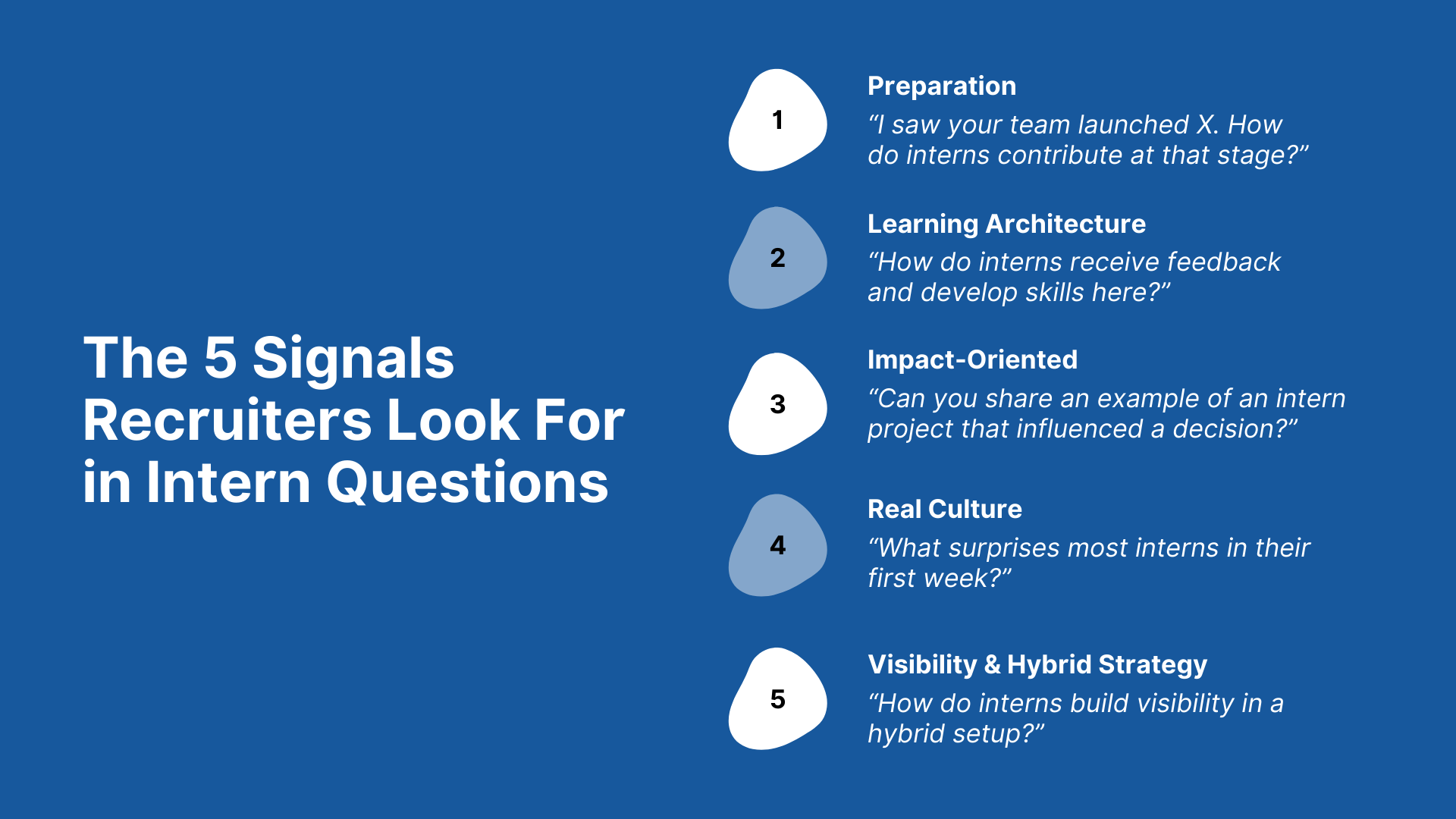
  • “I noticed the team launched [specific product or initiative] recently. How do interns typically contribute to projects at that stage?”
  • “The most recent annual report mentioned [specific challenge or growth area]. Is that something the internship program touches?”
  • “I saw that a former intern now works in [specific department]. How common is that kind of internal mobility?”

Each of these proves the candidate has spent time with publicly available information and can connect it to the role. 

As Matthew Crook, General Manager at PeopleHR Evo, puts it: “Interns who receive full-time offers are generally more successful because they’re shown to understand the ‘why’ of their work and how it fits into wider company goals.”

Internship Questions About Learning

Understandably, there’s always a temptation to ask about tasks. What will I be doing every day? What tools will I use? These are fine informational interview questions, but on their own, they signal a narrow view of what the internship is for.

A 2025 KPMG Intern Pulse Survey of more than 1,100 interns found that what they most hope to gain from an internship is a mentoring relationship with their manager. 

Despite younger generations being digitally native, their preferred way of learning new information is through hands-on practice projects, followed by peer-to-peer knowledge sharing. 

Knowing this, it makes sense to ask questions that check the learning architecture. For example, “How do interns typically receive feedback?” or “What skills have past interns developed most while working here?”

Joel Butterly, CEO & Founder of InGenius Prep, recognizes why these questions matter.

"A high adaptability quotient is the main factor distinguishing a high-performing intern from a worker who only works for pay. Successful interns leverage their internships as a means of empowering themselves intellectually and attaining an advanced level of professional competence that extends beyond their defined job description."
Joel Butterly
CEO & Founder of InGenius Prep

Internship Questions That Reveal Culture

Asking about the company culture directly almost never works. The answer is almost always a polished answer about collaboration and innovation. 

Instead, unexpected questions that force specific answers are far more revealing.

Something like, “What’s something that surprises most interns during their first week?”, or “Can you tell me about the team or manager an intern would work with, and the working style they encourage?” 

These questions are harder to answer with a script because they require real examples.

Joern Meissner, Founder & Chairman of Manhattan Review, captures the broader principle well: “It is important to bear in mind that an internship is a prolonged interview. Do not underestimate its significance. It is imperative to be aware of the impression you are conveying, regardless of whether you are employed in a casual environment.”

Internship Questions About Impact and Contribution

The least interesting question a candidate can ask is “What will I be working on?” Instead, the message that the question should convey is “How will I know if my work mattered?”

That’s because asking about impact signals is something rare in early-career candidates – an ownership mentality. 

Milos Eric, Co-Founder of OysterLink, has observed this distinction firsthand, saying, “Interns who consistently perform at a high level are known for their ability to demonstrate initiative and take on team member roles rather than merely waiting to be told what to do. Resourcefulness is the single characteristic that distinguishes successful interns from those who are not as successful.”

Here are a few impact-oriented questions worth raising:

  • “Is there an opportunity for interns to present their work to leadership?”
  • “Can someone give an example of an intern project that directly influenced a business decision?”
  • “How does the team measure the success of the internship program itself?”

These questions accomplish two things at once, as they tell the recruiter the candidate is thinking like a contributor, while also providing real data to evaluate whether the program is worth the commitment.

Internship Questions About Navigating Hybrid and In-Person Dynamics

Internship programs are no longer designed around a single way of working. Some prioritize in-person immersion, while others balance flexibility with scheduled time on-site. 

According to NACE’s 2025 report, employers with in-person programs extended offers at a 72% rate, compared to roughly 56% for hybrid programs. Put simply, proximity and visibility still matter for conversion.

What’s interesting is that most students seem to know this already. Handshake’s data shows that 49% say their ideal internship is hybrid, 40% prefer fully in-person, and only 11% would want to be fully remote. 

Therefore, questions to ask about work arrangements include, “How do interns typically build visibility with managers and senior team members in a hybrid setup?”, or, “What does in-person collaboration look like during the internship, and are there specific days the team is expected to be on-site?”

These tell the employer the candidate is already thinking about how to make the most of the program’s structure, not just whether remote Fridays are an option.

What HR Teams Should Listen For

On the employer side of the table, the questions candidates ask are some of the best informational interview questions a recruiter will ever receive, just in reverse. 

They reveal who prepared, who’s genuinely curious, and who is simply trying to check a box.

It’s worth paying close attention to candidates who ask follow-up questions in real time. The Harvard research mentioned earlier found that follow-up questions specifically, rather than introductory or mirror questions, drive positive impressions. 

A candidate who listens to a panelist’s answer and builds on it with a follow-up is demonstrating active listening and confidence. 

Similarly, HR teams should take notice of candidates whose questions reveal they’ve thought about the company’s challenges, not just the perks and company benefits.

When someone asks about growth targets, competitive positioning, or how the team incorporates AI in the workplace, they’re exhibiting a mindset that goes beyond self-centered interests. 

Crook reinforces this, stating, “Many competent interns are willing to turn up every day and get their workloads done with minimum fuss. But many of them fail to build that all-important bigger picture mindset.”

For employers evaluating early-career talent at scale, the Q&A is an underrated input into the broader recruitment process.

Questions to Avoid Asking During an Internship Interview

Surprisingly, some questions may actively hurt a candidate’s chances. They signal a lack of basic research, or even that the person is only interested in what the company can provide before demonstrating what they can contribute.

Candidates should avoid the following questions:

  • “So, what does the company do?” – that information is already publicly available
  • “How quickly can interns get promoted?” – the question can read as premature and entitled in an early-career context
  • “Is the internship paid?” – the info is usually published

Why do candidates still ask these? Mostly because they confuse having questions with having quality questions. Quantity and quality are entirely different currencies.

Meissner offers a helpful reminder for how interns should approach the entire experience, starting with the very first interaction.

“Take your work seriously, but don't take yourself seriously. Professionalism does not entail the suppression of one's individuality; rather, it necessitates an awareness that behaviors and habits that are acceptable in a social setting or on campus may not be suitable for a multi-generational workforce.”
Joern Meissner
Founder & Chairman, Manhattan Review

Conclusion

An internship info session looks like a passive event. People show up, listen, then leave. However, the questions to ask at an internship info session are one of the few chances candidates have to actively shape how they’re perceived.

The best questions to ask share three qualities: they’re specific, they’re informed, and they focus on impact rather than logistics. 

Ultimately, they show that a candidate is already thinking like someone who belongs inside the organization and contributes to its success, not someone on the outside hoping to get in.

Frequently Asked Questions

What Are Good Questions to Ask at an Internship Info Session?

Focus on questions that demonstrate preparation and genuine curiosity. Ask about specific projects or initiatives the company has recently launched, the feedback structure for interns, and how past interns have contributed to meaningful outcomes. Avoid generic prompts that can be answered by browsing the company website.

How Many Questions Should I Prepare for an Info Session?

Prepare three to five well-researched questions, but treat them as starting points. The best questions often emerge in real time as follow-ups to panelists’ answers. Quality always matters more than quantity.

What Should I Avoid Asking at an Internship Info Session?

Avoid questions that reveal a lack of preparation, such as asking what the company does or whether the internship is paid. Also steer clear of questions that sound entitled, like asking about promotion timelines before demonstrating value.

Do the Questions I Ask at an Info Session Really Affect My Chances?

Yes. Recruiters use info sessions to identify candidates who stand out. A thoughtful, specific question can make you memorable long before your application enters the formal review process.

Written by Ivana Radevska

Senior Content Writer at Shortlister

ATS Systems

Browse our curated list of vendors to find the best solution for your needs.

Stay Informed

Subscribe to our newsletter for the latest trends, expert tips, and workplace insights!

Related Posts

Unconscious Bias in the Workplace

To what extent are the organizational culture and business outcomes affected by unconscious bias? What is unconscious bias in the workplace, and what can be done about it?

Why Can’t Companies Retain Employees?

Despite ongoing economic uncertainty and a slowing labor market, more than half of employees are still job hunting. What’s driving this behavior, and how can companies respond?