What is a Good Job?
Is the idea and perception of “a good job” changing? Explore how modern work expectations are reshaping career satisfaction.
Community Advocate, Traffic Think Tank
VP of Growth Marketing at ecoATM/Gazelle
CEO of Featured
Have you noticed how some teams are able to recover from failures while others fall apart?
What separates the teams that grow from those that crumble often comes down to one variable: mindset.
A growing body of research and plenty of real-world experiences show that our beliefs about learning and ability directly influence performance, which is why more organizations are embracing the concept of a growth mindset.
The term has become a buzzword in corporate boardrooms and mission statements, but it’s often misunderstood or reduced to surface-level slogans such as “Fail. Learn. Grow.”
Many companies claim to value growth, but few embed the mindset into how they lead, develop, and respond to setbacks.
The reality is that the role of leaders in cultivating a growth mindset culture is far more complex and involved than simply encouraging positivity or determination.
A growth mindset is the belief that intelligence, talent, and abilities are not fixed traits, but can be improved through effort, learning, and perseverance.
Unlike a fixed mindset, which assumes our capabilities are static, a growth mindset sees potential and learning in every challenge.
Why is a growth mindset important? The simple answer is that it changes how we understand human potential.
Someone with a fixed mindset might think, “I’m just not good at sales, so there’s no point in trying new techniques,” whereas someone with a growth mindset would say, “I can get better at selling if I practice and learn from others.”
But can this same idea apply to organizations, too?
Indeed, the concept of a growth mindset, first coined by psychologist Carol Dweck, carries many implications for workplace dynamics.
A culture of growth means an entire organization operates on growth mindset principles. It’s more than just one or two people being open-minded – instead, it’s a shared belief that values continuous learning, curiosity, and resilience at every level.
The cultural differences between a fixed vs growth mindset in the workplace can show up in various ways:
| Fixed Mindset Culture | Growth Mindset Culture |
|---|---|
| Avoids risks | Encourages experimentation |
| Hides failures | Analyzes mistakes openly |
| Focuses on proving ability | Values learning over "looking smart" |
| Rewards short-term results | Balances outcomes with development |
While in theory, a growth mindset culture sounds better, organizations are complex social systems, and their culture largely reflects the beliefs and behaviors of those at the top.
So, what is the role of leaders in cultivating a growth mindset culture?
Leaders make up the cultural DNA of an organization.
Regardless of whether it’s an autocratic, laissez-faire, or transformational leadership model, leaders set the tone, reward effort, and inadvertently shape employee behaviors.
Therefore, to cultivate a leadership growth mindset culture, leaders must lead by example and set the tone from the top. In fact, an overwhelming 90% of senior leaders in a recent survey said that leaders should “lead by example” to foster a culture of growth.
How do leaders react when a project falls short? Do they treat it as a learning opportunity or a catastrophe?
The answer to these questions will either encourage a growth mindset in their teams or instill a fear of failure.
“Leaders shape growth culture through habits, not slogans. The most effective action is making room for learning in the process, not just the outcome,” says Alec Loeb, VP of Growth Marketing at ecoATM/Gazelle.
He explains that at his company, they use daily stand-up meetings to openly discuss what worked and what didn’t – without punishment or blame. Doing so creates clarity and trust, showing employees that “growth happens when people feel safe to share misses as well as wins.”
In short, when asking what a growth mindset in leadership is, the answer comes down to how leaders approach failure, learning, and potential.
Why should busy executives and HR decision-makers prioritize fostering a growth mindset culture?
When done right, combining growth mindset and leadership unlocks tangible benefits in innovation, resilience, talent development, and performance.
Growth mindset cultures are innovation engines.
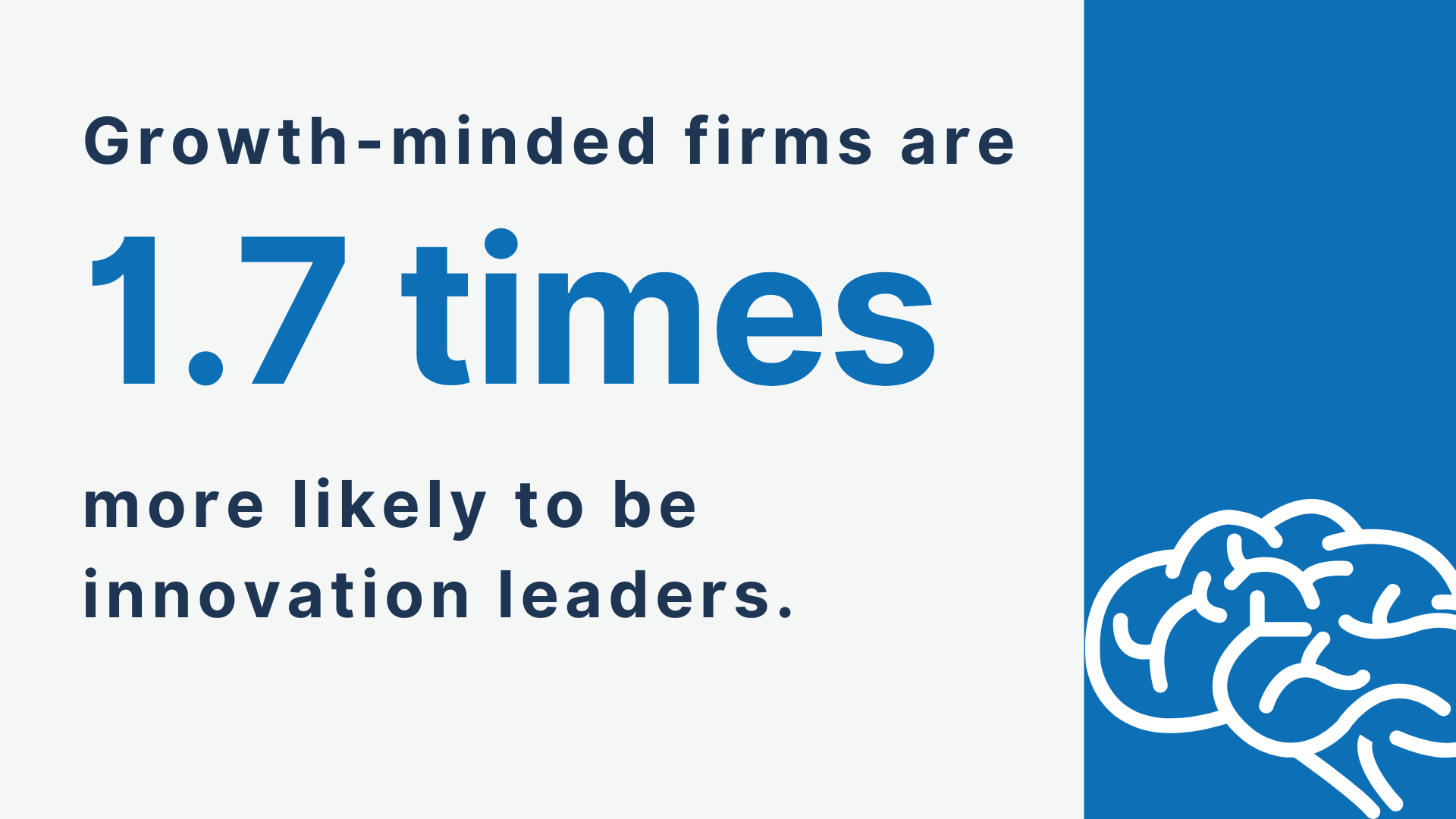
In fact, McKinsey research shows growth-minded firms are 1.7 times more likely to be innovation leaders.
It stems from the fact that creating a culture of innovation through a growth mindset requires intentionally building space for experimentation.
When employees are encouraged to take calculated risks and aren’t punished for failures, they’re far more likely to come up with creative solutions and bold ideas.
Alec Loeb explains, “Leaders break culture when they only reward short-term execution and ignore the value of iteration or experimentation. It signals that hitting today’s number matters more than learning how to build next quarter’s win.”
However, the key word here is “calculated.” A growth mindset doesn’t mean reckless experimentation. Instead, it means creating frameworks for intelligent risk-taking where failures provide valuable learning data.
For example, Amazon operationalizes innovation through specific mechanisms:
Scalable success pathways are built into formal processes, so when something works, it can grow quickly.
A growth mindset helps teams view setbacks as temporary and solvable. As a result, these teams are more adaptable when they are faced with change.
Studies also show that people with a growth mindset demonstrate greater persistence and cope better with change than those with a fixed mindset.
Leigh McKenzie, Community Advocate at Traffic Think Tank, observes this by saying, “Instead of freezing when a project pivots or tools evolve mid-sprint, employees trained in adaptability can recalibrate fast. They stop reacting and start responding, which keeps momentum strong even when pressure rises.”
He adds, “Leaders who make space for this kind of learning show that growth isn’t just about hitting bigger targets. It’s about how the team moves through uncertainty together. That culture of agility becomes a secret weapon in staying focused on long-term progress while still managing short-term demands.”
In short, when resilience is built into the team’s mindset, change stops being a disruptor.
Interestingly, companies and their leaders may have more of an impact on talent development than they realize.
The Pygmalion effect shows us that people often rise to meet the expectations set for them.
In other words, when leaders believe certain employees have high potential, they naturally give them more feedback, visibility, and development opportunities. Like a self-fulfilling prophecy, those employees then tend to grow faster and perform better.
In fixed-mindset cultures, career growth often depends on who leaders believe has potential. That kind of thinking creates uneven development – some employees get opportunities to grow, while others are overlooked, no matter their effort or progress.
On the other hand, organizations that embrace a growth mindset view talent as fluid, not fixed. They believe every team member has the potential to evolve, which naturally drives consistent investment in learning and development.
As a result, growth cultures tend to develop all talent and assume that everyone can grow.
Carol Dweck’s philosophy inspired one of the most well-known cultural transformations in corporate history.
In 2015, Microsoft CEO Satya Nadella vowed to move the company away from its “know-it-all” mindset – where people hesitated to ask questions – to a “learn-it-all” culture built on curiosity and continuous learning.
A decade later, Microsoft’s market value has surpassed $4 trillion, and Nadella attributes part of this success to the cultural shift.
But Microsoft’s success isn’t an outlier. Time and time again, it has been shown that growth mindset cultures build long-term, sustainable competitive advantages.
The impact of a growth mindset culture shows up in how employees feel and perform at work every day:
Eventually, these advantages compound into superior organizational and financial performance.
Transforming a culture will not happen overnight. Instead, it requires systematic changes across multiple organizational systems.
Leaders must align their performance management systems, hiring practices, and development programs around growth principles.
The best place to begin embedding a growth mindset is at the heart of the company – its people. However, it’s not just about teaching the concept to your employees.
A growth mindset needs to be built into every talent process, from recruitment and development to recognition and promotion.
It starts with how you welcome them, assign responsibilities, and frame what success looks like from day one.
During recruitment, ask candidates about times they failed and what they learned. Look for evidence of curiosity, resilience, and willingness to take on challenges outside their comfort zone.
Throughout onboarding, explicitly discuss your organization’s commitment to learning and development. Set expectations that continuous growth is part of everyone’s job and role, not an optional extra.
The way people think about their growth and abilities shapes how they respond to feedback, and ultimately how they perform.
One study found that young professionals who believe in the potential to grow are less likely to abandon career goals after receiving negative feedback. Teams rooted in this mindset are more likely to exchange honest input, learn from failure, and aim higher.
For these reasons, companies need to reconsider how they give feedback and evaluate performance.
Traditional performance reviews often consider only outcomes, and rarely take into account progress, effort, or even the courage to take on difficult challenges.
When a company shifts to a growth mindset, it values not only what is achieved but also how a person improves along the way.
Here are a few practical ways to embed this into your culture:
A growth mindset only works if you back it up with real support and tools, such as training programs, mentorship, and stretch assignments that push people beyond their current capabilities.
Offer executive coaching for growth mindset development. Encourage microlearning through short, skill-based modules that employees can complete regularly.
Brett Farmiloe, CEO of Featured, emphasizes an outward-looking approach to development, saying, “Always focus on the customer. That’s how businesses unlock growth. One growth mindset strategy I’ve nurtured at our company is to get employees talking with customers. I don’t care if the employee writes code or answers emails – getting close to the customer and listening to their needs is the only way to nail product-market fit.”
When learning is tied to real-world impact, it helps employees understand the magnitude of their work and motivates them to improve their skills continuously.
In growth mindset cultures, the goal isn’t to reward people for trying hard, but for learning effectively.
Encourage managers to call out learning behaviors as they happen – whether it’s someone testing a new approach, giving quick shoutouts, or sharing a lesson with the team.
Beyond informal gestures, your formal reward systems should also reflect growth-oriented values:
It’s a myth that growth mindset is only about praising effort. What matters is productive effort, or in other words, effort that is paired with reflection, feedback, and new strategies.
Cultural transformation isn’t easy. Organizations face several common obstacles when building a healthy company culture that is also focused on growth.
One common barrier is simply inertia – existing company norms or industry practices that favor the status quo. If an organization has long valued hierarchy or perfectionism, shifting to a growth mindset will take time and effort.
There may also be skepticism among employees. Many organizations have deeply ingrained cultures that punish mistakes, meaning employees won’t suddenly start taking risks just because leadership says it’s okay.
Overcoming these barriers requires persistence and sometimes uncomfortable changes in processes. It might mean updating HR policies, adjusting project timelines to allow learning cycles, or providing training to all levels of staff about growth mindset principles.
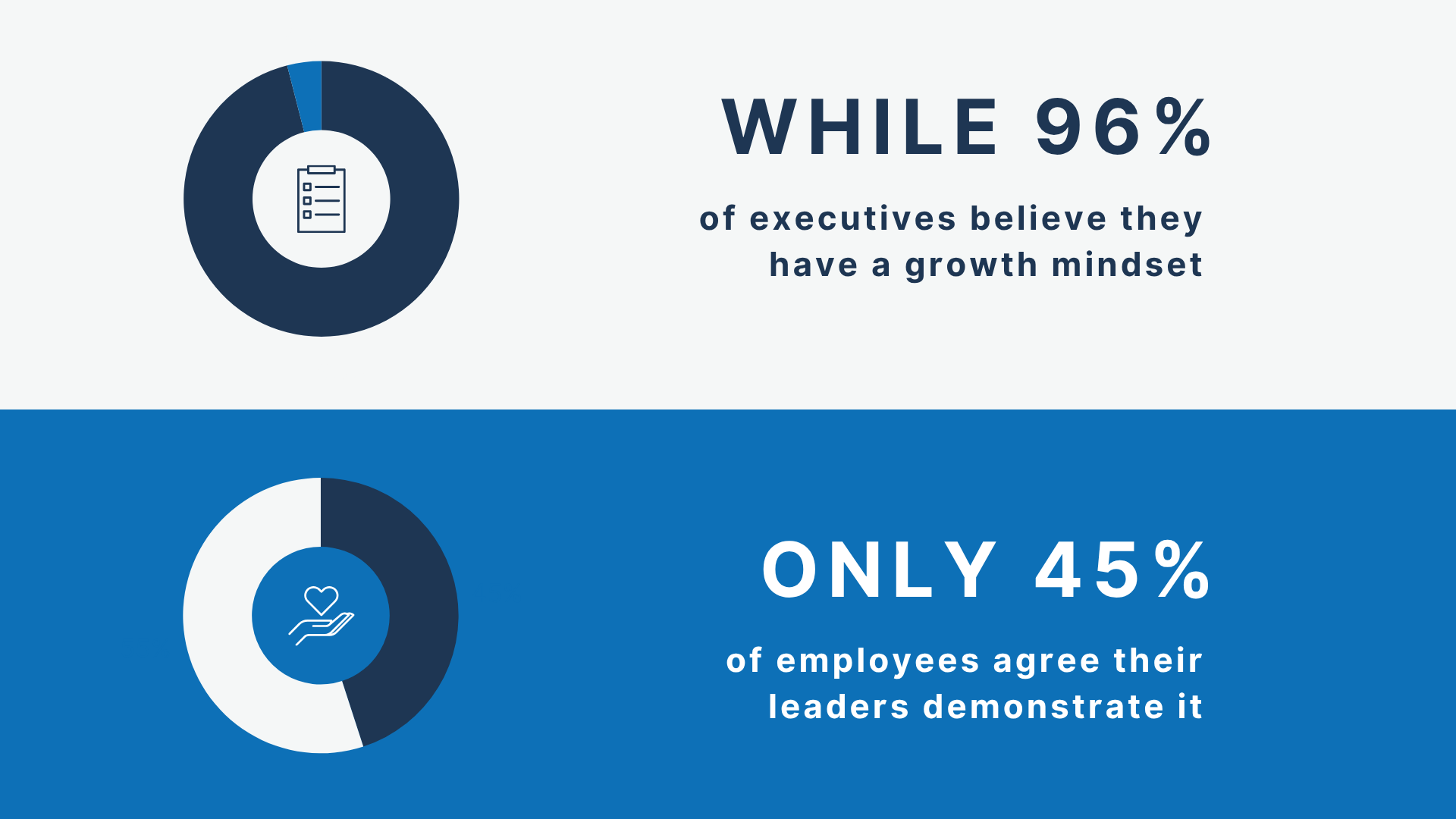
Perhaps the most significant barrier is when leaders aren’t truly aligned with growth mindset principles. While 96% of executives believe they have a growth mindset, only 45% of employees agree their leaders demonstrate it.
Similarly, McKinsey’s research shows a disconnect between belief and execution: many leaders say they’ve embraced growth-focused mindsets, but those intentions often fall short when it comes to translating into the behaviours that actually drive growth.
In the workplace, these leadership challenges and misalignment can appear as:
Solutions require conducting leadership mindset assessments and tying executive compensation to cultural metrics, not just financial results.
Can you have too much of a good thing? In corporate culture, “growth mindset fatigue” is a real risk.
Much like toxic positivity, the constant call to “grow” can become suffocating. When every aspect of life becomes a project for self-optimization, it stops being motivating and starts feeling like pressure.
Then there’s also the emotional toll. A culture that’s relentlessly focused on improvement can unintentionally dismiss discomfort. It’s important to note that not every failure needs a silver lining.
Sometimes, people just need space to feel discouraged, frustrated, or overwhelmed, without an expectation to immediately “learn from it.”
Most of us hold a mix of fixed and growth mindsets, often without realizing it.
At some point in our lives, we’ve all said things like “I’m just not a good public speaker” or “He’s a natural at leading people.” These beliefs can feel like facts, but they’re just stories we’ve told ourselves over time.
The truth is that mindset isn’t fixed.
Even science backs up this idea, Neuroplasticity shows us that our brains can keep learning and adapting at any age by forming new connections. Changing how we think is often just a matter of breaking an old habit.
For leaders, developing these new ways of thinking is a strategic leadership skill. It gives leaders the ability to question assumptions, not just in themselves, but across their teams, and create space for real development.
Ultimately, the role of leaders in cultivating a growth mindset culture is more than just cheerleading personal growth. It’s about shaping environments where learning, risk-taking, and progress are expected and supported.
Senior Content Writer at Shortlister
Browse our curated list of vendors to find the best solution for your needs.
Subscribe to our newsletter for the latest trends, expert tips, and workplace insights!

Is the idea and perception of “a good job” changing? Explore how modern work expectations are reshaping career satisfaction.

Value-based connections, hybrid events, expansion of AI, and the metaverse. In the ever-expanding networking realm, here’s what to look out for in 2025.

When we talk about human rights violations, we often picture distant places with dictatorial regimes. But the truth is, human rights concerns aren’t confined to remote corners of the globe.

Deciding to stay or leave a toxic work environment isn’t always straightforward. However, recognizing the signs is the first step toward resolution.
Used by most of the top employee benefits consultants in the US, Shortlister is where you can find, research and select HR and benefits vendors for your clients.
Shortlister helps you reach your ideal prospects. Claim your free account to control your message and receive employer, consultant and health plan leads.