Evolution of Applicant Tracking Systems from Paper to AI
From paper resumes to AI-driven platforms, see how applicant tracking systems have evolved alongside the workplace, as each phase solved the challenges of its time.
Recruitment has always reflected the realities of its time.
From paper resumes and newspaper job ads to digital candidate pipelines and advanced software solutions, hiring practices have adapted to shifting expectations around speed and scale. At the forefront of these changes, technological advances pushed the boundaries of what was operationally possible.
This transition is most clearly reflected in the evolution of applicant tracking systems, which transformed recruiting from a fragmented administrative function into a strategic priority.
An applicant tracking system is often described as software for managing candidates, but that definition understates its role.
In practice, an ATS provides the structure that allows recruitment to function at scale by centralizing all candidate information, job postings, applications, and hiring workflows into a single system. It also tracks how candidates move through the hiring process while documenting decisions and maintaining accountability across teams.
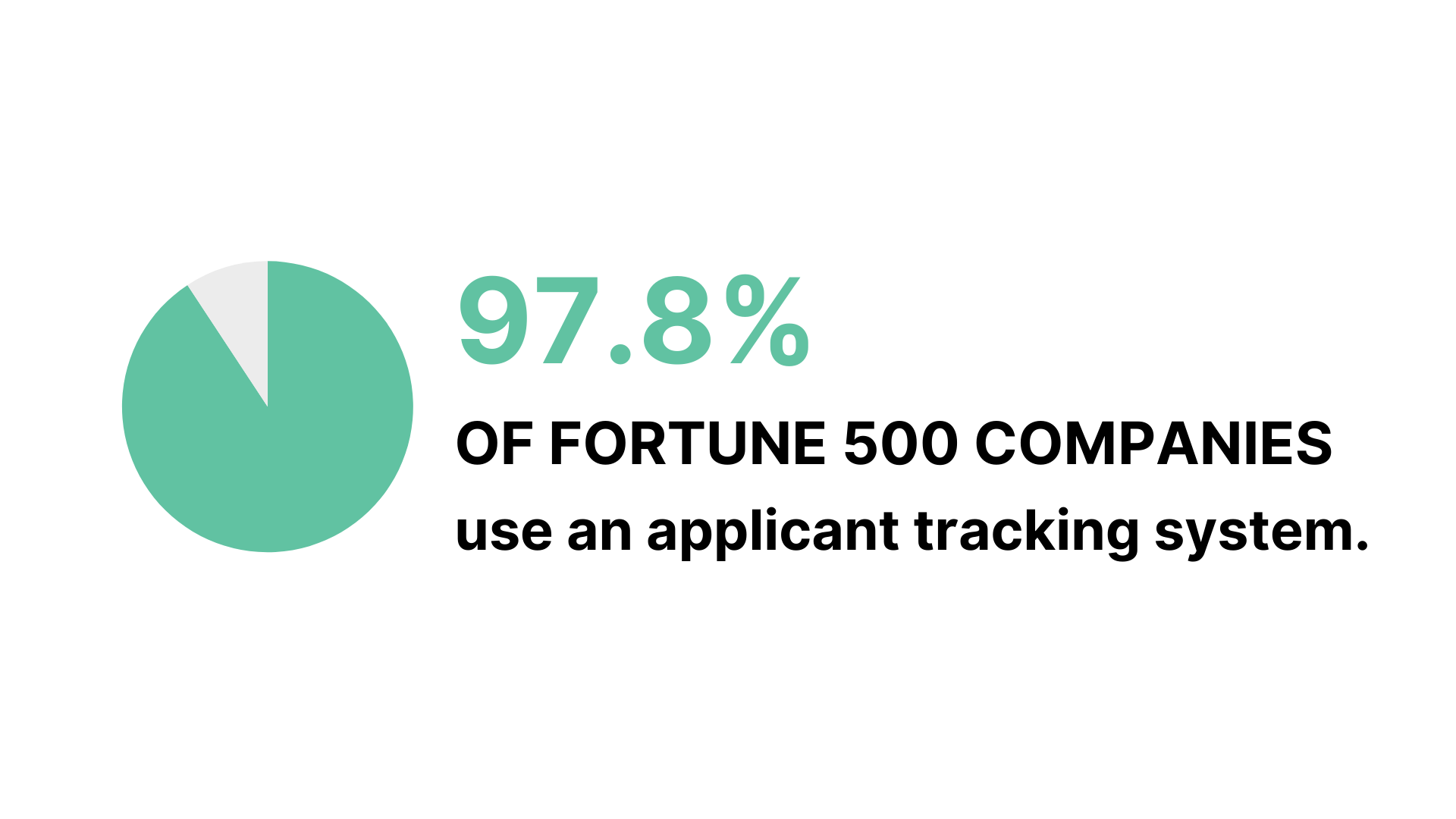
All of these functionalities led to widespread implementation. In fact, Jobscan’s 2025 Applicant Tracking System (ATS) Usage Report shows that 97.8% of Fortune 500 companies use an ATS.
However, this near-universal adoption is the result of gradual change shaped by decades of shifting hiring practices and organizational needs. What began as an administrative support tool evolved into the operational backbone of talent acquisition. Therefore, the current form and meaning of ATS tools reflect lessons learned across different eras of recruitment.
Looking back at this progression provides a clearer understanding of how applicant tracking systems became a foundational tool for hiring.
The workplace has changed tremendously over the decades, and recruitment has evolved alongside it.
Each period was accompanied by new expectations around scale, speed, and structure. While technology enabled these changes, the defining factor was how employers managed talent within the reality of their time.
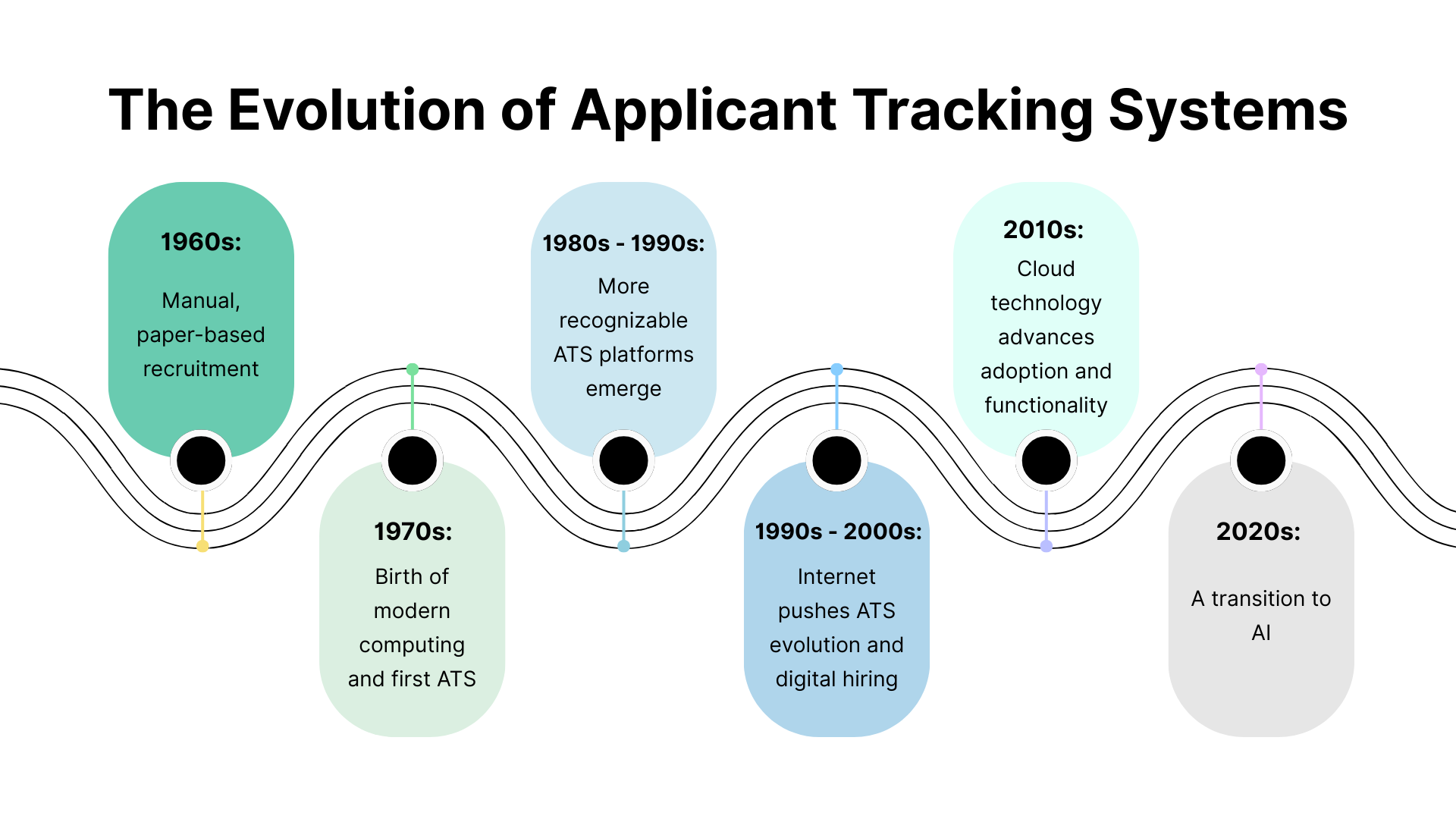
This timeline traces the evolution of applicant tracking systems, from paper resumes to AI-driven recruitment:
Before technology became a core aspect of the hiring process, recruitment looked immensely different from what it is today.
Companies advertised roles through print media or word of mouth, sent applications by post, and stored candidate data in physical files. Recruiters had to sort through hundreds of resumes to find those with qualifications that matched their job description.
This manual, fragmented process was often time-consuming and prone to human error.
While the pre-ATS recruitment method certainly worked for its time, the lack of structure and scalability made hiring more reactive than strategic. These inefficiencies set the stage for the upcoming shift in how companies manage candidate data.
The beginning of ATS dates back to the late 1960s and early 1970s.
It coincided with the “golden age of innovation” for IBM, one of the companies that laid the foundation for modern computing, particularly in data management and predictive applications. Although usage was more limited, IBM’s computers helped companies manage and produce large amounts of data as early as 1968.
These innovations eventually led to the first generation of applicant tracking systems.
They functioned as databases, storing resumes on a physical network, which was more efficient than paper files. Over time, ATS systems evolved to include features such as the ability to add resumes via paper scanning, cross-referencing candidates, and tracking and filtering data.
Although groundbreaking for its time, this was an incredibly complicated and expensive process, making the early ATS adoption largely confined to enterprises with dedicated IT support.
Then, the rise of the internet marked a significant step forward in recruitment efficiency.
The internet transformed the workplace in ways never seen before, and recruitment was no exception. It went from a localized activity into a high-volume, always-on function.
Online job boards from the late 1990s, such as Monster and CareerBuilder, as well as email applications, dramatically expanded employer reach while simultaneously increasing applicant volume. Meanwhile, LinkedIn, which launched in 2003, provided new ways to source candidates through social recruitment.
In response, ATS platforms evolved to accommodate digital submissions and introduced more advanced algorithms and keyword-based screening to manage scale. Basic automation, such as resume parsing and candidate scoring, became standard.
While these changes improved efficiency, they also exposed new limitations. Many ATS platforms prioritized speed over relevance, making it harder for recruiters to identify qualified candidates amid growing application volume.
Cloud technology marked a turning point in ATS adoption and functionality.
Around the 2010s, web- and cloud-based platforms began replacing on-premises systems, enabling faster, more accessible deployments. At the same time, subscription models reduced upfront costs, which lowered barriers to entry for smaller companies.
These modern solutions also introduced features such as collaborative workflows, configurable hiring stages, more advanced reporting and analytics, and integration features. Automation expanded to include anything from interview scheduling to compliance management.
As integration with broader HR systems improved, applicant tracking systems evolved from record-keeping tools to a central technology supporting every step of the recruitment process.
The latest phase of the applicant tracking system evolution introduced innovations driven by artificial intelligence.
AI use in the workplace has increased rapidly over the past few years. In fact, a McKinsey report shows that, in 2025, 80% of organizations had already adopted this technology in at least one area of their operations.
But where does AI stand when it comes to candidate tracking and recruitment?
Right now, this technology mainly centers on data-driven insights to support hiring decisions through pattern recognition and predictive analytics. Natural language processing (NLP), for example, assists with candidate matching by interpreting resume content and scoring the candidate’s qualifications based on the job criteria.
Automation in this context emphasizes relevance and quality over volume processing.
While adoption for many companies is still in the pilot phase and AI regulations and governance remain a challenge, the gradual implementation of AI features in ATS systems is reshaping how companies access potential and define candidate fit.
The evolution of applicant tracking systems has been driven less by a single breakthrough and more by steady advances in foundational technologies.
Each shift in infrastructure and system design expanded what an ATS platform could do and how companies can use it. From early databases that replaced paper resumes to automation, these technologies shaped recruitment into a strategic priority for long-term success.
At the core of every applicant tracking system is the ability to store, retrieve, and organize candidate data. Early systems relied on basic databases with limited capabilities, resulting in slow, highly manual searches.
The first advances came with the introduction of relational database management systems, which could answer any question as long as the information was in them, and had more efficient storage.
As technology matured, it introduced more substantial features, such as keyword filtering and semantic search. These advances helped recruiters navigate more candidates by turning unstructured resumes into searchable, comparable data, laying the foundation for scalable hiring.
After several decades of paced progression, the internet brought rapid, significant change to HR technology. It enabled digital applications and global talent reach, while cloud infrastructure changed how these tools are built and delivered.
Cloud-based systems removed the need for in-house installations and allowed continuous access across locations and devices. This shift significantly improved ease of use and made enterprise-grade recruitment tools accessible to small companies.
Cloud infrastructure also supported faster innovation cycles, allowing ATS providers to release new features and security updates without disrupting operations.
As recruitment became more specialized, ATS platforms needed to connect to a broader range of workforce tools.
Application programming interfaces (APIs) made this possible.
The technology allows different software systems to communicate and exchange data and functionalities.
Therefore, it became critical to build an interconnected ecosystem in which ATS tools could integrate with job boards, recruiting software, background screening providers, HRIS databases, and more. Data could flow across the hiring lifecycle, improving both the talent acquisition process and the candidate experience.
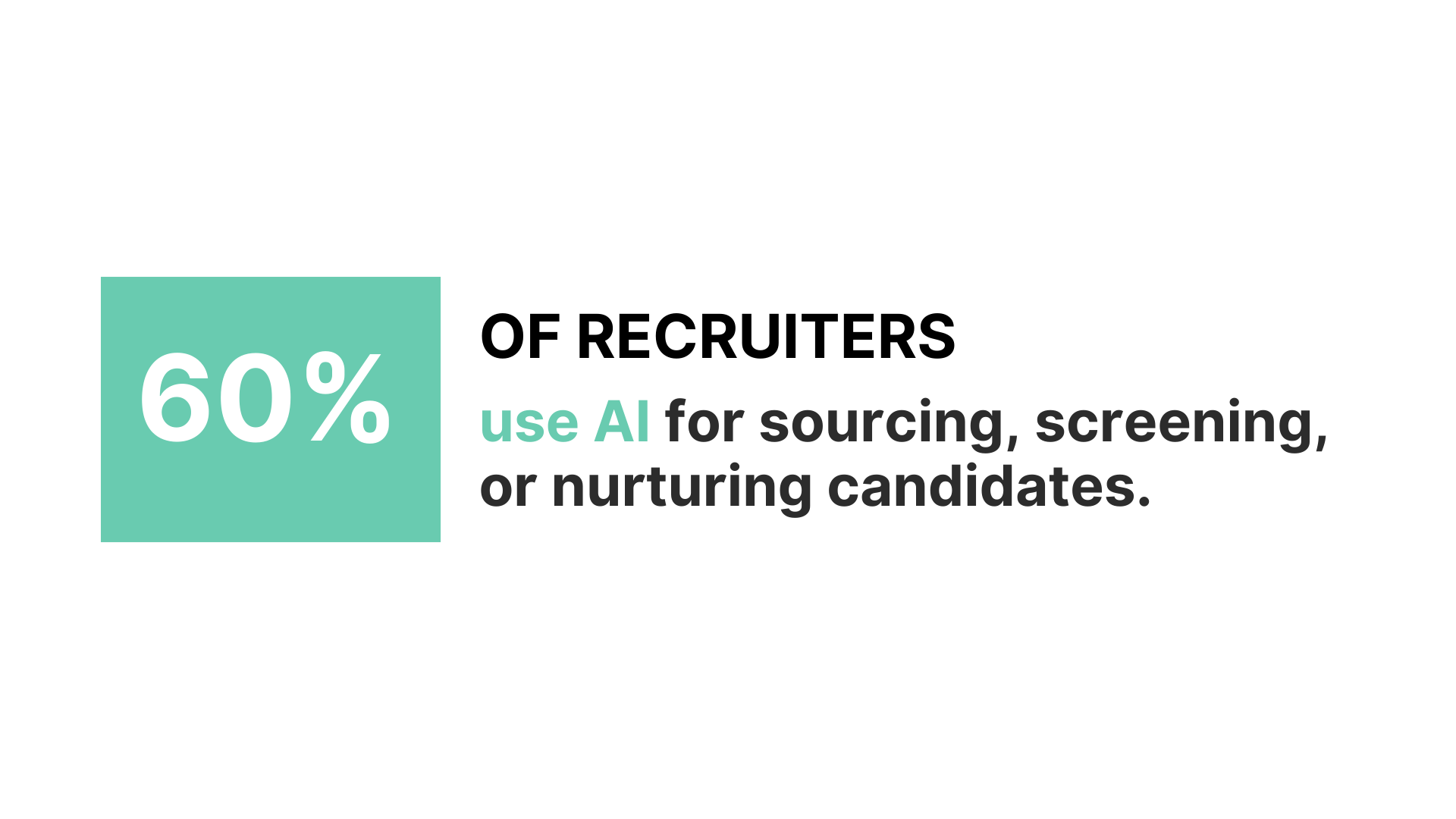
Research by Josh Bersin on how AI is transforming recruiting shows that almost 60% of recruiters use it for sourcing, screening, or nurturing candidates.
Its growing use over the years reflects how integral artificial intelligence has become in all areas of work, including in the evolution of applicant tracking systems.
This technology, along with machine learning as a subset of AI, helps companies analyze large volumes of hiring data to identify patterns that are often more challenging to detect manually. The use cases range from easier candidate matching and ranking to skills inference and pipeline forecasting.
Unlike earlier automation, which mainly focused on speed and volume, AI-powered ATS software also strives to improve relevance and decision quality.
However, Josh Bersin’s research also points out that, despite the potential, the widespread adoption of this technology remains constrained by challenges around trust, transparency, perceived bias, and candidate experience.
As the latest stage of the ATS evolution unfolds, artificial intelligence continues to take shape, with its role in hiring still being actively explored and refined.
Recruitment is no longer an isolated administrative task.
Over time, it’s become a coordinated, high-impact function that directly affects a company’s bottom line.
However, as its importance evolved, so too did its challenges.
According to the 2025 Recruiter Nation Report, the most significant issues in talent acquisition were competition (50%) and a shortage of quality candidates (46%).
These aligned with recruiter priorities for 2026, as many will focus on attracting more candidates (52%), improving candidate quality (47%), and increasing hiring speed (24%).
An ATS system should be able to support these objectives.
Therefore, the following features are non-negotiable when you’re looking for a reliable provider:
Together, these features should support any objective, whether it’s finding more or better candidates or speeding up the recruitment process.
ATS platforms have become reservoir of large volumes of sensitive data. Candidate resumes and communication history contain highly personal information that creates immediate tension between operational efficiency and regulatory responsibility.
Hiring across jurisdictions adds another layer of difficulty, as employers must navigate different regulations, such as the GDPR for EU-based employees or national data protection laws, like the California Consumer Privacy Act (CCPA). These require clear limits on how long companies can retain candidate data and for what purposes.
At the same time, modern ATS platforms face increasing exposure to data security threats. Centralized systems have become a target for breaches, placing pressure on companies to assess vendor security standards and data hosting practices.
The good news is that the history of applicant tracking systems reflects a pattern of adaptation.
Each phase addresses the limitations of the one before it, responding to the pressures and expectations of its time. In that context, privacy and compliance are now defining considerations, shaping how the next stage of ATS evolution unfolds.
Growth projections suggest that applicant tracking systems will remain a central part of recruitment infrastructure for years to come. In 2025, the global ATS market size was valued at $17.22 billion, with projections that it will reach $34.83 billion by 2034.
Yet, scale alone no longer defines progress, especially in the age of AI.
Research shows that 72% of job seekers place a high value on personal engagement, particularly during the application and interview stages. For 68%, automation can’t fully substitute personal interactions.
Meanwhile, as candidates push for human oversight, HR leaders are preparing for broader AI integration.
According to SHRM, 92% of CHROs anticipate greater AI use in workforce operations, but with caution, recognizing that technology must be viewed as an enabler rather than a replacement. Their data further reveals that reducing bias in AI hiring tools is also expected to become more prevalent in 2026, a reminder that innovation must balance automation with ethical responsibility.
Although it’s difficult to predict the exact trajectory, based on these patterns, the next stage in the evolution of applicant tracking systems will likely favor balanced, strategic, and candidate-centered features that will not replace, but redefine the human element in recruiting.
Content Writer at Shortlister
Browse our curated list of vendors to find the best solution for your needs.
Subscribe to our newsletter for the latest trends, expert tips, and workplace insights!
From paper resumes to AI-driven platforms, see how applicant tracking systems have evolved alongside the workplace, as each phase solved the challenges of its time.

Explore the implications of technology on the inevitable shift of the labor market and what this would mean for the future of work.

As machines take on more at work, the question isn’t how fast AI can go, but whether we’re ready for where it’s taking us.

With the rise of AI in the workplace, its impact has become multi-dimensional. While there is no doubt about its ability to reduce manual labor, this technology also reshapes job expectations, creating new opportunities and challenges.
Used by most of the top employee benefits consultants in the US, Shortlister is where you can find, research and select HR and benefits vendors for your clients.
Shortlister helps you reach your ideal prospects. Claim your free account to control your message and receive employer, consultant and health plan leads.