Monthly Industry Pulse

Is 2026 the Year of Portable Benefits?

New state and federal laws are making portable benefits real for millions of gig workers and contractors.
In This Post:

Roughly 74 million Americans earn income as freelancers, contractors, gig workers, or self-employed professionals, generating an estimated $1.5 trillion in annual revenue. Yet most of these workers can’t access the same benefits as a salaried employee. 

Not because companies refuse to offer them, but because outdated federal labor laws make it legally risky to try.

For decades, workplace benefits in America have followed a simple rule – your employer provides them, and when you leave, you lose them. That model worked well enough when most careers followed a linear path. However, clearly that is no longer the case. 

Portable benefits legislation aims to address these gaps, and in 2026, the pace of change has accelerated faster than at any point in modern labor policy.

What Are Portable Benefits?

Portable benefits are work-related benefits that stay with the person regardless of who they work for. The concept isn’t new. Social Security is the original portable benefit, in which contributions follow the worker across every job they hold throughout their career.

The newer proposals apply that same logic, where the worker decides how to spend those funds on:

Workers, or companies, or both, contribute to an account managed by a bank or third-party platform. The worker owns the account and keeps it even if they stop working for a particular company.

Why does this matter right now? A June 2025 survey by Zety found that 47% of U.S. gig workers named the lack of benefits as their single biggest concern. Yet at the same time, over 80% of independent workers prefer to stay independent rather than become traditional employees.

Portable benefits are a solution that lets workers keep autonomy while still building a safety net that travels with them.

The Worker Reclassification Challenge

Understanding why portable benefits are gaining popularity requires understanding what blocked them. 

Under both federal law and most state frameworks, when a company provides benefits to a worker, regulators can treat that as evidence of an employer-employee relationship. 

So, if companies offer contractors health insurance, they risk the IRS, Department of Labor, or a state agency reclassifying that contractor as an employee, triggering back taxes, penalties, and lawsuits.

The Senate HELP Committee’s 2025 white paper states that federal labor laws from the 1930s actively prevent independent workers from accessing common workplace benefits. 

The latest portable benefits legislation removes these challenges by creating a legal “safe harbor.”

What's Happening at the State Level

The policy landscape has moved faster in the last 18 months than most expected.

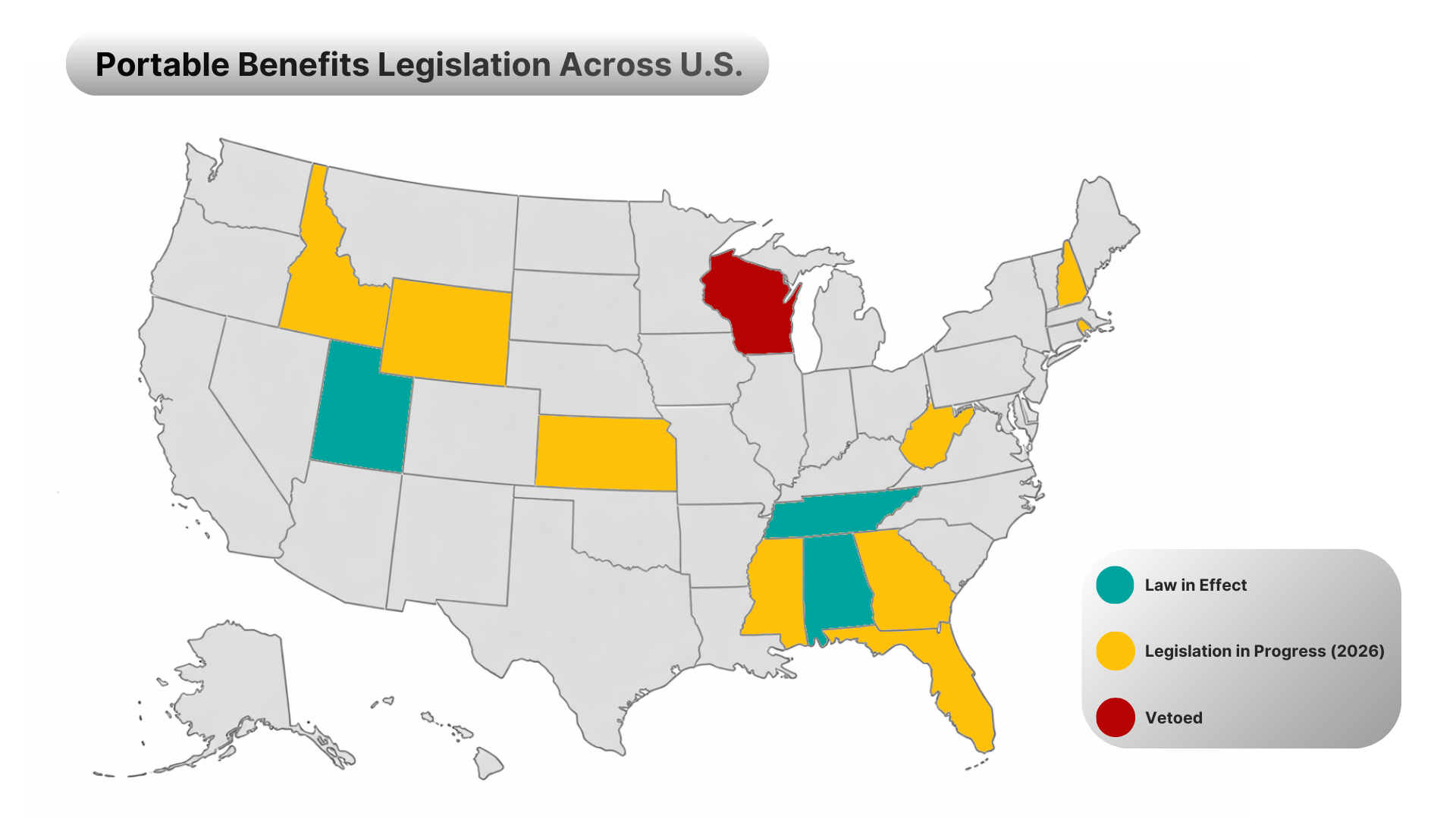
Utah passed the first voluntary portable benefits law in 2023, allowing companies to contribute to worker-owned accounts without triggering reclassification. Alabama and Tennessee followed in April 2025. 

Alabama went further than any state before, creating the nation’s first fully tax-advantaged portable benefits framework. Under SB 86, companies can deduct 100% of their contributions to contractor benefit accounts as a business expense, and workers pay no state income tax on the value received.

In the first month of 2026 legislative sessions, nine states introduced portable benefits bills modeled after the Independent Women’s Forum (IWF) Voluntary Portable Benefits Act: 

  • Florida
  • Georgia 
  • Idaho
  • Kansas 
  • Mississippi 
  • New Hampshire 
  • Rhode Island
  • West Virginia
  • Wyoming

West Virginia’s Governor Patrick Morrisey became the first governor in the country to announce portable benefits as a key legislative priority. And in February 2026, Georgia’s House passed HB 987 with bipartisan support, covering more than one million Georgian independent workers.

What’s Happening at the Federal Level

The pace of state-level action has created pressure for a federal response. 

In July 2025, Senators Bill Cassidy, Tim Scott, and Rand Paul introduced a legislative package with three bills targeting different angles of the problem:

  • The Unlocking Benefits for Independent Workers Act – creates a federal safe harbor so companies can voluntarily offer benefits to contractors without reclassification risk
  • The Modern Worker Empowerment Act – establishes a single, consistent employment test across federal law
  • The Association Health Plans Act – amends ERISA to let gig workers, sole proprietors, and small-business employees pool together for health insurance

On the House side, Rep. Kevin Kiley introduced H.R. 1320, which mirrors the safe harbor approach and has already cleared committee. Whether these bills become law this session remains uncertain, but the legislative infrastructure is further along than ever before.

What Does This Mean for HR and Business Leaders?

Every state is structuring its portable benefits framework slightly differently. 

As mentioned, Alabama offers full tax deductibility. Utah’s model focuses on safe harbor without the tax incentive. Some states are voluntary, while others may eventually explore mandates. 

For multi-state employers, the patchwork is growing. NCSL has flagged that tracking these varying frameworks is becoming a real compliance challenge for HR teams.

Federal legislation, if passed, would simplify compliance by providing a single baseline. Until that happens, HR leaders working across state lines should start mapping which contractor relationships fall under new or proposed portable benefits laws. 

Real-World Pilots Are Showing Promise

The wave of new laws are encouraging, but the real test is whether these policies deliver results.

DoorDash has been running portable benefits pilots in Pennsylvania, Georgia, and Maryland, contributing 4% of pre-tip earnings into worker-owned accounts. 

In Pennsylvania, roughly 4,400 Dashers enrolled, and among those who previously lacked benefits, 89% said the program made them feel more financially secure.

Georgia’s pilot produced similar results. An independent analysis found that about 73% of the roughly 5,500 participating Dashers felt more financially secure, and 91% said they would feel even more secure if the pilot became permanent.

Even at this early stage, the data gives both policymakers and employers tangible evidence that portable benefits can deliver meaningful outcomes.

Where Do ICHRAs Fit In?

Most employers and benefit advisors are already familiar with Individual Coverage Health Reimbursement Arrangements, or ICHRA plans

Available since 2020, ICHRAs let employers reimburse W-2 employees tax-free for individual health insurance premiums and qualified medical expenses. The HRA Council estimates that between 500,000 and one million people were enrolled in ICHRAs and QSEHRAs by 2025. 

So, are ICHRAs and portable benefits the same thing? Not exactly. While ICHRAs and portable benefits may appear similar, they each serve a fundamentally different population.

ICHRAs are designed for W-2 employees and require at least one person on payroll.

Portable benefits target 1099 independent contractors and gig workers who have no employer-employee relationship at all. ICHRAs also focus exclusively on health coverage and medical expenses, while portable benefit accounts can fund a broader range of benefits, including retirement savings, paid time off, life insurance, and disability coverage.

Key Takeaways for 2026

  • Three states (Utah, Alabama, Tennessee) have enacted portable benefits laws. Nine more introduced bills in 2026. Georgia passed its bill in February.
  • Alabama offers the most business-friendly framework: 100% tax deductibility on both sides of the contribution.
  • Federal legislation (S.2210 and H.R. 1320) has advanced further than previous attempts, with bipartisan committee support.
  • Companies using independent contractors should evaluate whether contributing to portable benefit accounts makes strategic sense now.

More Than a Policy Trend

Portable benefits are not a theoretical policy experiment anymore. Three states have enacted laws, nine more introduced bills in early 2026, and federal legislation is further along than any previous attempt.

For HR and business leaders, these changes are worth watching closely. As more states build out their own frameworks, tracking how portable benefits laws affect contractor relationships will become important for workforce planning.

Ultimately, the future of work increasingly requires benefit systems that are as mobile as the people they are intended to protect.

Written by Ivana Radevska

Senior Content Writer at Shortlister

ICHRA Providers

Browse our curated list of vendors to find the best solution for your needs.

Stay Informed

Subscribe to our newsletter for the latest trends, expert tips, and workplace insights!

Related Posts