Monthly Industry Pulse

What Are the 2026 ACA Reporting Requirements?

Higher penalties, stricter accuracy standards, and expanded e-filing define the 2026 ACA reporting cycle.

In This Post:

Compliance fatigue is a real concern, especially when ACA reporting feels like a seasonal chore. Yet the 2026 cycle has a few federal updates that change how employers furnish forms, how penalties stack, and what “affordable” means for plan years beginning in 2026.  

More importantly, the latest updates indicate a meaningful momentum in federal guidance: reduce unnecessary paper, enforce electronic filing, and maintain a penalty structure that is sharp enough to make errors expensive.  

In this article, we explore the most important 2026 ACA reporting changes, why they matter, and how business and HR leaders can stay ahead of compliance errors.

Who Must File ACA Reports in 2026?

The rule remains that Applicable Large Employers (ALEs) – generally those with 50 or more full-time or full-time-equivalent employees – are required to file annual ACA information returns. 

Each ALE must submit Form 1094-C and provide a Form 1095-C for each full-time employee, reporting whether coverage was offered. 

But it’s not only big companies that need to pay attention. Self-insured employers of any size, including those offering level-funded plans or ICHRA plan arrangements, also have ACA reporting duties.

Self-insured employers are required to file Forms 1095-B and 1094-B to report the minimum essential coverage they provide.

Key Deadlines for 2026 Filing Season

Timing is non-negotiable. For the 2025 calendar year (filed in early 2026), mark these dates:

  • Employee Statements (Forms 1095-C/B) – These must be furnished to employees by March 2, 2026. The standard January 31 deadline got a permanent 30-day extension in IRS regulations, effectively making early March the new annual deadline. 
  • IRS Submission (Forms 1094-C and 1095-C/B) – Electronic filings are due by March 31, 2026, while any paper filings (allowed only for very small filers) must be postmarked by February 28, 2026.

Organizations filing 10 or more returns must file electronically. The IRS lowered this threshold in 2024 and expanded electronic filing requirements significantly. Paper filing is now reserved for the smallest employers.

Missing these deadlines triggers automatic penalties. You can request an automatic 30-day extension for IRS filing by submitting Form 8809 before the original deadline. This extension only applies to IRS filing, and not to the employee furnishing deadline.

The Paperwork Burden Reduction Act Changes Distribution

For over a decade, employers mailed paper Form 1095-Cs to every full-time employee. That requirement is now optional. The Paperwork Burden Reduction Act, signed in December 2024, provides an alternative method that dramatically reduces administrative workload.

The New Alternative Furnishing Method

Instead of printing and mailing a Form 1095-C to every full-time employee, employers can now post a notice on their website informing employees that they can request a copy.

To use this option, the notice must be clear and easy to find, posted by March 2, 2026, and remain visible through October 15, 2026. It should include contact information (email, phone, and physical address) and use plain language with a noticeable heading like “Important Health Coverage Tax Documents.”

If an employee requests their form, companies must provide it within 30 days of the request or within 30 days of March 2, whichever is later.

The 2026 Affordability Threshold

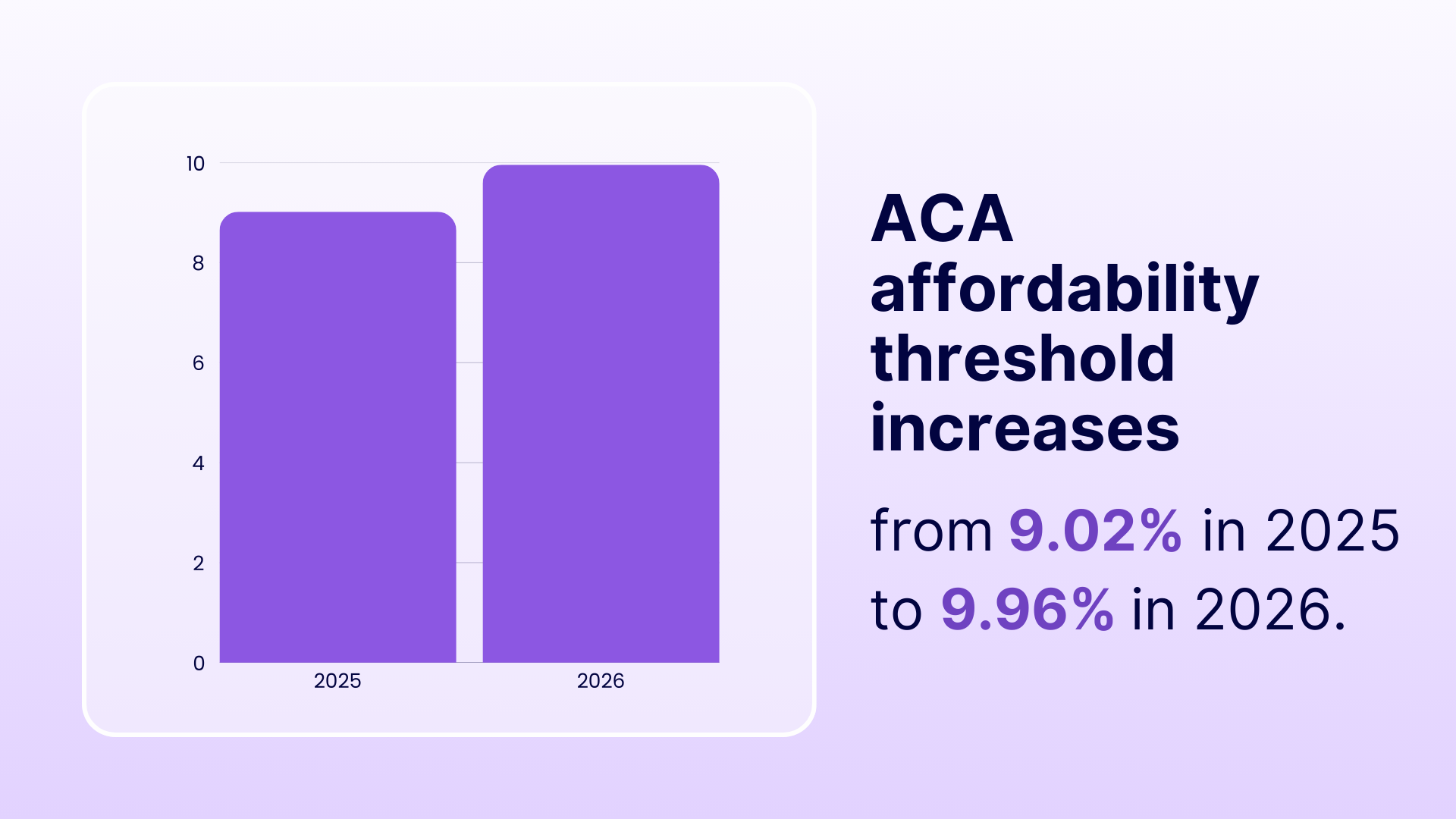
The latest changes bring some good news for employers struggling with healthcare costs. The affordability percentage jumped from 9.02% in 2025 to 9.96% in 2026. The 0.94% increase from 2025 represents the highest affordability threshold ever.

What does 9.96% mean in practice? An employer-sponsored plan is considered “affordable” if the employee’s share of the lowest-cost, employee-only coverage doesn’t exceed 9.96% of their household income. Since employers rarely know employees’ household income, the IRS provides three safe harbors.

The Three Affordability Safe Harbors

Federal Poverty Line Safe Harbor – Offer at least one plan where employee-only coverage costs no more than $129.89 per month. This calculation uses the 2025 FPL of $15,650, multiplied by 9.96%, divided by 12.

Rate of Pay Safe Harbor – For hourly workers, multiply the hourly rate by 130 hours, then by 9.96%. A $20/hour employee’s monthly threshold is approximately $258.96.

W-2 Safe Harbor – The employee’s contribution cannot exceed 9.96% of their Box 1 W-2 wages.

Increased Penalty Amounts for 2026

For 2026, the IRS increased penalty amounts under Section 4980H. According to IRS Revenue Procedure 2025-26:

  • Section 4980H(a) Penalty: $3,340 per full-time employee annually ($278.33 monthly) if you fail to offer minimum essential coverage to at least 95% of full-time employees
  • Section 4980H(b) Penalty: $5,010 per affected employee annually ($417.50 monthly) if coverage is unaffordable or doesn’t meet minimum value

Reporting penalties also increased. Each failure to furnish or file a correct form triggers a $340 penalty per form. Correct errors within 30 days, and the penalty drops to $60. Fix them before August 1, and it’s $130. Willful disregard costs $680 per form with no cap.

In prior years, the IRS would waive penalties if an employer demonstrated good-faith effort to comply, even if there were mistakes. That “good faith” relief officially ended – now penalties will apply for inaccuracies unless you can prove reasonable cause. Even a small typo or data gap could cost you, so diligence is key.

The Six-Year Statute of Limitations

The Employer Reporting Improvement Act established something employers have long wanted: a deadline for IRS penalty assessments. A six-year statute of limitations now applies to the abovementioned Section 4980H penalties.

The clock starts running from the later of your filing deadline or actual filing date. Previously, the IRS claimed no statute of limitations existed. Therefore, employers faced open-ended liability for years-old coverage failures.

There is one important caveat: the new limitation applies only to returns due after December 31, 2024. Older violations remain subject to assessment indefinitely.

What Employers Should Do Now

So, what should employers be doing now to prepare for the 2026 ACA reporting cycle? Here are a few proactive steps to consider:

  • Determine if you’re an ALE for 2025. If you’re not an ALE but you offered self-insured health benefits (including level-funded plans or ICHRAs) in any month, note that you still have federal reporting obligations. 
  • Clearly check the 2026 deadlines for furnishing and filing, and make sure your HR/benefits team knows them.
  • Decide whether you will use the new alternative furnishing method. If yes, work with your IT or web team to create a compliant website notice before March 2, 2026.
  • Take time to review your 2025 records now. Do you have the correct full-time/part-time status tracked for each month for each employee? Verify that your HRIS or benefits system is capturing all the data needed to populate Forms 1094-C/1095-C correctly.
  • Assess whether your internal systems are sufficient to handle the complexity of ACA reporting in 2026. Many organizations find value in using specialized ACA reporting software or outsourcing to compliance vendors. 
  • Train your team so that those involved in ACA compliance (HR staff, payroll, benefits administrators) are up to speed on 2026 changes. Conduct a training session or planning meeting to go over the new deadlines, the furnishing options, the affordability threshold changes, and so on. 
  • ACA forms don’t impact most employees’ day-to-day, but a little communication can go a long way in reducing confusion. If you’re switching to the “on request” method for furnishing 1095-Cs, consider notifying employees.

Conclusion

The 2026 ACA reporting landscape offers both relief and responsibility. 

Legislative changes reduced the burden of distributing forms to employees. The higher affordability threshold and new statute of limitations give employers flexibility and protection in plan design. 

Yet, the core obligations remain. ALEs must offer affordable, minimum-value coverage to full-time employees. Everyone must file accurate forms with the IRS by March 31, 2026. And penalties for non-compliance continue climbing.

As a result, navigating these requirements will require careful attention to detail and proactive planning. 

Written by Ivana Radevska

Senior Content Writer at Shortlister

ACA Reporting Software

Browse our curated list of vendors to find the best solution for your needs.

Stay Informed

Subscribe to our newsletter for the latest trends, expert tips, and workplace insights!

Related Posts