
Retirement and Financial

The Tax Advantages of Corporation Status for Business Owners

What if your biggest tax lever isn’t a deduction but your legal structure?
In This Post:
Expert Contributors:
Picture of David Fritch

David Fritch

Attorney, Fritch Law Office

Picture of Reem Khatib

Reem Khatib

Partner, Tax Law Advocates

Every business owner wants to minimize taxes, but have you considered how your company’s legal structure affects your tax bill? The truth is, the advantages of corporation status can be substantial for the right business. 

In this article, we’ll explore how incorporating can affect your tax burden, when it makes the most sense, and how to avoid common pitfalls.

What is a Corporation?

A corporation is a type of business entity that is legally separate from its owners.

Unlike sole proprietorships where you and your business are legally the same, corporations exist independently. They can enter contracts, own property, and even pay their own taxes.

In addition, a corporation is managed by a board of directors and officers, and it has an indefinite life span independent of its founders.

The phrase ‘incorporate’ is often used to say, ‘to start a business,’ but in law, only corporations are incorporated. 

What Types of Corporations Are There?

In the United States, business owners typically choose between two primary types of for-profit corporations: C corporations and S corporations

Tax Treatment for C Corporations

By default, any new corporation is a C corporation.

A C corporation is taxed as a separate entity and can have unlimited shareholders, including other companies or foreign owners. The corporation pays corporate income tax on its profits at the current federal rate of 21%

However, profits distributed to owners are taxed again as dividends. As a result, C corporations are often said to face “double taxation” under the U.S. tax system.

Tax Treatment for S Corporations

On the other hand, an S corporation is a special status a corporation can elect with the IRS to become a pass-through entity. This means that an S corporation doesn’t pay federal income tax itself, and therefore avoids double taxation. 

Instead, all its profits and losses pass through to shareholders’ personal tax returns, avoiding corporate-level tax. For many small business owners, this is a huge benefit.

The appeal of S corporations is clear: keep the corporate liability protection but get taxed like a smaller entity.

Why Business Structure Shapes Your Tax Bill

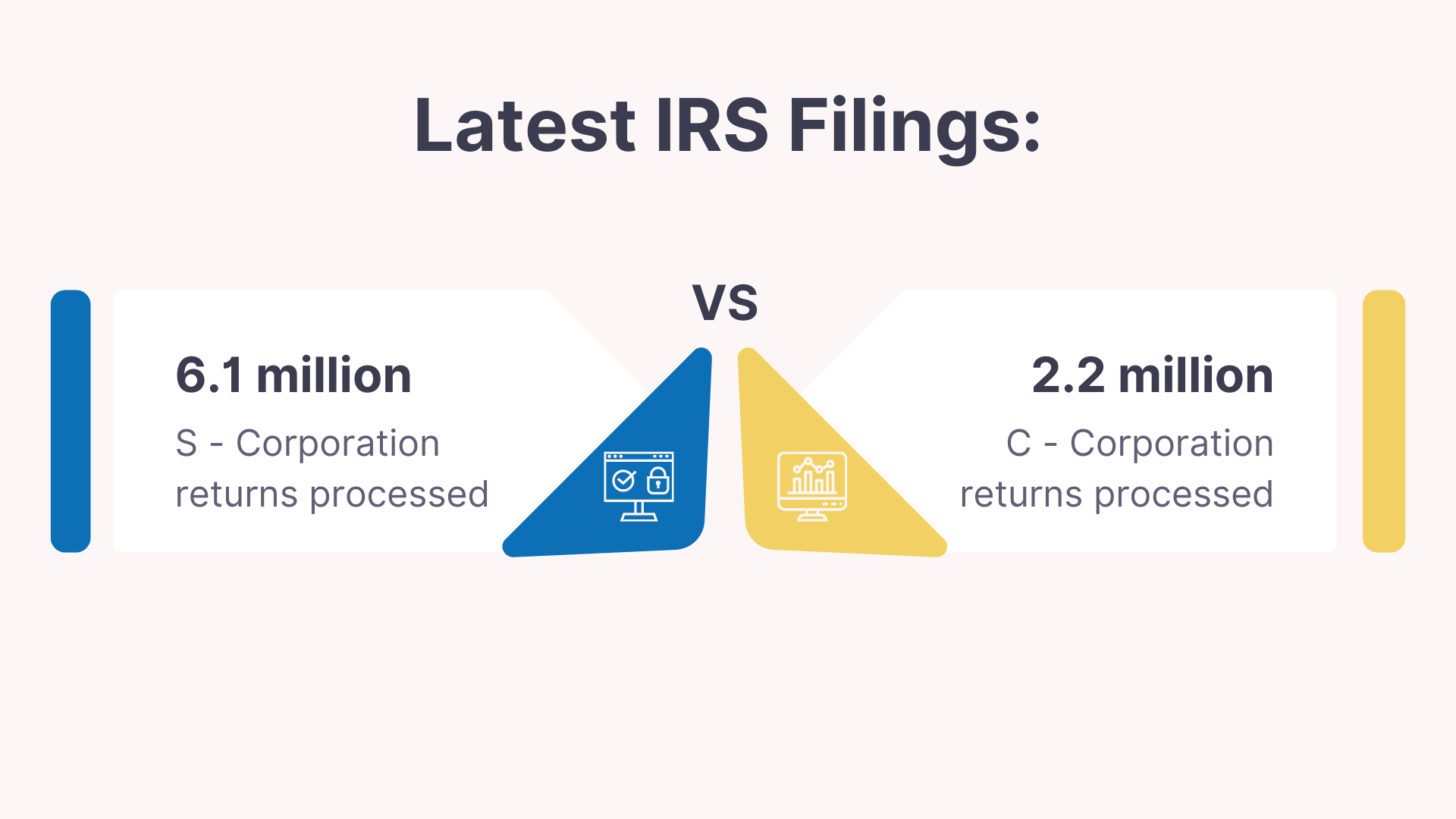
Many owners assume corporations are only for giants like Amazon or Microsoft. In reality, corporations are widespread. In the latest IRS filings, roughly 6.1 million S-corporation returns were processed alongside about 2.2 million C corporation returns.

Even a micro business can change its tax outcome by choosing the right entity. Are you picking the structure that fits how you earn and distribute cash?

Your legal structure dictates who gets taxed, when profits are taxed, and how money leaves the business. Different entities trigger different federal and payroll taxes, which can change your total bill by thousands of dollars, as shown by the table below. 

Topic Sole Prop or Single-Member LLC S Corporation C Corporation
Federal income tax Pass-through to owner at individual rates Pass-through to shareholders at individual rates 21% corporate rate, then shareholders taxed on dividends
Self-employment / payroll tax SE tax on net earnings FICA on reasonable salary; distributions not subject to SE/FICA FICA on wages to owner-employee; dividends not subject to FICA
Fringe benefits for owners Limited as the owner is not an employee; self-employed health insurance deduction may apply Many fringe benefits are taxable to >2% owners; health insurance added to W-2 then deducted on personal return Broadest benefit treatment; many fringe benefits can be tax-free to owner-employees and deductible to the company
Investors and stock N/A Limits: ≤100 eligible shareholders; one class of stock No shareholder limits, multiple classes; VC-friendly
Administrative load Lowest Moderate: payroll services for compensation, S election, compliance Highest: corporate formalities, separate tax return

Main Tax Advantages of a Corporation

So, what are the advantages of a corporation, and why do so many growing companies choose to incorporate? Could incorporating save you a great deal on taxes? 

For many businesses, the answer is yes – especially once they reach a certain stage. Below, we list the core advantages of a corporation business status when it comes to taxes, and why these benefits matter.

1) Low Corporate Tax Rates

One major appeal of the C corporation is the lower flat corporate tax rate

As mentioned, the current federal corporate tax rate is 21%, thanks to the Tax Cuts and Jobs Act of 2017. If your business is doing well, 21% can be significantly lower than the top individual tax rates – which go up to 37% federally, plus state taxes. 

In addition, the corporate 21% rate is permanent under current law. However, the 199A QBI deduction for pass-throughs is scheduled to expire after 2025 barring an extension.

2) Deductible Business Expenses

Every business can deduct ordinary and necessary expenses, but corporations enjoy a few extra deduction opportunities that other entities may not. 

For example, a C corporation may treat most fringe benefits as ordinary business expenses, so the amounts it pays for items such as health coverage, education assistance, retirement contributions, childcare benefits, and similar perks reduce its taxable income.

Rules and caps still apply. The deductible amount can depend on the benefit type, who receives it, and the provisions of the tax code in effect.

For startup costs, any new business can deduct up to $5,000 immediately, reduced when total startup costs exceed $50,000, with the balance amortized over 15 years. Corporations may also deduct up to $5,000 of organizational expenses with the same limits.

3) Retained Earnings for Growth

Here’s where the advantages of a corporation business structure really shine: Corporations can hold profits at lower tax rates for future expansion.

In a pass-through entity, all profits are taxed to the owners in the year they’re earned, whether or not those profits are taken out of the business. 

However, a C corporation allows you to leave profits in the company – perhaps to buy new equipment, open a new location, or simply build up a cash reserve – and only the corporation pays taxes on those earnings. 

David Fritch, Attorney at Fritch Law Office, emphasizes this advantage, stating, “The C-corp’s lower corporate tax rate on reinvested earnings can be a strategic advantage, particularly for large-scale physical expansions or significant real estate holdings.”

There are limits, as the IRS won’t let corporations stockpile earnings purely to avoid shareholder taxes – but for genuine expansion plans, the C corporation structure provides flexibility.

However, C corporations that accumulate earnings beyond reasonable business needs risk a 20% accumulated earnings tax penalty. A commonly referenced threshold is an accumulated earnings credit of $250,000 ($150,000 for certain service corporations).

4) Retirement Plans and Benefits

Corporations offer superior retirement planning options.

Corporations can establish qualified retirement plans, like a 401(k) or pension plan, and health insurance plans that cover employees and owners, often with significant tax advantages. 

For example, if your company sets up a 401(k) plan, you as the owner can contribute pre-tax dollars as an employee, and the company can make matching or profit-sharing contributions that are deductible to the business.

In 2025, the 401(k) employee deferral limit is $23,500, with higher catch-ups for eligible ages and generous combined employer-employee caps. Under section 415 (c), employer and employee contributions are capped at $70,000.

Employer contributions are also deductible to the corporation and help attract and retain talent.

5) Flexible Fiscal Year

Sole proprietorships, partnerships, and most S corporations must follow the calendar year for tax purposes. C corporations, on the other hand, can set their own fiscal year, such as July 1 to June 30. 

This flexibility allows C corporations to time certain payments, like bonuses or dividends, in a way that may reduce overall tax obligations by spreading them across two different calendar years.

When Incorporation Makes Financial Sense

Incorporation comes with administrative costs and added responsibilities, so it’s not a no-brainer for every business from day one. 

The question to ask is: At what point do the tax advantages of corporation status outweigh the extra paperwork and fees? 

The advantages and disadvantages of corporation status shift based on profit levels and growth trajectories.

To put it simply, incorporation pays off when annual profits exceed at least $100,000. Below this threshold, administrative costs often outweigh tax savings. 

So, while the tipping point varies, the following scenarios clearly favor incorporation:

  • Service businesses generating over $150,000 in consistent profits
  • Companies planning to raise outside capital within 2-3 years
  • Businesses accumulating assets or intellectual property
  • Operations with multiple owners requiring structured governance
  • Plans on hiring employees and offering benefits to attract top talent

Reem Khatib, Partner at Tax Law Advocates, offers his advice:

“For businesses planning to scale aggressively, seek outside investors, or eventually go public, a C corp structure is almost always a better fit. An S corp might look attractive in year one when profits are modest, but it can create unexpected tax burdens as retained earnings grow.”

“For businesses planning to scale aggressively, seek outside investors, or eventually go public, a C corp structure is almost always a better fit. An S corp might look attractive in year one when profits are modest, but it can create unexpected tax burdens as retained earnings grow.”

Which Corporate Structure Delivers Better Tax Results?

So, which business structure is better for you – S or C corporation? 

The answer truly depends on your business goals, profit levels, and growth plans. 

Typically, S corps work best for:

  • Service businesses with consistent profitability
  • Owners actively working in the business
  • Companies with simple ownership structures
  • Mature businesses with predictable profits

C corps excel for:

  • Businesses looking for outside investments
  • Companies planning significant asset accumulation
  • Organizations with complex ownership needs
  • Startups anticipating rapid scaling

Common Misconceptions About Incorporation and Taxes

“Incorporating always saves money” ranks as the biggest myth in business structuring. If your business profits are small or you can’t take advantage of the special deductions, the costs of maintaining a corporation might outweigh the tax savings.

As Fritch points out, “The biggest misconception about corporate tax savings is believing the initial election guarantees optimal savings without continuous, active tax planning.”

In practice, you need to stay on top of things like reasonable compensation (for S corporations), deductible expenses, timing of income and deductions (for C corporations maybe using a fiscal year strategically), and changes in tax regulations that could affect your chosen structure.

"The biggest misconception about corporate tax savings is believing the initial election guarantees optimal savings without continuous, active tax planning."

Another dangerous assumption is that S corporation status protects you from taxes.

Khatib shares, “We recently worked with a client who assumed S corp status would ‘shield’ them from higher taxes, but they were shocked when they were taxed on earnings they never actually received in cash.”

Don’t fall for the myth that an S corporation is universally the “best” structure for small businesses. It’s fantastic for some cases, and less ideal for others.

Conclusion

Ultimately, the advantages of corporation status extend well beyond simple tax rate comparisons. When done for the right reasons, incorporating can be a powerful tool for saving on taxes, protecting assets, and positioning your business for growth.

Written by Ivana Radevska

Senior Content Writer at Shortlister

Payroll Companies

Browse our curated list of vendors to find the best solution for your needs.

Stay Informed

Subscribe to our newsletter for the latest trends, expert tips, and workplace insights!

Related Posts