Monthly Industry Pulse

Midyear Benefits Compliance Update for 2026

The second half of 2026 is turning benefits compliance into a vendor, reporting, and plan-design test for employers.

In This Post:

July is when benefits planning begins to show its technical side. Beyond plan design and renewal pricing, employers now have to look closely at the systems, vendors, and reporting processes that will carry their 2026 obligations.

Below is a breakdown of the regulatory developments that matter most heading into the second half of the year, along with what each one requires from benefits administration teams.

The 2027 HSA, HDHP, and ACA Plan Limits

On May 29, 2026, the IRS issued Revenue Procedure 2026-24 with the inflation-adjusted amounts for health savings accounts and high-deductible health plans. Separately, HHS published the 2027 ACA out-of-pocket maximums for non-grandfathered plans via the annual Notice of Benefit and Payment Parameters.

Key 2027 Numbers

HSA contribution limits: Self-only coverage rises to $4,500 (up $100 from 2026). Family coverage rises to $9,000 (up $250). The $1,000 catch-up contribution for individuals aged 55 and older remains unchanged.

HDHP minimum deductibles: Self-only increases to $1,750 (from $1,700). Family increases to $3,500 (from $3,400).

HDHP out-of-pocket maximums: Self-only rises to $8,700 (from $8,500). Family rises to $17,400 (from $17,000).

ACA out-of-pocket maximums (non-grandfathered plans): Self-only jumps to $12,000 (from $10,600). Family jumps to $24,000 (from $21,200). The roughly 13% year-over-year increase is one of the steeper single-year jumps since ACA implementation.

Excepted Benefit HRA maximum: Increases to $2,250 for plan years beginning in 2027, up from $2,200.

Employers offering HSA-eligible plans should begin reviewing plan designs now to confirm that deductibles and out-of-pocket ceilings meet the updated thresholds before open enrollment materials go out.

ACA Employer Penalties Rise for 2027

The IRS included the 2027 ACA employer shared responsibility penalty amounts in Rev. Proc. 2026-22. Both penalty tiers increased substantially.

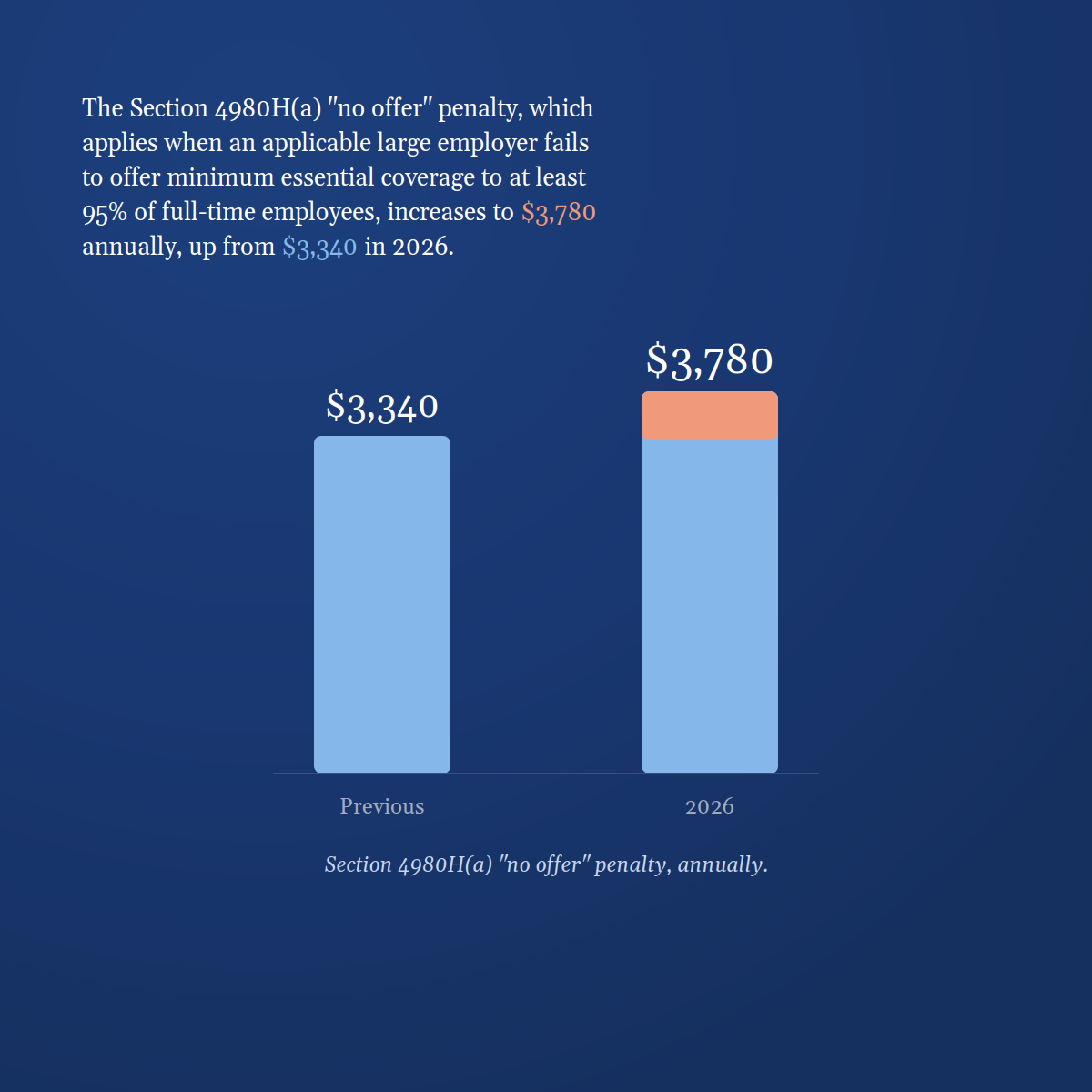
The Section 4980H(a) “no offer” penalty, which applies when an applicable large employer fails to offer minimum essential coverage to at least 95% of full-time employees, increases to $3,780 annually, up from $3,340 in 2026.

The 4980H(b) “inadequate offer” penalty for coverage that is unaffordable or inadequate climbs to $5,670, compared with $5,010 this year. The new amounts raise the stakes of the 2026 ACA reporting requirements, since filing errors and coverage gaps feed directly into penalty exposure. 

However, one figure has not changed. Due to the fall 2025 government shutdown, the Bureau of Labor Statistics could not release the inflation data required for annual penalty indexing, so the Department of Labor will keep 2025 civil penalty amounts in effect for benefit-related violations through 2026.

In addition, the 2027 affordability safe harbor percentage has not yet been released. For 2026, the threshold stands at 9.96% of an employee’s household income.

With penalties continuing to rise, ALEs should audit their benefits administration processes and confirm that coverage offerings meet affordability standards.

A Final Rule for the No Surprises Act Arbitration Process

The No Surprises Act protects patients from surprise out-of-network bills and channels the resulting payment fights into a process called Independent Dispute Resolution. However, the system had logged more than 5 million disputes since its April 2022 launch, far exceeding federal projections and creating widespread delays.

On May 28, 2026, the Departments of Health and Human Services (HHS), Labor, and the Treasury published a final rule overhauling the federal independent dispute resolution process.

What Changed

The most visible change is the cost – the administrative fee drops to $15 per party per dispute, down from $115, for disputes initiated on or after June 11, 2026.

Beyond the pricing, the rule establishes several procedural changes:

  • Payers must register with the agencies and receive a unique IDR identification number.
  • Certified entities must decide eligibility within five business days of selection.
  • Payers must use standardized claim codes to flag whether a claim falls under the surprise-billing rules.
  • Providers can open negotiations through the federal portal before filing a dispute.

2027 NBPP Final Rule and the Marketplace Shift

On May 15, 2026, CMS issued the final 2027 Notice of Benefit and Payment Parameters (NBPP). While the NBPP primarily targets the ACA Marketplace, the rule carries two indirect implications for employer-sponsored coverage.

First, CMS relaxed some federal limits on standardized plan designs, permitting broader non-standardized and catastrophic-style, lower-premium options on the individual market. More affordable Marketplace plans could prompt some employees, especially lower-wage or younger workers, to consider individual coverage over employer plans. 

Second, CMS strengthened income and eligibility verification for Advance Premium Tax Credit (APTC) eligibility, which may reduce incorrect subsidy determinations that have historically triggered inaccurate employer penalty assessments.

Meanwhile, ACA Marketplace enrollment declined by 4.9% for 2026, closing at 23.1 million enrollees after the enhanced subsidies expired at the end of 2025. The drop was the largest year-over-year decline since the Marketplace launched.

Midyear Deadlines - PCORI Fees & Form 5500

Two July 31 deadlines deserve a place on every benefits calendar.

First, sponsors of self-funded health plans must report and pay the Patient-Centered Outcomes Research Institute (PCORI) fee using the second quarter IRS Form 720. 

Under IRS Notice 2025-61, the fee is $3.84 per covered life for plan years ending between October 1, 2025, and December 31, 2025, which includes all calendar-year 2025 plans. Plan years ending earlier in 2025 owe $3.47 per covered life.

Second, calendar-year ERISA plans must file Form 5500 by July 31, 2026, unless they secure a two-and-a-half-month extension via Form 5558. Carriers handle PCORI for fully insured plans, but the Form 5500 obligation remains with the plan administrator regardless of funding.

On a Final Note

The volume of guidance released in late May and early June alone, from IDR overhaul to 2027 limits to escalating ACA penalties, indicates that the second half of the year will demand careful attention from benefits teams. For employers still setting up their compliance calendars, July 31 is the first hard deadline on the board.

Written by Ivana Radevska

Senior Content Writer at Shortlister

Benefits Administration Companies

Browse our curated list of vendors to find the best solution for your needs.

Stay Informed

Subscribe to our newsletter for the latest trends, expert tips, and workplace insights!

Related Posts