Monthly Industry Pulse

How an Extended Government Shutdown Impacts Employers and HR

As the U.S. government enters a shutdown now tied for the second‑longest in modern history, employers face mounting compliance delays, payroll complications, and workforce uncertainty.
In This Post:

The government shutdown of 2025 has now become one of the three longest funding lapses in modern U.S. history. 

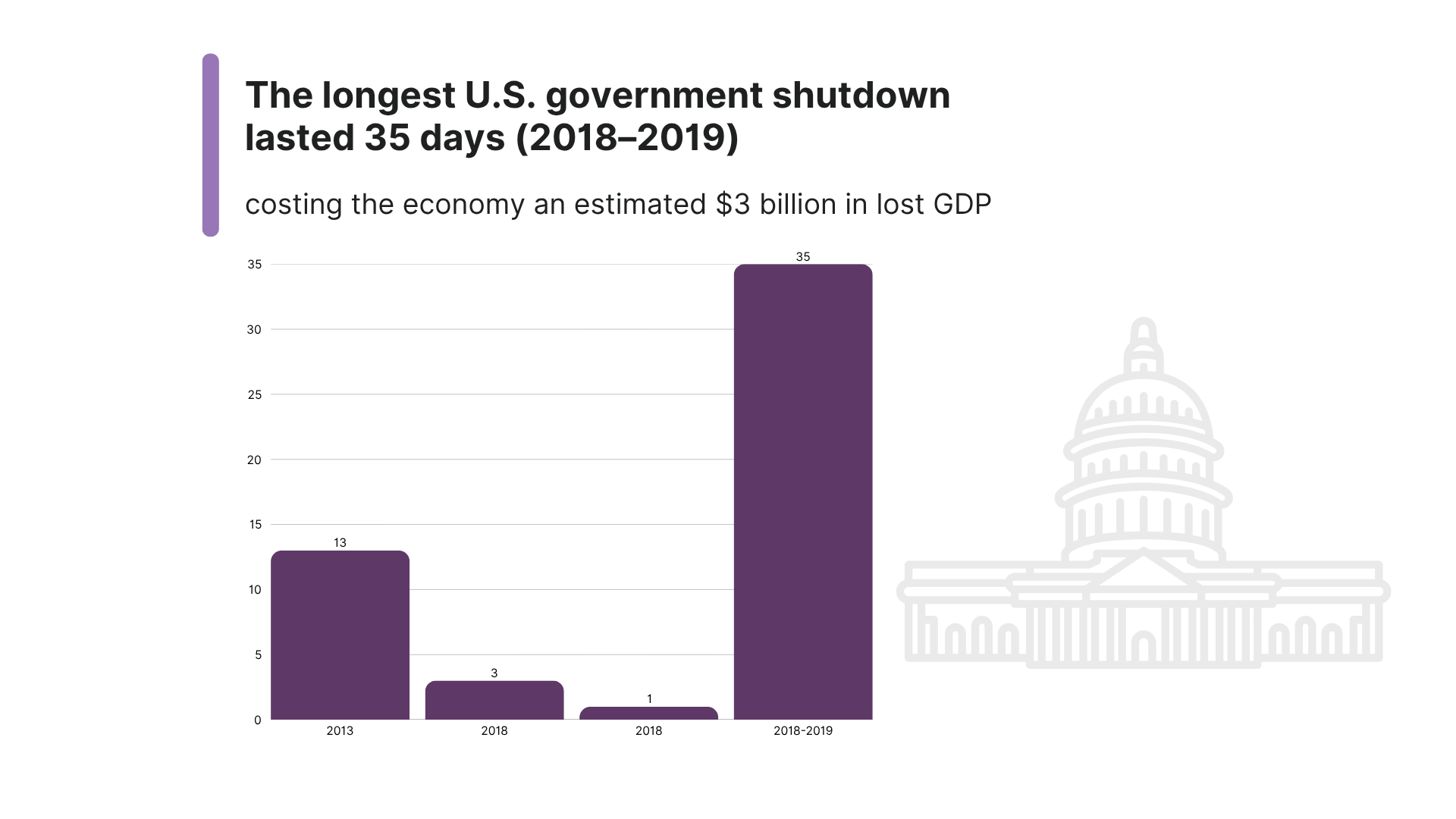
Historical patterns reveal that shutdowns can extend for significant periods. In fact, three of the last four federal shutdowns lasted more than a week, with the longest continuing for 35 days in 2018–2019. That record-setting shutdown cost the U.S. economy an estimated $3 billion in lost GDP. 

For employers and HR leaders, an extended government shutdown introduces prolonged uncertainty and operational challenges that call for strategic foresight and preparedness.

Understanding the Current Shutdown

The current government shutdown began at 12:01 A.M. on October 1, 2025, after Congress missed the fiscal year deadline without passing either a budget or a continuing resolution.

Under federal law, no government spending can occur without a budget approved by Congress. When lawmakers fail to pass appropriations or a temporary stopgap measure, federal agencies must suspend all “non-essential” operations until new funding is authorized.

So far, the Senate has failed to advance a funding bill thirteen times, leaving federal operations in limbo. Thousands of federal employees have received layoff notices as the administration carries out reduction-in-force (RIF) actions. 

However, a federal judge in San Francisco temporarily blocked the Trump administration’s latest round of layoffs at over 30 federal agencies, pausing further cuts for now.

The Far-Reaching Cost of a Government Shutdown

Shutdowns are not confined to Washington. It’s easy to assume that only federal agencies are impacted, but the consequences often extend well beyond government walls. 

SHRM data reveals that while up to 860,000 federal employees face daily furloughs, cascading effects can be felt across businesses and communities nationwide. Contractors, suppliers, universities, hospitals, and local governments feel the strain, and households lose income.

Even a brief shutdown of one to three days could disrupt daily operations for 25% of organizations and put 23% of their annual financial goals at risk.

Research shows 89% of workers believe their communities would be affected by the shutdown, threatening the livelihoods and stability of millions and leaving families to cope with growing uncertainty and shrinking support systems.

Economic Impact Across Industries

The impact across industries isn’t evenly distributed.

Travel and tourism face outsized losses. The U.S. Travel Association estimates about $1 billion in weekly losses as people cancel trips to national parks, historic sites, and Washington, DC. Venues such as the Smithsonian museums and the National Zoo are closed to visitors.

Small businesses are also facing mounting pressure as federal funding and loan programs remain frozen.

Per the U.S. Chamber of Commerce, the SBA typically backs roughly $860 million in loans each week for about 1,600 firms, but new lending is paused during the shutdown. Flood insurance issuances and renewals are also on hold, slowing home closings and real estate deals. 

Aviation is strained by staffing gaps. The FAA reports air traffic controller shortages from Boston and Philadelphia to Atlanta and Houston, triggering delays that have spread to airports including Nashville, Dallas, and Newark.

These macroeconomic ripple effects eventually land in HR’s hands, reshaping compliance timelines, changing payroll services routines, and workforce confidence.

How is the Government Shutdown Impacting Employers?

An extended shutdown can affect employers in both obvious and unexpected ways. 

Compliance and Regulatory Slowdowns

Over the last four weeks, federal agencies critical to HR operations have drastically reduced their functions.

The EEOC has suspended new investigations and mediations, while the NLRB has paused case handling and elections, continuing only emergency actions.

The Department of Labor has suspended operations across most key divisions, pausing the processing of Labor Condition Applications (LCAs), prevailing wage determinations (PWDs), and PERM labor certification filings. 

Workplace safety inspections, except for emergencies, have essentially stopped.

What does this mean for your pending compliance issues? Consider these immediate impacts:

  • EEOC compliance: New discrimination complaints can be filed, but investigations won’t move forward until the government reopens
  • Union elections: All NLRB elections are postponed indefinitely
  • OSHA inspections: Only imminent danger situations receive attention
  • Wage and hour guidance: No new interpretations or opinion letters

In addition, federal courts lost funding for full operations on October 20, with judges continuing to serve with pay while 33,000 court staffers either perform limited tasks unpaid or face furlough.

As the funding freeze enters a critical fourth week, delays in civil litigation will compound other business disruptions.

Payroll, Benefits, and Financial Operations

The shutdown creates immediate cash flow concerns for businesses, particularly federal contractors. Unlike furloughed federal employees who receive guaranteed backpay, contractor employees have no such assurance.

Moreover, the Affordable Care Act marketplace opens for enrollment on November 1, but with the current shutdown and the ongoing political battle over ACA subsidy extensions, employers face much uncertainty about their benefits strategies.

Similarly, while electronic tax filings continue, the IRS cannot process paper documents or respond to taxpayer inquiries after its initial five-day operating period using special funding. 

Employers awaiting guidance on complex tax matters face indefinite delays.

Immigration and Workforce Authorization

The E-Verify system had been unavailable since the start of the 2025 federal government shutdown on October 1. 

On October 9, the U.S. Citizenship and Immigration Services (USCIS) confirmed that E-Verify became operational again as of October 8, allowing employers to resume verifying new hires’ work eligibility, resolve pending cases, and manage compliance duties.

Beyond E-Verify, the government freeze has caused ripple effects across immigration processes. USCIS announced it may excuse late filings for certain visa petitions, such as H-1B, H-2A, H-2B, and CW-1, if delays were directly caused by the shutdown or the inability to secure necessary labor condition approvals. 

Employers facing missed deadlines are advised to document how the closure disrupted their submissions and be prepared to justify the delay once operations stabilize.

Key Takeaways for Employers

  • Stay Informed & Document – Check credible updates on the shutdown’s status and any regulatory announcements. If a compliance task becomes impossible due to agency closure, document the issue thoroughly and seek legal counsel on how to proceed.
  • Maintain Compliance – Keep fulfilling all legal duties and deadlines despite the shutdown. Laws like the ACA employer mandate, OSHA safety requirements, and payroll tax obligations remain in force, even if federal agencies aren’t fully staffed.
  • Track Agency Status Changes – Monitor DOL, EEOC, NLRB, and OSHA updates and prepare for a post‑shutdown backlog of investigations, filings, and audits.
  • Adapt HR Operations – If you’re in the middle of open enrollment or year-end benefits planning, double-check that you’re not waiting on a delayed government update. Be ready to use alternative procedures or make judgment calls in the absence of normal agency guidance.
  • Support Your Workforce – Your employees may feel anxious or financially strained, especially if they have family members out of work due to the shutdown. Remind staff about any mental health or financial wellness resources available, such as Employee Assistance Programs (EAPs) or hardship loans.
  • Plan with Limited Data – Delays in key economic indicators from Labor and Commerce complicate budgeting, merit cycles, and demand forecasts.

Moving Forward

The current shutdown reveals how deeply federal operations intertwine with private sector success. From the smallest contractor to the largest corporation, no business remains untouched by such disruptions.

Ultimately, employers can stay operational, but friction grows by the day. The question isn’t whether your organization will be affected, but how well you can navigate and position yourself for the inevitable post-shutdown challenges ahead.

As the government shutdown of 2025 continues to unfold, staying informed, maintaining flexibility, and supporting your workforce remain your best strategies for weathering this government disruption.

Written by Ivana Radevska

Senior Content Writer at Shortlister

Payroll Companies

Browse our curated list of vendors to find the best solution for your needs.

Stay Informed

Subscribe to our newsletter for the latest trends, expert tips, and workplace insights!

Related Posts

What is Retro Pay?

When payroll errors can happen, there are ways for employees to get their money from the employer. Discover what retro pay is, how it happens, the differentiation from back pay, and its effect on taxes.

Paylocity competitors

Best Paylocity Competitors & Alternatives in 2025

Paylocity has secured a spot as one of the top payroll providers thanks to its convenience and comprehensive features. However, as companies’ needs evolve, we explore Paylocity alternatives and competitors that stay current with these changes.

What is the Federal Minimum Wage?

While the federal minimum wage sparks a debate about whether or not it needs to be increased, one thing is certain – business owners must stay up-to-date with the latest labor law changes.