How Professional Employer Organizations Can Help Mitigate Risk in the Workplace
As there’s no such thing as a perfect or risk-free work environment, can PEOs benefit companies in managing threats, and to what extent?

Firing someone is rarely easy. However, getting sued for it is an entirely different level of risk.
Every year, thousands of employers face wrongful termination claims that have severe financial and non-economic consequences for companies.
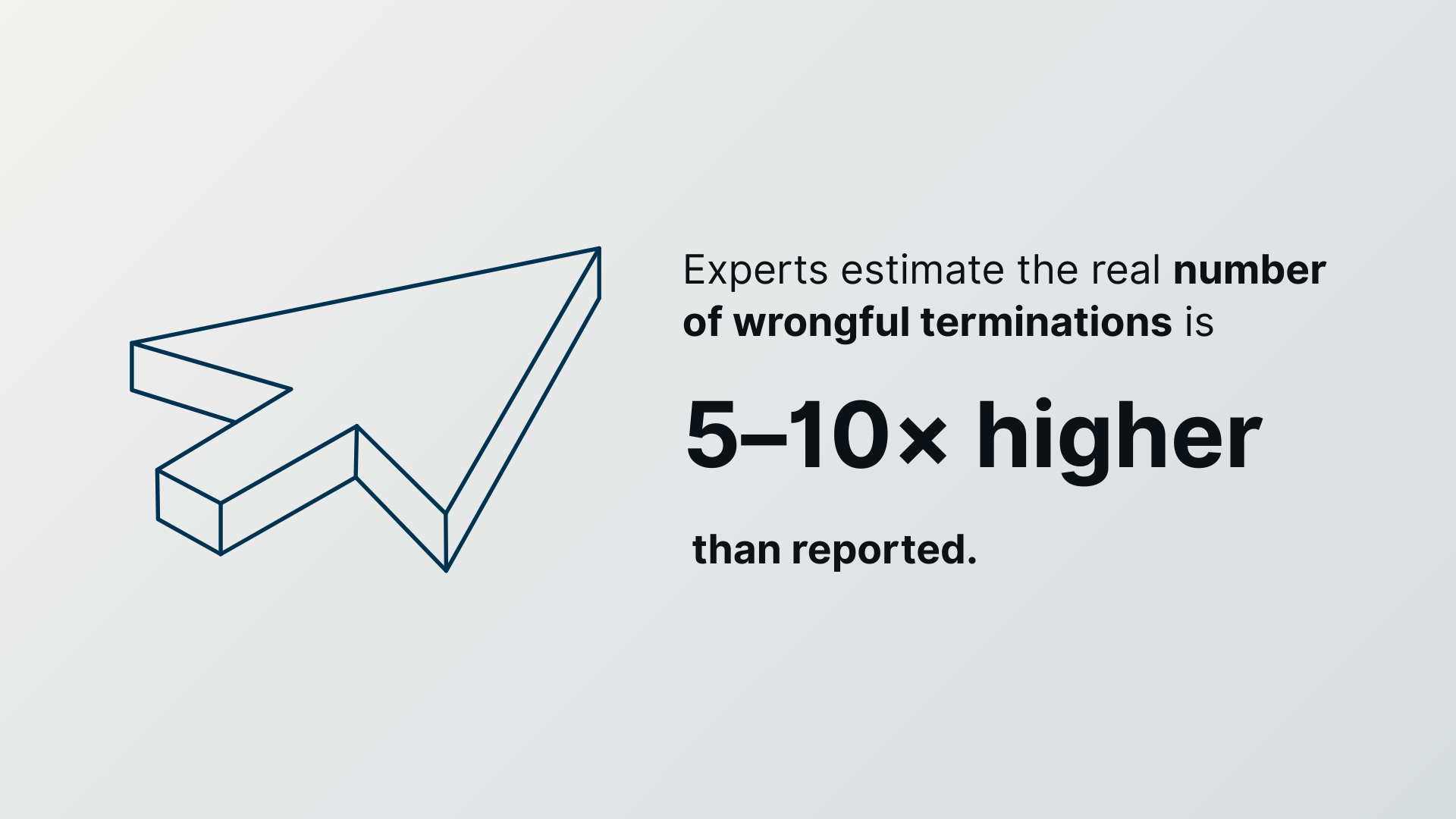
Interestingly, employment law experts estimate that the actual number of wrongful terminations could be five to 10 times higher than the number of formal claims filed, as many employees fear retaliation, lack resources, or don’t realize their dismissal was illegal.
So, how can companies address a disciplinary infraction without inviting legal trouble?
To begin with, what is a disciplinary infraction? It’s important to understand what one looks like and all that it entails.
Every organization has standards of behavior and performance that employees are expected to follow. A disciplinary infraction refers to any violation of those established rules or policies by an employee.
It could be as minor as being late to work or as serious as violating safety protocols. When an infraction occurs, employers initiate disciplinary actions to correct the behavior.
Clear examples reduce manager improvisation and help them understand the line between “coachable” and “terminable.” Consider organizing examples in your policy by category:
Have you ever been frustrated by a rule you didn’t know existed? Now, imagine losing your job over it.
Ambiguity in workplace policies is a bad practice that often leads to worse outcomes.
Unfortunately, research from PwC found that 78% of companies lack processes for staff to appeal or question management decisions, and 63% report that bosses rarely encourage open communication.
When employees don’t understand expectations or feel unheard, these misunderstanding can lead to resentment, and litigation becomes more likely.
In other words, having company policies in place and establishing employee handbooks protects the company from lawsuits. It also protects employees from discrimination or wrongful termination claims.
Not all infractions demand the same response. The disciplinary actions have a spectrum from gentle correction to immediate termination, and matching the response to the offense is where many employers struggle.
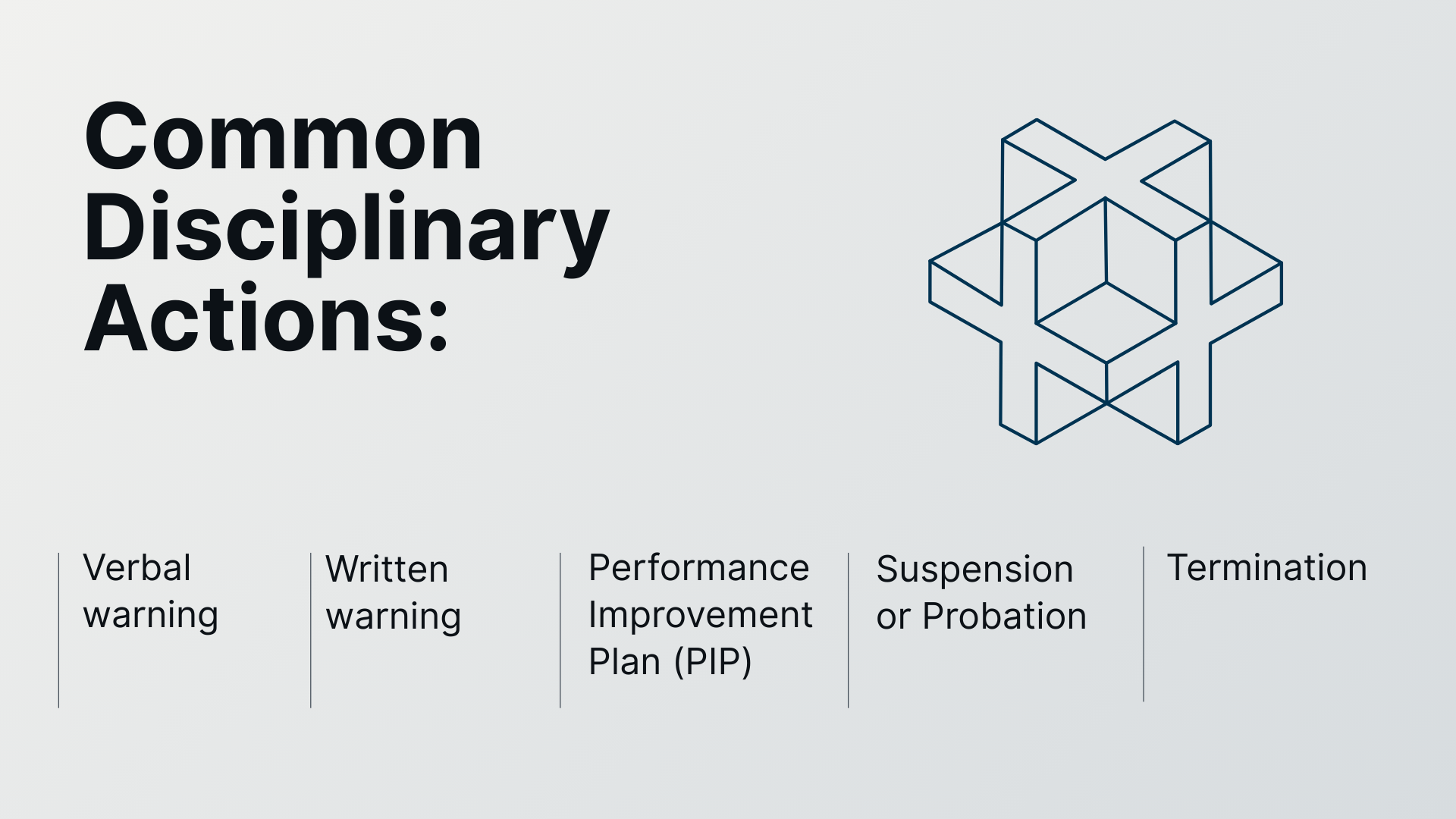
Common disciplinary action examples include:
Each of these actions should be clearly described in your company’s disciplinary policy. For example, many organizations use a progressive discipline model – escalating from a verbal warning up to termination – to give employees opportunities to improve.
While firing on the spot might seem like the quickest way to deal with a problem employee, it’s also the fastest route to a lawsuit. No organization is immune to wrongful termination claims, and the fallout is rarely contained within the courtroom.
But when exactly does a termination cross the line into “wrongful”?
At-will employment isn’t the same as anything-goes employment. While most U.S. states allow employers to terminate workers without cause, terminations become wrongful when they violate federal or state laws, contractual agreements, or public policy.
If an employee is let go due to their race, gender, age, disability, or other protected characteristic, that would be considered illegal discrimination. If they’re fired for reporting harassment, safety violations, or another protected activity, that would be considered retaliation – another major source of claims.
For example, a Chipotle manager with 14 years of positive performance reviews was fired for allegedly stealing $636 from a safe – but the accusation came shortly after she filed a workers’ compensation claim and took pregnancy leave. A jury awarded her approximately $8 million after finding the theft allegation was a pretext for retaliation.
Similarly, not following your own stated disciplinary policy can expose you to breach-of-contract allegations. For example, if your handbook promises a sequence of warnings but a manager skips steps, a court might find the firing wrongful despite the at-will status.
In short, terminations tied to misconduct or performance are generally lawful, but how you execute the process can make all the difference.
Wrongful termination claims carry many costly business risks. The U.S. Equal Employment Opportunity Commission (EEOC) recovered nearly $700 million for victims of discrimination in 2024, the highest monetary recovery in its recent history.
Among the claims, retaliation is the most frequently cited issue for the 17th consecutive year.
For employers, the financial consequences of such legal battles can be severe.
Research shows that wrongful termination settlements average roughly $48,800 when employees have legal representation, while defense costs alone can exceed $250,000 per case.
Although many out-of-court settlements fall between $5,000 and $80,000, around 10% of cases result in verdicts of $1 million or more, particularly when discrimination is involved.
In addition to these direct costs, a wrongful termination claim can impact employee trust, affect external credibility, and consume executives’ attention during litigation.
How confident are you that your company’s disciplinary process would hold up under legal scrutiny? To increase that confidence, consider the following best practices that exemplify a fair and defensible approach.
Vague policies inevitably lead to arbitrary enforcement. Your employee handbook should define disciplinary infractions and misconduct with specific examples and list corresponding consequences. What constitutes insubordination? Where’s the line between constructive feedback and harassment?
Modern HRIS systems can help centralize and distribute these policies, track acknowledgments, and provide easy reference for managers. When policies live in a shared system rather than a forgotten binder, compliance becomes simpler.
In addition, employers must review their handbook annually with legal counsel. Workplace laws change, norms shift, and what protected you in 2020 may expose you today.
Consistency is the key to fairness. If John received a verbal warning for chronic lateness while Sarah was fired for the same behavior, you’ve handed Sarah’s attorney the beginning of a discrimination claim.
To avoid this, apply your disciplinary procedures uniformly across the organization. This doesn’t mean every context is identical, but the standard should be the same.
If your policy says a first offense gets a warning, then every employee should get that warning for a first offense.
Consistency also means being mindful of unconscious biases in the workplace. Are high performers given more leeway than others? Are there patterns where one manager is more strict, while another is more lenient?
If you spot such disparities in how different managers handle similar situations, address them immediately before they become evidence.
Rather than jumping straight to termination for all but the worst offenses, most experts advocate a progressive discipline approach, and doing so serves two purposes:
First, it shows the employee that you’re invested in their success by not firing them at the first mistake. Second, it creates a clear record that the company acted reasonably, which becomes critical evidence if a termination is later challenged.
For these reasons, documentation at each stage is essential. Every warning or disciplinary meeting should be noted – what the issue was, what guidance was given, and what the expectations are going forward.
Weak or non-existent records leave room for doubt and “he said, she said” scenarios, which opens the door for claims.
When an employee commits a serious infraction or is a chronic problem, it can be tempting to fire them on the spot out of frustration. However, these rash decisions are often regretted later. It pays to slow down and assess the situation thoroughly before terminating anyone.
Employers must thoroughly investigate: What exactly happened, and have you investigated the incident objectively? What do the company’s policies and past practices dictate in this scenario?
Consult with HR and, if the situation is legally sensitive, with legal counsel. In short, never let anger or urgency drive a termination decision.
No employee should walk into a termination meeting surprised that they’re being fired. If an employee is genuinely caught off guard by a firing, it often means the communication along the way wasn’t clear enough.
To avoid this, managers should provide regular feedback and coaching, rather than waiting until issues escalate.
When expectations are clear from the start and consistently reinforced, disciplinary conversations become collaborative rather than confrontational.
How you handle the disciplinary process – especially how you fire someone – can influence whether an ex-employee decides to sue.
Public humiliation, escorted walkouts in front of colleagues, or dismissive treatment during exit conversations can make a bad situation worse.
If the employee feels they were treated unfairly or as if they were disposable, they may seek revenge through legal channels out of anger.
On the other hand, if you show genuine respect – thanking them for their contributions, expressing regret that things didn’t work out, and treating them like an adult – it can defuse some of their anger.
Your policies are only as effective as the people enforcing them. Most wrongful termination claims stem not from executive decisions but from frontline managers who weren’t equipped to handle difficult situations properly.
Studies indicate that organizations investing in manager training have a 50% higher employee satisfaction rate. Training should cover documentation requirements, legal boundaries, bias awareness, and communication techniques for difficult conversations.
In addition, don’t make training a one-time event. Regular refreshers, scenario-based workshops, and the right HR software tools can ensure managers stay sharp.
Finally, know when to seek expert advice. Some situations are straightforward, but many live in a gray area.
Perhaps the employee about to be fired has recently complained about overtime pay, or they belong to a protected class and the timing could look suspicious. In scenarios like these, a brief consultation with an HR professional or an employment attorney can be invaluable.
Don’t hesitate to tap into their expertise – it’s often far cheaper to spend an hour consulting upfront than to spend months fighting a lawsuit later.
Wrongful termination claims aren’t inevitable – in fact, they’re preventable. With proper documentation alone, case success rates drop from 63% to just 28% for employees.
The right policies, training, and tools don’t just protect your organization, they create a fairer workplace for everyone.
Below are answers to the most common disciplinary infraction questions, including how to define disciplinary infractions, examples, and when termination is on the table.
A disciplinary infraction is any violation of an employer’s workplace rules, policies, or code of conduct. Infractions can involve attendance, performance, safety, conduct, or ethics.
Common examples include repeated tardiness, insubordination, time theft, violating safety protocols, harassment, falsifying records, and misuse of company property.
Typical actions include verbal warnings, written warnings, performance improvement plans, suspension or probation, and termination. Many employers use progressive discipline to escalate consequences.
Yes, when the infraction is severe (violence, theft, serious safety violations) or when policy allows. Risk rises when termination is inconsistent with prior practice or when documentation is weak.
Senior Content Writer at Shortlister
Browse our curated list of vendors to find the best solution for your needs.
Subscribe to our newsletter for the latest trends, expert tips, and workplace insights!
As there’s no such thing as a perfect or risk-free work environment, can PEOs benefit companies in managing threats, and to what extent?
Managing a contingent workforce is inherently complex, but the right tools can turn the unpredictable nature of external talent into a controlled and purposeful operation.

Growth rarely follows a straight path, and workforce needs evolve with each turn. Understanding when, why, and how to evaluate the staffing needs of a growing company becomes crucial in securing its continued expansion.
When managing benefits goes wrong, even minor administrative oversight can lead to major consequences, making employee benefits liability coverage essential to risk management strategies.
We're working hard to make it easy for you. Sign up for news, trends and insights.