Fraternization in the Workplace
Is workplace fraternization a recipe for disaster or a catalyst for a stronger work culture? The answer isn’t black and white.
Earlier this year, Cambridge expanded its lexicon with more than 6,000 new words and phrases, including “work spouse” and “work wife”, which are terms used to describe a close but platonic relationship between colleagues.
It’s a phenomenon that has become so widely accepted, yet it opens a Pandora’s box of workplace dynamics.
Are close friendships and office romances a recipe for disaster, or a catalyst for a stronger workplace culture?
The answer isn’t black-and-white, but one thing is clear – no organization can afford to ignore the potential consequences of fraternization in the workplace.
What is fraternization in the workplace?
In simple terms, it refers to personal relationships at work that cross professional boundaries.
The fraternization meaning in a business context encompasses everything from close friendships to romantic or family relationships between colleagues.
For example, a manager who constantly socializes with certain team members outside of work might be viewed as fraternizing if it leads to cliques or unfair treatment.
Not all personal bonds are problematic – humans are social by nature, and positive relationships can boost morale.
However, fraternization typically refers to situations where personal feelings could influence professional judgment or create a perception of bias.
It’s easy to see why personal relationships develop at work. Employees spend a large portion of their lives on the job, approximately 90,000 hours over a lifetime, according to some estimates.
Shared projects, late nights, and common goals can naturally create some closeness.
A plethora of research supports this idea.
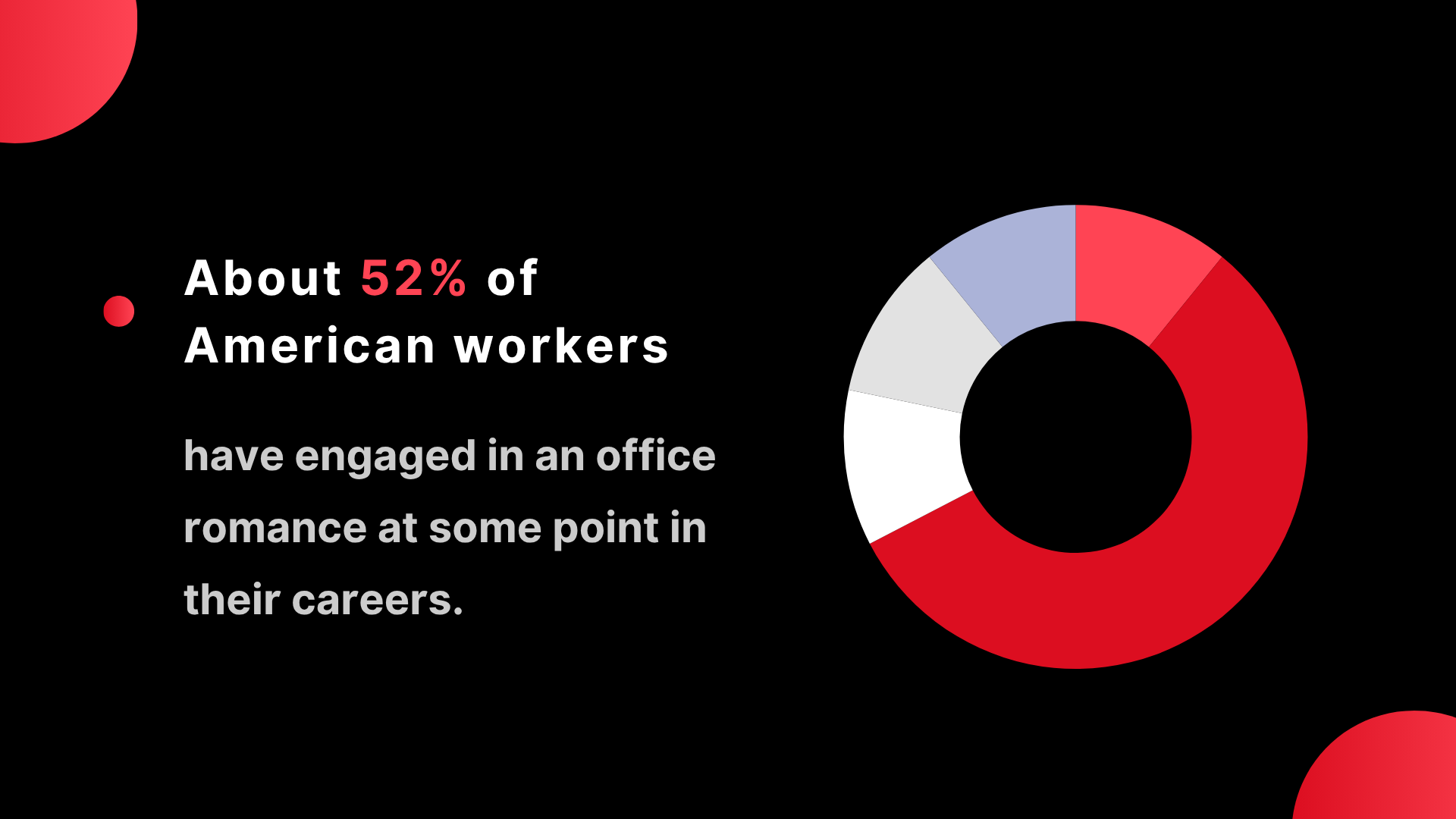
Studies suggest that nearly half of all employees have been involved in a workplace romance at some point. In the U.S. specifically, SHRM’s recent survey indicates that about 52% of American workers have engaged in an office romance at some point in their careers.
But what happens if we take everyday proximity out of the equation?
While one might assume that remote work would reduce office romances, the opposite proved true. SHRM’s research found that workplace relationships actually increased during the pandemic, even as many employees worked from home.
The work-from-home era likely accelerated the blurring of personal and professional boundaries, along with a loosening of traditional corporate norms around behavior, workplace attire, and communication.
That said, the recent trend of close workplace relationships isn’t exactly a problem in every setting.
In some high-risk industries, fraternization is a particularly troublesome issue.
Take the military, healthcare, or aviation: strict hierarchies mean any fraternizing in the workplace between ranks is explicitly forbidden, with serious penalties for infractions.
The stakes are high because a personal relationship in these fields can undermine the chain of command and affect safety and discipline.
The education sector is similarly sensitive. For example, teacher-student relationships have prompted many schools to implement zero-tolerance fraternization policies to protect minors.
This concern has recently moved into the C-suite, where relationships are increasingly viewed as governance risks.
Over the last few years, we have seen a string of high-profile CEO exits across industries due to undisclosed workplace relationships.
Just a few months ago, Astronomer’s CEO and the firm’s Chief People Officer (head of HR) made headlines after a viral incident at a Coldplay concert, which ultimately led to both stepping down from their roles.
In 2023, energy giant BP’s CEO Bernard Looney stepped down after failing to fully disclose past relationships with colleagues. Major firms like McDonald’s, Intel, and CNN have also seen leaders exit over policy-breaching romances.
These examples show that fraternization isn’t just a theoretical HR issue, but a very real workplace ethics problem that can trigger public scandals, legal action, and leadership crises.
Every office romance or close friendship starts out innocently enough.
However, fraternization in the workplace can carry significant risks for both employees and organizations. So, while smart companies don’t want to play morality police, they also can’t ignore the potential risks.
Below, we list some of the key risk areas that HR and leaders should monitor.
One of the most obvious concerns with workplace fraternization is an asymmetric power dynamic that creates an environment where true consent becomes questionable. When a relationship involves different levels of seniority, such as a manager dating a direct report, complications multiply.
Will other team members suspect the subordinate is getting special treatment? Will colleagues feel they have equal access to opportunities and feedback?
Even if no special treatment is given, the inherent imbalance of power will still raise many questions.
The subordinate’s achievements may be minimized, with comments like, “She only got that project because she’s close with the boss.” While the manager’s impartiality will constantly be questioned, and perceptions of fairness across the team can quickly erode.
Fraternization often walks hand-in-hand with conflicts of interest. It could range from a partner or friend being granted leniency on deadlines to being fast-tracked for a promotion.
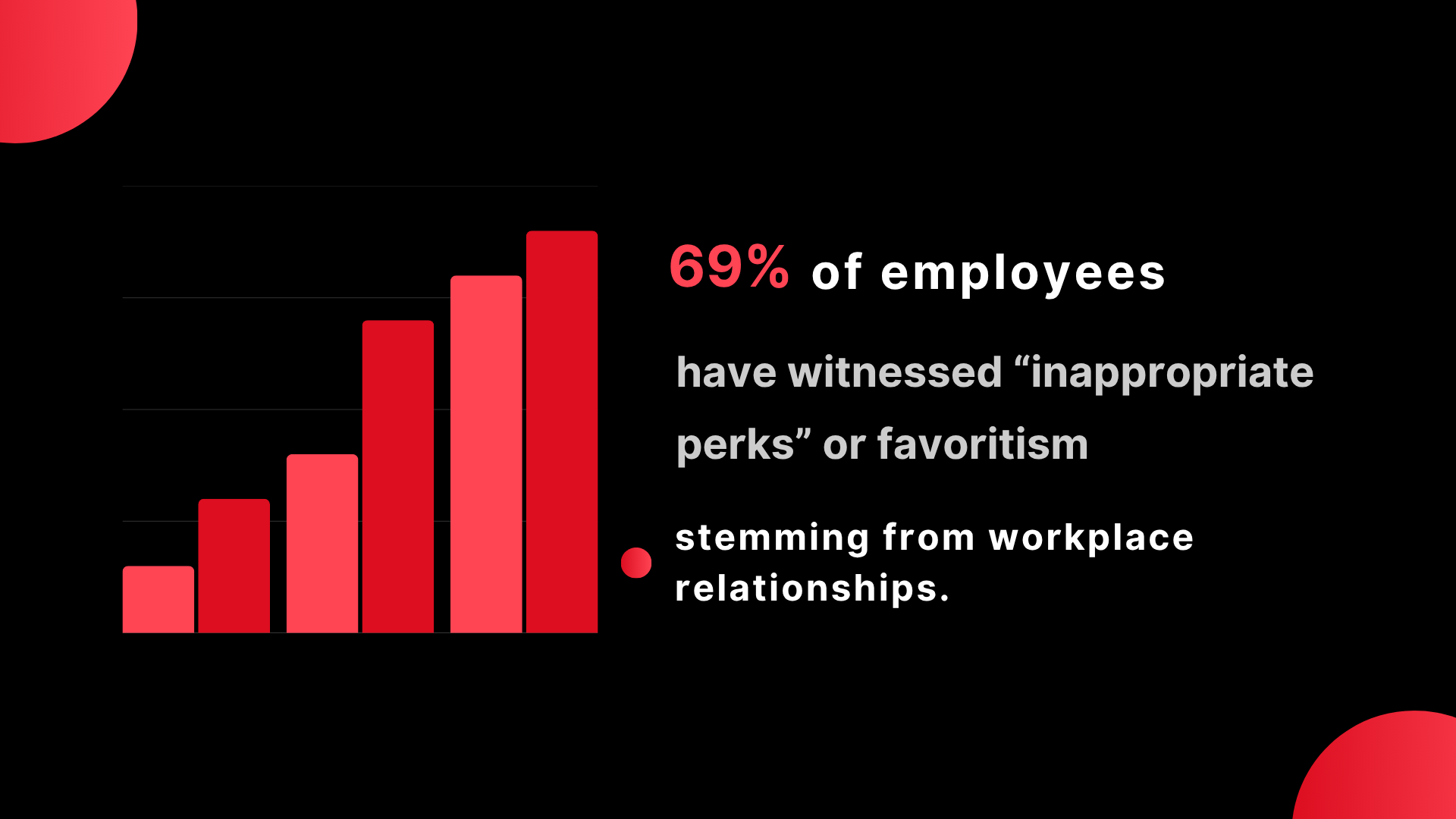
In fact, one survey found that 69% of employees have witnessed “inappropriate perks” or favoritism stemming from workplace relationships.
Even if such favoritism is unintentional, the damage is done once coworkers perceive unfairness. Unconscious bias in the workplace can creep into decisions, which is a serious organizational risk.
Favoritism born from fraternization doesn’t just upset coworkers – it can rise to the level of legal concern. U.S. courts have noted that widespread favoritism toward a boss’s romantic partners can create a hostile work environment for others.
In one case from California, employees sued after discovering their supervisor had relationships with certain subordinates and granted them promotions and perks.
The state’s Supreme Court ruled that this behavior constituted sexual harassment toward the other staff who weren’t in the boss’s favor.
Unfortunately, legal cases related to workplace relationships are anything but rare.
The EEOC has reported that 27% of sexual harassment claims in 2023 were tied to workplace romances that had backfired, with companies paying hefty settlements as a result.
Even when no laws are broken, office romances can wreak havoc on team morale and cohesion if handled poorly.
Coworkers often notice when two people become unusually close – and office gossip tends to fill in the blanks, accurately or not. In fact, nearly 60% of employees say that office romances have sparked gossip among colleagues.
Naturally, this gossip can become a distraction and shift focus away from work.
What’s more, any visible affection in the workplace may leave others feeling uncomfortable or even irritated.
Studies show that while many employees tolerate colleague romances, a sizeable number still view them as unprofessional. As much as 40% of workers believe workplace romances are unprofessional, so seeing one unfold can quietly irritate or demoralize those coworkers.
Breakups are painful in any context, but in the office, they carry the extra burden of daily proximity.
Former partners may still need to interact with each other in meetings, collaborate on projects, or maintain a supervisor-subordinate relationship. The aftermath can be awkward not just for the couple but for colleagues who sense the tension.
For these reasons, usually one person ends up leaving the team or the company altogether after an office romance, either by choice or necessity.
Nearly one in three employees (29%) have left a job due to a workplace romance that went sour, according to one survey. Companies risk losing good talent in these situations, essentially as collateral damage of a failed relationship.
Is workplace fraternization always a bad thing? It’s easy to list the risks, but human relationships at work also provide undeniable benefits.
When handled properly and kept within appropriate boundaries, the human connections people form at work can be a source of collaboration, loyalty, and resilience.
First, colleagues who genuinely like and trust each other tend to collaborate better.
Employees who feel comfortable with one another will ask questions, share knowledge, and tackle problems together without hesitation. Research backs this up, as employees with strong social connections at work are often both more productive and resilient in the face of challenge.
A famous Gallup study even found that people who strongly agree they have a best friend at work are seven times more engaged in their jobs.
Rather than a distraction, a healthy friendship or romance might make coming to work more enjoyable and teamwork more intuitive.
“People don’t quit jobs, they quit bosses” – so the saying goes. Similarly, people often stay in jobs because of the people they work with.
If your workplace has a culture where colleagues celebrate each other’s birthdays, grab coffee together, and genuinely care about each other, employees feel “at home.” They’re not just earning a paycheck – they’re part of a community.
Therefore, when employees have close friends in the office, they report higher job satisfaction and are 50% more likely to feel a strong connection to the company’s mission.
All of this translates to lower turnover rates.
Therefore, fostering healthy fraternization in the workplace – such as mentoring circles, social events, or employee recognition programs – can be a strategic tool for retention.
Jobs are inherently stressful. Tight deadlines, market pressures, and even personal life issues inevitably affect employees’ mental states.
Instead of facing these challenges alone, employees with strong bonds have an outlet to vent, to seek encouragement, or to brainstorm solutions together.
Psychological research consistently finds that social support is one of the most reliable predictors of resilience against stress and burnout.
So, on a very human level, work friends make the hard days more bearable and the good days more celebratory.
Ultimately, the way a company handles fraternization can become part of its cultural identity – for better or worse.
Who wouldn’t want to work at a place where everyone gets along and has fun, without fear of unfairness?
A workplace that allows natural bonds to form – friendships, “work families,” even the occasional office romance – yet maintains clear standards of conduct, signals maturity and trust.
Culture is difficult for competitors to copy, and a culture enriched by healthy socialization is a powerful motivator.
So, how can companies enjoy the benefits of workplace camaraderie while minimizing the pitfalls? The answer lies in clear boundaries and a strong fraternization policy.
Key elements of an effective fraternization policy include:
First and foremost, the policy must clearly explain what “fraternization” means in a workplace context. Does it include only romantic relationships, or also close friendships and family ties? By defining fraternization up front, you eliminate ambiguity.
A good policy should outline who and what it applies to.
Some companies focus on power-imbalanced relationships and prohibit any supervisor-subordinate romance anywhere in the company. Others might allow peer dating but ban relationships within the same chain of command.
The policy should also specify whether it covers only full-time employees or also contractors, interns, and other relevant personnel. Being explicit on scope helps employees know exactly which situations are problematic.
A policy should make the disclosure process easy, non-punitive, and confidential, encouraging honesty without fear of reprisal.
Employees should be required to disclose any romantic relationship with a colleague to HR or management, ideally early on. This allows the company to assess potential conflicts of interest and adjust if needed.
Modern HRIS systems provide smart ways to support compliance with relationship policies while maintaining data privacy.
To maintain professionalism, a fraternization policy often includes guidelines on on-the-job behavior for colleagues who are in a close relationship. For example, it may prohibit public displays of affection in the office or using work time to pursue personal relationships.
Some policies also address social media conduct, for example, cautioning managers about connecting with subordinates on personal social media platforms, as those interactions can blur professional lines.
Lastly, the best policies don’t just sit on paper – they are backed by everyday actions, accountability, and leadership that models the standards they set.
Managers should receive regular training on handling disclosures discreetly, preventing harassment, and managing conflicts of interest.
New employees should be introduced to the fraternization guidelines as part of onboarding. The policy should be written in plain language and included in employee handbooks or orientations so everyone is aware of the rules.
In conclusion, fraternization in the workplace isn’t a problem to be solved so much as a reality to be managed.
Companies that manage it well turn what could be a liability into an asset. They create an environment where employees can connect and feel part of a community, without letting personal matters derail professionalism.
In doing so, they protect both relationships and reputations – proving that, with the right approach, culture and compliance can indeed coexist to the benefit of all.
Senior Content Writer at Shortlister
Browse our curated list of vendors to find the best solution for your needs.
Subscribe to our newsletter for the latest trends, expert tips, and workplace insights!

Is workplace fraternization a recipe for disaster or a catalyst for a stronger work culture? The answer isn’t black and white.

Is there really a nice way to fire someone? While termination will never be easy, it can be done with professionalism and compassion.

A company can only grow as fast as its workforce allows. In an economy defined by constant disruption, strategic HR staffing becomes an investment in long-term business success.

Can small businesses truly compete with corporate giants by leveraging employee incentive programs, and what unique strategies can they employ to motivate and retain top talent?
Used by most of the top employee benefits consultants in the US, Shortlister is where you can find, research and select HR and benefits vendors for your clients.
Shortlister helps you reach your ideal prospects. Claim your free account to control your message and receive employer, consultant and health plan leads.