Monthly Industry Pulse

5 Key U.S. Workplace Law Changes for 2026 

Multiple workplace law changes are happening in 2026. Which updates will affect your HR policies and payroll processes?
In This Post:

Is your organization ready for the wave of employment law changes coming in 2026? U.S. employers face a busy year as new requirements take effect across multiple fronts. From expanded leave benefits to AI oversight and pay transparency, 2026’s legal shifts will demand proactive attention.  

In this article, we explore the key workplace law changes in 2026 and what they mean for employers. 

1) Family Leave and Sick Leave Expansions

State-paid leave requirements continue to expand, and 2026 brings a new set of mandates and program upgrades.   

Paid sick leave coverage is broadening, while paid family and medical leave (PFML) continues to scale, with 13 states plus D.C. already offering payroll-tax-funded paid leave and more implementation milestones ahead.  

Several states are also widening unpaid family and medical leave by lowering employer-size thresholds, extending leave beyond 12 weeks, and adding new qualifying reasons.  

Some of the upcoming 2026 leave law changes include:  

  • Minnesota launches paid leave in 2026 
  • Delaware PFML benefits begin (contributions started in 2025) 
  • Washington expands PFML eligibility and job protections 
  • Colorado adds extra NICU-related leave 
  • Rhode Island increases Temporary Caregiver Insurance from 7 to 8 weeks 
  • Other states roll out new or expanded sick and safe leave rules 

With no federal paid sick leave standard, multistate employers should treat 2026 as a compliance audit year across payroll setup, policy language, employee communications, and absence management. 

2) AI Guardrails and Discrimination Rules

AI is quickly becoming integrated into everyday workplace decisions, and compliance expectations are also rising rapidly. 

Regulators, courts, and plaintiffs’ attorneys are increasingly treating these automated decision tools as a governance and discrimination risk, even though the U.S. still lacks a comprehensive federal AI law.  

As a result, state and local activity is filling the gap. In 2025, every state introduced AI-related regulations and 38 states enacted roughly 100 measures, pushing employers toward stronger controls around AI use. 

What employers are being asked to prove: 

  • Fairness: Bias audits and impact assessments are becoming a standard practice.  
  • Accountability: Clear ownership for how tools are selected, configured, monitored, and challenged. 
  • Privacy discipline: Better data governance, faster breach response timelines, and opt-out expectations for certain data uses. 

Where the rules are getting updated:  

  • New York City (Local Law 144): Independent annual bias audits for automated hiring or promotion tools, public-facing disclosures, and advance notice to candidates when AI is in play. 
  • Colorado (effective June 30, 2026): A “reasonable care” standard for employers using high-risk AI, with stronger footing when impact assessments, risk controls, and disclosures are in place. 
  • Illinois, California, New Jersey: Anti-discrimination rules increasingly apply directly to AI decisions, with California also leaning into record-keeping and protections tied to bias testing. 

In the upcoming year, employers must audit where AI is used, document why it is used, and assign an accountable owner. Bias testing, vendor diligence, and record retention should be embedded into routine HR processes to reduce discrimination and compliance risk. 

3) Pay Transparency and Wage Increases

Pay transparency is moving from a corporate taboo topic to a regulated disclosure.  

Over the last two years, more than a dozen states and several cities have adopted rules that require salary ranges in job postings, and some also require disclosure to employees on request. In 2026, enforcement and reporting expectations will only increase.  

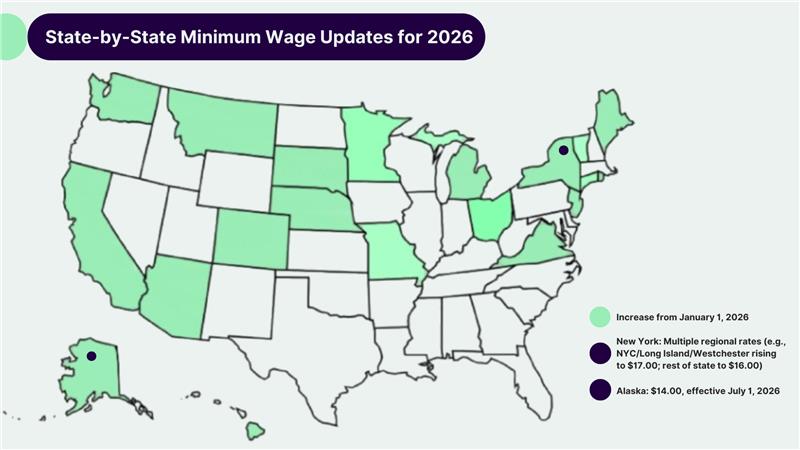
Aside from the increased transparency around compensation, minimum wage floors are rising, too. At least 19 states increase minimum wages on January 1, and statewide rates will reach or exceed $15 for the first time in Arizona, Colorado, Hawaii, Maine, Missouri, and Nebraska.  

What to watch on January 1, 2026:  

  • Salary range disclosures: New requirements and expansions continue, including New York State’s job posting range rule, with New York City expected to move toward pay data reporting for larger employers. 
  • California posting rules: Job listings must reflect a good-faith estimate of total compensation, not just base pay, and employers face tighter retention expectations for job titles and wage histories. 
  • Pay stub and hire notice detail: Oregon requires clearer written explanations of potential earnings and deductions at hire, kept accessible and refreshed annually. Ohio expanded pay stub detail requirements for hourly workers, including hours and overtime. 
  • Minimum wage: At least 19 states will increase their minimum wages on January 1.   

For multistate employers, the practical challenge is consistency. Better job-posting controls, standardize compensation bands and documentation, and pressure-test pay practices.  

4) Workplace Safety Rules

Workplace safety oversight is entering a new phase in 2026, and employers should understand the shifting dynamics.  

On the federal side, the Occupational Safety and Health Administration (OSHA) is poised for leaner enforcement due to budget and policy changes. 

However, this lighter federal touch doesn’t mean safety can slip. Many states operate their own OSHA-approved safety agencies, and some are responding to federal pullbacks by imposing stricter safety standards locally. 

For instance, Nevada will require certain employers to monitor air quality and protect workers from wildfire smoke exposure – an issue largely unregulated by federal OSHA. 

Oregon is rolling out workplace violence prevention rules for healthcare employers, while Washington State is expanding safety protections for isolated workers like hotel housekeepers and security guards.  

Ultimately, employers must stay vigilant about safety, regardless of any federal slowdown. 

5) Immigration Enforcement

If your workforce includes foreign nationals or if you rely on visa talent, 2026 will demand more attention. U.S. immigration enforcement is becoming more active and more data-driven, with agencies increasingly sharing information and using analytics to identify inconsistencies.   

Since early 2025, ICE has stepped up Form I-9 audits with 72-hour notice inspections and penalties that can approach $30,000 per violation, making internal audits, tighter onboarding, and a rapid-response plan essential. 

In addition, H-1B employers are navigating higher baseline costs, alongside recent visa rule updates that sharpen expectations around specialty-occupation fit, employer control, and documentation. A separate $100,000 fee for new H-1B petitions was also introduced in 2025 and has already added uncertainty and cost pressure for sponsors. 

Another development is “continuous vetting” of visa holders. In 2025, the State Department began systematically reviewing the status of roughly 55 million current U.S. visa holders to flag any violations. 

In other words, even employees on valid work visas are not guaranteed stability. For employers, this means that critical foreign talent may face sudden status changes that disrupt work eligibility. 

What 2026 Really Demands From Employers

Workplace law changes in 2026 will test organizations’ agility and commitment to compliance. For HR and business leaders, the next steps are to anticipate and adapt 

In other words, now is the time to re-evaluate your policies and compliance strategies.   

Audit your HR practices against new laws: update that employee handbook for paid sick leave, review your AI tools, adjust your pay scales and job postings, and double-check your data privacy notices.  

As we enter 2026 with a complex legal landscape, the companies that thrive will be those who prepare early and often. 

Written by Ivana Radevska

Senior Content Writer at Shortlister

Payroll Companies

Browse our curated list of vendors to find the best solution for your needs.

Stay Informed

Subscribe to our newsletter for the latest trends, expert tips, and workplace insights!

Related Posts