What Are the 2026 ACA Reporting Requirements?
Higher penalties, stricter accuracy standards, and expanded e-filing define the 2026 ACA reporting cycle.

If your employment contracts include any provision requiring workers to repay training costs, relocation expenses, or sign-on bonuses upon early departure, the legal ground beneath those clauses is changing fast.
Over the past 18 months, California, New York, and Colorado have each moved to ban or limit so-called “stay-or-pay” provisions, and attorneys general have backed up those laws with multimillion-dollar enforcement actions.
In this article, we cover the new restrictions and offer practical steps to reduce compliance risk.
A stay-or-pay provision is a clause in an employment contract that requires a worker to reimburse the employer for training, relocation, sign-on bonuses, or other costs if they leave before a set period of time. When these provisions relate specifically to training programs, they are commonly known as training repayment agreement provisions, or TRAPs.
For decades, these clauses appeared primarily in high-skill industries like aviation, finance, and engineering. Their use expanded rapidly during and after the pandemic, particularly among lower-wage employers in healthcare, trucking, retail, and the service sector.
After formally investigating the practice in 2023, the Consumer Financial Protection Bureau raised concerns about hidden debt terms, limited worker bargaining power, and misrepresentation of training value.
Why does that matter for employers? Because critics and regulators increasingly view these provisions as a workaround to non-compete bans. Rather than restricting where a worker can go after leaving, these clauses impose a financial penalty for leaving at all.
In April 2024, the Federal Trade Commission issued a rule that would have banned most non-compete agreements and certain training repayment provisions. Federal courts blocked that rule before it took effect.
Then, in September 2025, the FTC under a new administration withdrew its appeals entirely. That left a federal vacuum, and states moved quickly to fill it.
California, New York, Colorado, Connecticut, Wyoming, and Indiana have all enacted or amended laws targeting stay-or-pay agreements since 2024. Meanwhile, Massachusetts, Nevada, Ohio, Vermont, and Washington have introduced legislation that would further restrict or outright prohibit these provisions.
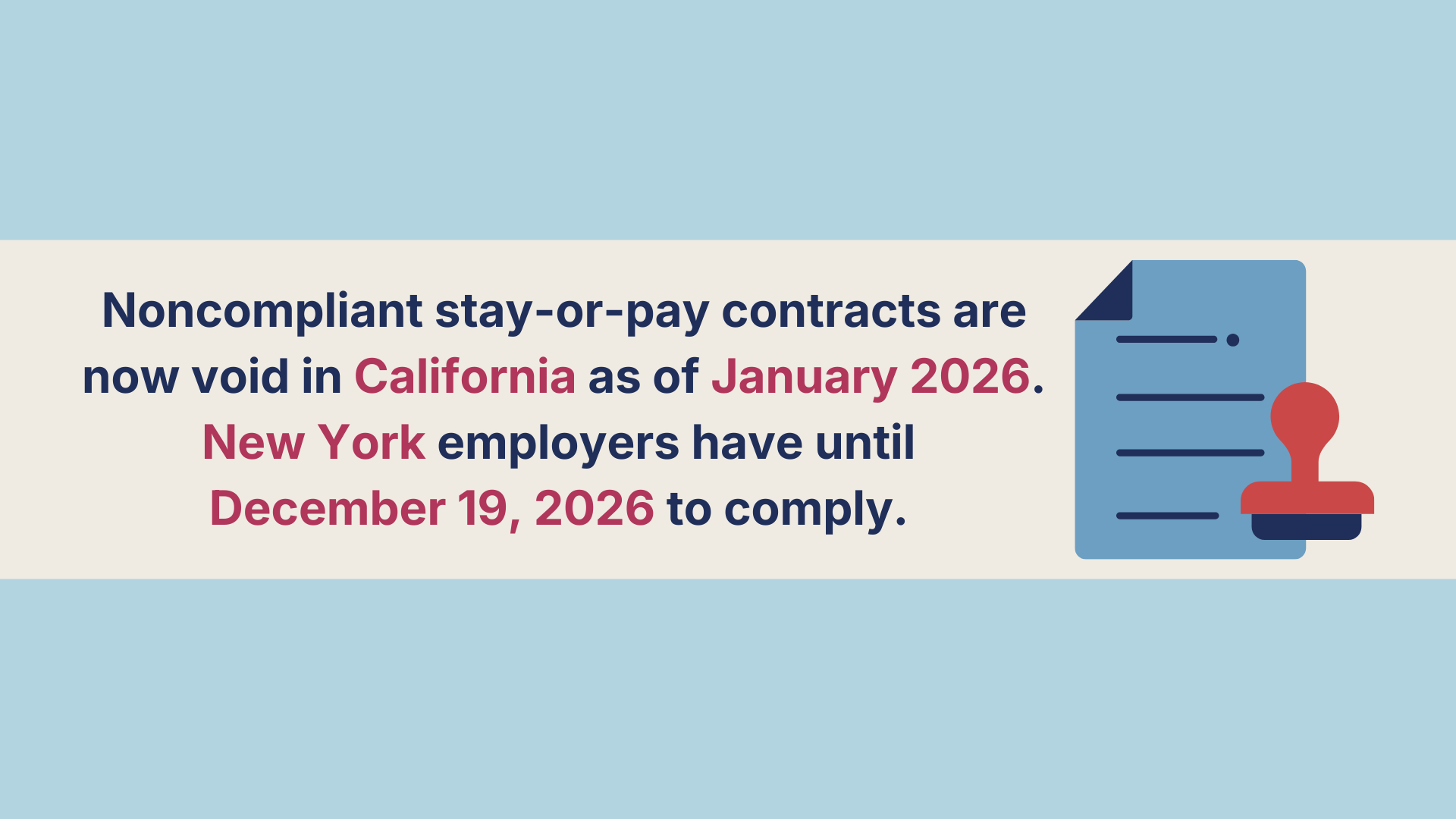
On October 13, 2025, Governor Gavin Newsom signed Assembly Bill 692 into law. Effective January 1, 2026, AB 692 prohibits employers from including in any employment contract a provision that requires a worker to repay the employer for a debt or that imposes a penalty upon separation from employment.
The law applies broadly to “workers,” which includes employees and prospective employees, though independent contractors were removed from the final version of the bill.
AB 692 does not eliminate all repayment arrangements. Two categories remain permissible, but only if they meet strict conditions:
Noncompliant contracts entered after January 1, 2026 are void as unlawful restraints of trade. The law is not retroactive and applies only to agreements entered into on or after January 1, 2026.
On December 19, 2025, Governor Kathy Hochul signed the Trapped at Work Act into law. However, she flagged that the original text was ambiguous regarding voluntary tuition assistance programs and signed the bill with a “chapter amendment” condition, requesting the legislature make changes.
That chapter amendment was signed into law on February 13, 2026, narrowing the law’s scope and pushing the effective date to December 19, 2026.
The amended Act prohibits employers from requiring, as a condition of employment, that an employee execute an “employment promissory note,” which is defined as any agreement requiring a worker to pay the employer if they leave before a stated period of time.
There are a few notable differences from California’s approach:
With the December 2026 effective date, New York employers have time to prepare. Even so, existing contracts and onboarding documents should be reviewed now to identify provisions that would not be valid once the law takes effect.
California and New York passed the broadest restrictions, but they are joining a list that has been growing for years.
Colorado has emerged as the most aggressive enforcer. Under C.R.S. § 8-2-113, employers may only recover training expenses “distinct from” normal, on-the-job training, limited to reasonable costs that decrease proportionally over two years. A 2024 amendment (HB24-1324) folded these expenses into Colorado’s consumer credit statutes and authorized the attorney general to recover five times the amount of any violation. In 2025, SB 25-083 further tightened restrictive-covenant rules for healthcare providers, though physician agreements may still include damages reasonably related to the injury suffered on termination.
Connecticut has prohibited employment promissory notes as a condition of employment since 1985, making it the longest-standing state restriction. The law originally applied to employers with 26 or more employees, but a 2023 amendment expanded the prohibition to all employers regardless of size.
Wyoming and Indiana took narrower, sector-specific approaches. Wyoming’s 2025 non-compete law preserves limited recovery of relocation, education, and training costs on a declining schedule, while Indiana’s recent activity has focused on physician non-compete agreements and certain law enforcement training reimbursement rules.
Two high-profile cases in 2025 signaled that attorneys general are willing to pursue companies over stay-or-pay practices.
In July 2025, the attorneys general of California, Colorado, and Nevada announced a joint settlement with HCA Healthcare, the largest for-profit hospital system in the country. The investigation found that HCA required newly hired nurses to sign agreements for its StaRN training program and billed them for prorated training costs if they left within two years. Nurses who failed to pay were sent to debt collection.
Under the settlement, HCA must stop using TRAPs, void all existing training repayment debts, forgive approximately $288,000 in outstanding obligations, and pay $2.9 million in combined penalties across the three states.
Colorado Attorney General Phil Weiser sued PetSmart in July 2025, alleging the company advertised its Grooming Academy as “free” but then required participants to sign repayment agreements obligating them to repay up to $5,500 if they left within two years. Investigators found that PetSmart presented these agreements after employees had already enrolled, sometimes during shifts or breaks.
PetSmart settled in November 2025 for $225,000, agreed to halt all collection activities against Colorado workers, and began distributing restitution payments to more than 60 affected workers in February 2026.
For employers still using stay-or-pay arrangements, the legal risk is no longer hypothetical.
Employers who use HRIS systems should also verify that automated onboarding workflows do not generate contract language that conflicts with state-level restrictions.
Training repayment agreements are not gone entirely, but the conditions under which they can be enforced are narrowing fast. Therefore, employers who have not yet audited their contracts for TRAP exposure should do so before the next round of state legislation.
Senior Content Writer at Shortlister
Browse our curated list of vendors to find the best solution for your needs.
Subscribe to our newsletter for the latest trends, expert tips, and workplace insights!

Higher penalties, stricter accuracy standards, and expanded e-filing define the 2026 ACA reporting cycle.

In This Post: Is your organization ready for the wave of employment law changes coming in 2026? U.S. employers face a busy year as new requirements take effect across

The new administration’s first 100 days bring significant changes to DEI, AI rules, labor boards, and immigration.

While the early weeks of Q2 suggested a more subdued pace, May brought a decisive uptick in industry activity. From major acquisitions to IPO filings and product launches, here’s what defined the past 30 days.
Used by most of the top employee benefits consultants in the US, Shortlister is where you can find, research and select HR and benefits vendors for your clients.
Shortlister helps you reach your ideal prospects. Claim your free account to control your message and receive employer, consultant and health plan leads.