
50+ Maternity Leave Statistics in 2025
Stay informed about maternity leave with 50+ essential statistics. Gain valuable insights into policies and practices for expectant mothers in the workplace.

You’ve likely seen GLP-1 medications like Ozempic, Wegovy, and Mounjaro making headlines lately.
While GLP-1 drugs have been used for years to manage type 2 diabetes, the newer versions of these drugs are now in the spotlight for a different reason: weight loss.
Amid an obesity epidemic, these drugs hold a promise for healthier, slimmer, and more fulfilling lives for millions of Americans.
As a result, their popularity and demand have skyrocketed over the last year. According to a recent PwC survey, about one-third of people are considering using GLP-1 medication.
However, due to their high price tag—often $1,000 to $1,500 monthly—many employers are still debating whether to include them in benefits plans.
In this article, we aim to answer the question, “Can employers roll out GLP-1 coverage without putting a strain on their budgets?”
Up until recently, drugs like Ozempic were only covered by employers for diabetes treatment. For years, they’ve been the standard care for diabetes management, with as many as 96% of employers including them in their benefits plans in 2024.
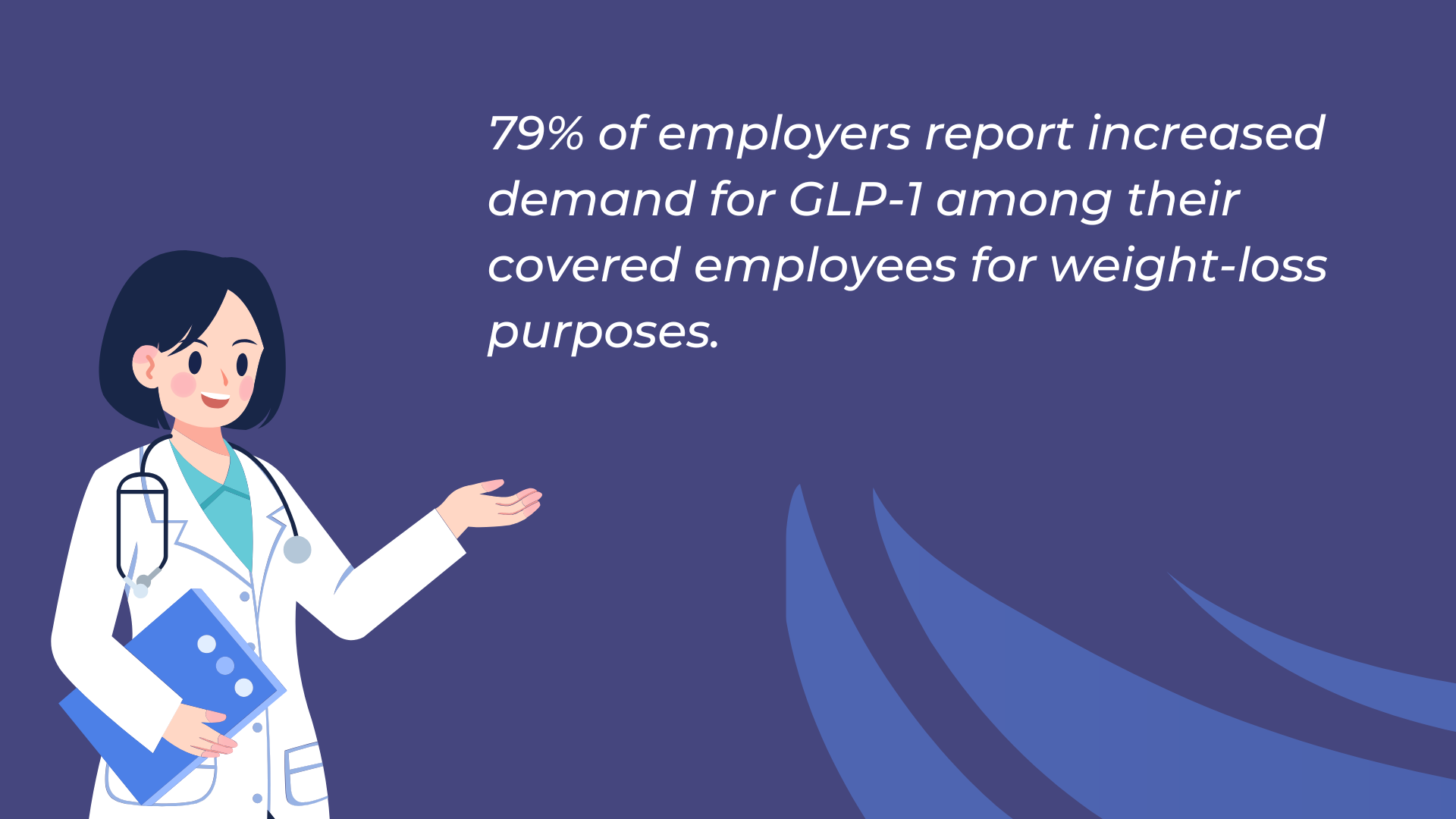
However, as demand for obesity treatments rises, employers are forced to reevaluate their coverage. According to recent surveys, 79% of employers report increased demand for GLP-1 among their covered employees for weight-loss purposes.
Even with such a high interest, current GLP-1 coverage remains uneven.
A KFF survey found that only 18% of companies with at least 200 employees, and 25% of those with 1,000 or more, cover GLP-1s primarily for weight loss.
So, why are employers so slow to expand GLP-1 coverage?
Undoubtedly, the discovery of how glucagon-like peptide-1 (GLP-1) agonists work has been one of the most impactful breakthroughs in recent times.
While initially used for diabetes treatment; scientists quickly discovered their potential beyond blood sugar control.
Last March, the FDA approved Wegovy for treating cardiovascular disease in overweight patients.
Then, in April, tirzepatide (sold as Mounjaro and Zepbound) reported promising late-stage trial results for managing sleep apnea, a breathing condition, while other studies hinted it might also improve chronic kidney disease.
Researchers are now exploring GLP-1 drugs for a wide range of conditions: liver disease, addiction, delaying Alzheimer’s, and even as a preventative therapy for those at risk of obesity.
Over time, more promising findings lengthen the list of potential uses. However, like any groundbreaking medication with much potential, GLP-1s do come with some uncertainties, mainly around cost and sustainability.
Despite their immense promise, GLP-1 drugs have sparked both enthusiasm and concern.
For employers, the combination of high prices and long-term use raises serious questions about sustainability. To start, we know that the cost of anti-obesity drugs runs about $10,000 per patient for just one year.
But what does this mean in terms of dollars and cents for employers?
These drugs now account for roughly 10% of pharmacy expenses, with employers spending an extra $10 to $15 per member per month to cover them.
The potential future cost increase is just as shocking.
More than 42% of adults under 65 with private insurance could be eligible for these medications under current FDA guidelines. With U.S. obesity rates hovering around 40%, even modest adoption among eligible employees could lead to a sharp rise in prescription spending.
Beyond these direct costs, long-term use is another factor.
Many employees will have to use these medications indefinitely, making these drugs one of the most expensive categories in employer-sponsored health plans.
So, while they offer hope for better health outcomes, their financial impact is a reality employers can’t ignore.
When it comes to GLP-1s, there’s no universal strategy.
Some companies are aligning strictly with FDA-approved uses, while others exclude weight management entirely or impose strict eligibility rules.
When evaluating which coverage option to select, employers must develop a strategy that considers everything, from their employee population to talent retention strategy and their bottom line.
Despite the high costs, the potential savings from improved health outcomes in a workforce with high obesity rates could make GLP-1s a worthwhile investment.
For example, PwC analysts suggest that anti-obesity treatments could actually reduce overall health plan costs by lowering expenses tied to cancer and cardiometabolic health, such as heart disease, diabetes, and high blood pressure.
In addition, these benefits play an important role in talent retention.
Retail or hospitality employers with a high turnover might prioritize short-term savings, therefore choosing tight prior authorization rules.
Meanwhile, tech firms or corporate giants competing for talent might offer a more generous GLP-1 coverage as a recruitment perk.
As employers race to find the best way to balance costs and access, utilization management (UM) has emerged as an essential tool.
In fact, employers offering GLP-1 coverage primarily rely on utilization management to contain costs, with 85% of those surveyed using this approach, according to IFEBP.
Only around 9% of employers have no cost-control measures in place.
Common UM strategies, such as prior authorization (PA), step therapy, and duration limits, guarantee that these high-cost drugs are prescribed appropriately and sustainably.
In many cases, employers might require documented evidence of a BMI over 30 (or 27 with comorbidities) paired with participation in a corporate weight management program before approving coverage.
Similarly, step therapy usually requires that patients start with a lower-cost medication before “stepping up” to a more expensive option. For those with type 2 diabetes, this often means trying metformin first before advancing to a GLP-1.
Other employers may limit treatment duration unless employees achieve specific health benchmarks, like a 5% weight reduction within six months.
Ultimately, finding the right balance requires collaboration with pharmacy benefit managers (PBMs) and healthcare consultants to create coverage based on workforce needs and risk factors.
As employers test out various strategies, one thing is certain: the ideal UM strategy integrates with broader workplace health initiatives.
For these reasons, employers are increasingly weaving GLP-1 coverage into existing wellness programs, disease management platforms, and mental health resources.
For example, an employee prescribed a GLP-1 might be automatically enrolled in nutrition counseling, health coaching, or stress management workshops—creating a “wrap-around” ecosystem that addresses obesity from multiple angles.
Employers can implement several cost management strategies for GLP-1 coverage:
Employers can explore many ways to manage GLP-1 drug costs, but stricter controls might reduce rebates and increase administrative expenses. Tighter rules could also result in fewer employees accessing the medication or shifting costs elsewhere in the healthcare plan.
No matter the approach, it’s vital to track how it affects drug use, PBM/vendor deals, and overall medical costs.
Obesity is a long-term medical condition shaped by genetics, environment, and behavior. Therefore, managing it effectively takes more than just taking a GLP-1 medication alone.
For lasting success, anti-obesity drugs need to be paired with ongoing support and lifestyle changes. Employees using GLP-1s benefit most when they have access to weight management programs, coaching, nutrition guidance, and long-term health monitoring.
Lifestyle changes are the foundation of long-term weight control, even for those on prescription weight-loss medications. According to Shortlister’s Workplace Wellness Report 2025, employer interest in weight management programs has more than doubled since 2021.
With GLP-1 usage increasing, companies are investing in structured weight management programs to support lasting results, improve overall employee health, and potentially reduce long-term healthcare costs.
Dietary choices are always important for overall health, but even more so for employees using GLP-1 medications. Poor eating choices can counteract medication benefits, leading to nutrient deficiencies, muscle loss, or digestive issues.
For these reasons, access to registered dietitians and meal plans can help employees make better choices that support their weight loss goals.
Sustainable weight loss isn’t just about food and medication—it’s about mindset, habits, and accountability. Health coaching programs can provide guidance and support to help employees build lasting routines. Coaches can also address the root causes of emotional eating, help with stress management, and motivation.
Obesity and diabetes are deeply connected, meaning employees on GLP-1s may also find diabetes programs useful. Employees that are managing diabetes at work benefit from education, monitoring tools, and lifestyle interventions that work alongside GLP-1 medications.
GLP-1 medications have reshaped the way we understand obesity—not as a lack of willpower but as a complex, chronic condition.
Yet, despite this shift, stigma still exists, and employees who choose GLP-1s may face judgment or be unfairly labeled as “taking the easy way out.”
So, when discussing weight and GLP-1s, it’s essential to use language that is respectful and free from stigma. Employers should make sure their messaging avoids harmful stereotypes or imagery. Training for HR teams, managers, and leaders can further reinforce these standards.
The same applies to vendor communications—review materials carefully to avoid things like language that ties weight to personal worth, or humor that reinforces negative biases.
After employers establish their GLP-1 strategy, they need to set clear rules and communicate them openly with employees.
Documentation must include all the details—like who qualifies, whether a doctor’s authorization is needed, and how these drugs fit into the rest of their health benefits.
Sharing this information early on helps avoid confusion and helps employees understand the necessary steps to get GLP-1 coverage.
In addition to company policies, employers should collaborate with vendors and PBMs to make sure they stay compliant with changing healthcare laws and rules.

The latest analysts believe the GLP-1 market will surpass $150 billion by 2030, mainly due to changes in production, competition, and access.
While early drug shortages created challenges for diabetes care and health equity, compounding pharmacies and telehealth platforms stepped in to meet demand by providing compounded GLP-1s. Now, with the FDA already removing Ozempic, Mounjaro, and Wegovy from its shortage list, the compounded versions of GLP-1 drugs will no longer be a viable option.
Some virtual health companies are already shifting their strategy by exploring generic alternatives of drugs like Ozempic or even providing “personalized doses” of compounded GLP-1s.
As shortages ease and new alternative options emerge, these medications will become more accessible to employees. In addition, more companies are entering the market and expanding availability.
With 124 anti-obesity drugs in the development pipeline, treatment options are increasing, which could help ease access and lower costs. About half of these drugs are injectables, while 46% are oral. The introduction of oral versions—simpler to take and produce—could also speed up acceptance among workers.
As awareness spreads, demand for GLP-1s in weight loss and diabetes care is expected to keep climbing. With so many changes ahead, companies must stay agile, monitoring and adjusting their GLP-1 coverage strategies as the market evolves.
Senior Content Writer at Shortlister
Browse our curated list of vendors to find the best solution for your needs.
Subscribe to our newsletter for the latest trends, expert tips, and workplace insights!
Stay informed about maternity leave with 50+ essential statistics. Gain valuable insights into policies and practices for expectant mothers in the workplace.
Diabetes is the most expensive chronic illness in the US. The global health expenditure reached $966 billion, with North America accounting for 42.9% of this, or $415 billion.

Gain insight into the current state of adoptions in the United States with 50+ crucial statistics and trends, providing valuable information on the evolving adoption landscape.
These vital men’s health statistics depict the importance of addressing men’s health issues and promoting holistic approaches to men’s healthcare.
We're working hard to make it easy for you. Sign up for news, trends and insights.