AI Benefits Index

How AI Assistants Decide Which Benefits Vendors to Name 

ChatGPT can hand an HR director three vendor names in seconds, and the pages behind those names increasingly decide who reaches the RFP.
In This Post:

An HR director types “best mental health vendors for a 5,000-person company” into ChatGPT a few weeks before renewal planning. Seconds later, three vendor names come back, each with a short explanation of why it might fit. 

None of the three names on that list is the market leader by revenue. None of them purchased a sponsored placement or paid for ad space.  

For marketing and growth, the puzzle is why these three specific vendors got named.  

Understanding how to improve brand visibility in AI search engines starts with understanding what happens between the prompt and the answer. 

What Happens When Someone Asks an AI Assistant to Recommend Vendors

The mechanics of how AI gives recommendations now carry real weight in benefits procurement.  

Marsh projects per-employee health benefit costs will climb 8.2% in 2027, the steepest rise since 2003.  

At the same time, Shortlister’s RFP data shows average invitation lists shrinking from 18.5 vendors in 2022 to 5.6 in 2026 as discovery moves into marketplace databases and AI research tools.  

With fewer places on the invitation list, early discovery deserves attention, regardless of the research tools a buyer uses. 

Retrieval, Not Ranking

ChatGPT doesn’t keep a ranked list of mental health vendors.  

Instead, the answer is typically assembled from a variety of sources retrieved at the moment and influenced by the user’s personal preference. 

When it searches the web, OpenAI explains that it usually turns a prompt into one or more focused queries for its search partners, and may then run narrower follow-ups once it has seen the first results.  

Google describes the same “query fan-out” approach in AI Overviews and AI Mode. 

What this means is that the HR director’s question might split into searches for enterprise mental health benefits and large-employer EAP alternatives. 

If your company is not inside those retrieved results, you do not exist in the assistant’s context, no matter how famous your brand is in the physical world. 

Why Two People Asking the Same Question Get Different Vendors

Because retrieval happens dynamically in real time, small changes in prompt phrasing, or current web search results alter the retrieved pool of pages. 

In SparkToro’s study of 2,961 runs of 12 recommendation prompts, ChatGPT and Google’s AI had under a 1-in-100 chance of returning the same brand list twice. 

Personal context widens the search too, since OpenAI says ChatGPT may fold a user’s general location and, with Memory on, remembered details into searches. Changes in models can alter the sources retrieved, too, and, in turn, the names returned. 

So, if every answer is assembled from retrieved pages, why do so few of them belong to the vendors being named? 

Why AI Assistants Cite Third-Party Pages More Often Than Vendor Websites

A vendor website may contain the deepest information about its own service. Yet, that does not necessarily make it the page an AI assistant is most likely to cite. 

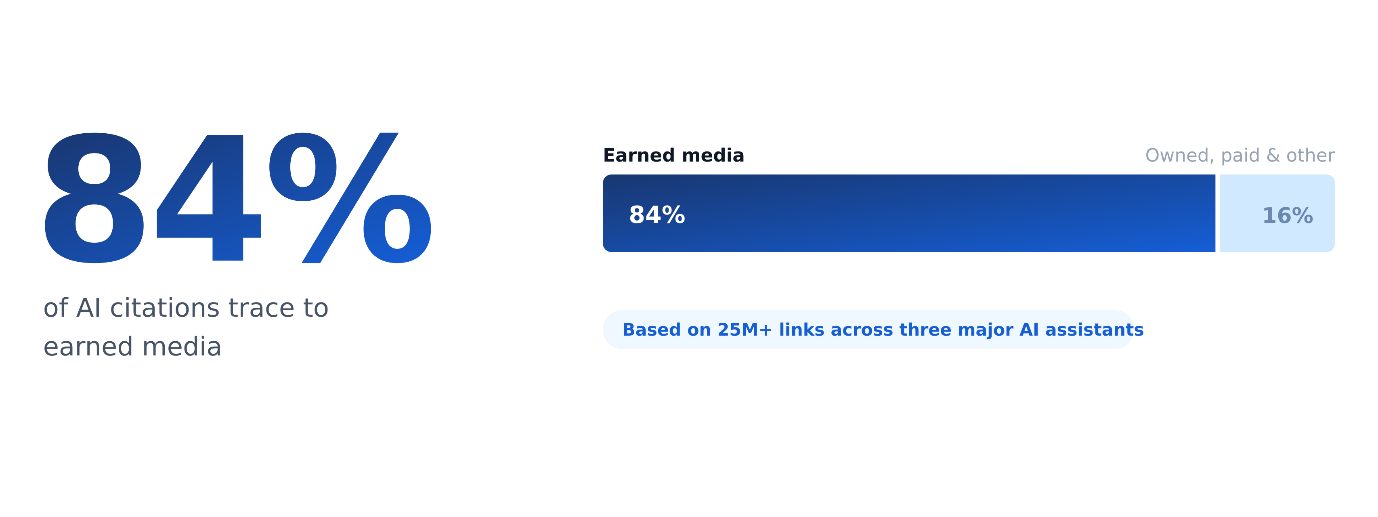
Muck Rack’s May 2026 study of more than 25 million links cited by three major assistants traced 84% of citations to earned media, with paid and advertorial content at just 0.3%. 

But if vendors know their own products best, why does so much of the evidence come from somewhere else? 

ai-assistants-vendor-image

The Question-Shape Mismatch

When a buyer asks an AI for a vendor recommendation, they are asking a comparative question: “What are my options, and how do they differ?”  

Vendors wondering how to show up in ChatGPT often spend thousands polishing product landing pages that never make it into the retrieval set.  

That’s because a vendor’s product page is designed to answer a single-entity question: “What does Company X do?”  

When an AI engine retrieves a single vendor page, that document rarely contains comparative context.  

That creates a structural advantage for third-party pages during discovery.  

A product page can explain one provider exceptionally well, but it cannot easily answer a question that requires comparing dozens of them. 

What Corroboration Across Sources Does to a Model’s Answer

Large Language Models are probabilistic systems designed to minimize hallucinations. When an LLM scans a third-party comparison list or industry report, it sees multiple vendors side-by-side with uniform criteria.  

And when multiple independent sources corroborate that Vendor A specializes in “1-on-1 coaching” while Vendor B focuses on “automated payroll integration,” the model gains high statistical confidence in those facts.  

Therefore, a fact repeated across independent pages carries more weight with a model than the same fact on one page. 

The idea is not new in the SEO world. In 1998, Google’s founders built PageRank on the premise that links from other pages measure a page’s importance.  

Ahrefs’ study of 75,000 brands finds the same pattern applies in AI search.  

Brands in the top quartile for web mentions averaged more than 10 times as many mentions in Google AI Overviews as brands in the next-highest quartile.  

Researchers studying knowledge conflicts find that retrieval-augmented models also follow a majority rule and trust the evidence that appears more often. 

What Makes a Source Citable

No platform publishes a universal scoring formula for vendors seeking guidance on how to get cited by ChatGPT. Still, four practical properties make information easier to compare and verify. 

1) Comparable Structure Across Vendors

A category page that lines up dozens of vendors in identical fields hands an assistant a ready-made comparison.  

For example, Shortlister’s mental health comparison page compares more than 400 companies on the same set of attributes, including minimum group size, lives served, platform features, and NCQA or URAC accreditation.  

In contrast, a single vendor’s page describes one company in its own format and leaves the model to rebuild the grid. 

2) Specific, Checkable Claims Instead of Adjectives

Broad claims like “available nationwide” or “industry-leading access”give the AI assistant and the buyer almost nothing to test. 

On the other hand, a statement like “Platform X provides 1-on-1 financial coaching, syncs directly with calendars, and requires a 100-life minimum seat threshold,” gives both of them factual attributes that can be verified and compared. 

3) Visible Dates and Recency

Benefits offerings change quickly – new legislation impacts compliance in health benefits, new software integrations launch quarterly, and company mergers and acquisitions happen regularly.  

For these reasons, AI retrieval algorithms prioritize recent sources with explicit date stamps (e.g., “Updated for Q3 2026”).  

Ahrefs analyzed 17 million citations and found that URLs cited by AI assistants averaged 1,064 days old, against 1,432 days for organic search results, with ChatGPT the most inclined toward newer pages.  

Similarly, Google recommends showing a prominent publication or update date, and warns that the date should change only after a substantial update. 

4) Named Authorship

Who is willing to stand behind the information?  

Google strongly encourages accurate bylines and background about the people who created or reviewed a page, especially where a reader would expect expertise. 

A claim attached to a named author or a known organization carries more weight than an anonymous text. Clear attribution gives the model a reason to trust the source enough to repeat it. 

Does Traditional SEO Still Get You Into AI Answers?

Yes, but ranking well is no longer the whole visibility strategy. 

Traditional SEO helps make a page discoverable. But now AI systems make another decision – whether that page contains the information needed to answer the specific question being asked.  

Where SEO and AEO Are the Same Work

Any plan for how to improve brand visibility in AI search engines still rests on sound SEO.  

For search-engine-native features – specifically Google’s AI Overviews – traditional rankings remain correlated with citation. In Ahrefs’ research, approximately 38% of links cited in Google AI Overviews came from pages already ranking in Google’s top 10.  

Both Google and Microsoft explicitly state that crawlability, clear site hierarchy, descriptive titles, and accurate structured data are non-negotiable SEO baselines.  

If search bots cannot crawl and index your site, AI models cannot retrieve your content. 

Where They Pull Apart

Outside Google, the overlap falls sharply. 

Across 15,000 prompts, Ahrefs found only about 12% of links cited by ChatGPT, Gemini, and Copilot appeared in Google’s top 10 for the same prompt. More than 80% came from pages that did not rank for that query at all. 

This is where the primary requirement shifts from page ranking to entity resolution. 

To cite your company, an LLM doesn’t just need a high-ranking URL. Instead, it must also be able to confidently map scattered web mentions back to one single entity with one consistent set of attributes.  

A benefits vendor that rebrands but leaves its legacy name across six software review profiles risks splitting that evidence into two.  

Traditional SEOAI answer visibility
What you win A high-ranking position for a URL A brand mention/citation in an answer
What gets matched One target keyword A "fan-out" cluster of multi-part sub-questions
Signal that tracks it Backlinks and page authorityCross-web consensus and consistent entity facts
Where the work happens Mostly your site Mostly on third-party aggregators and industry sources
Worst case Dropping to page two of search results Being confused with another entity or omitted entirely

What a Vendor Can Change This Quarter

So, what strategies improve brand visibility in AI search engines?  

Once the website’s basic information is accurate and accessible, the first priority should be the external pages that organize the category and repeatedly appear in relevant answers.  

Your Presence on the Sources That Organize Your Category

Start with the pages a model actually fetches for the category question: vendor databases, comparison articles, analyst roundups, and broker resource pages.  

Every benefits vendor already has profiles on some of them, and most are incomplete or years out of date.  

Completing a category profile is unglamorous, but it is the one place where a vendor controls the attributes a comparison page presents.  

In Shortlister’s vendor categories, for example, a profile with a stated employer size range and the number of lives serviced gives the model two attributes for comparison.    

Naming Consistency Everywhere Your Company Appears

AI models rely on entity matching.  

If your company is listed as “X Health Benefits, Inc.” on Shortlister, “X Health” on Google, and “X Wellness Solutions” in a trade magazine, LLMs may fail to connect these as a single entity.  

Standardizing your brand name, core product definitions, and primary feature terminology across all external publications helps the model pool all mentions toward a single entity profile. 

Answer-Shaped Content on Your Own Site

While off-page presence drives retrieval, your on-page strategy must still support it. 

Knowing how to optimize content for AI search engines means publishing structured data, feature matrices, transparent pricing tiers, and explicit answers that directly match prompt structures.  

Replace marketing superlatives with clear specs, implementation timelines, and target company sizes so that when an AI crawler does index your site, it extracts factual attributes instantly. 

How Would You Even Know If It’s Working?

The answer is not in analytics.  

When the HR director acts on those three names, it typically happens days later, by Googling a vendor or emailing a broker.  

The visit shows up as branded search or direct traffic, and the ChatGPT conversation that produced it leaves no referrer behind.  

The most reliable measurement is to sample the assistants directly: a fixed set of category prompts, run on a schedule across several engines, with results recorded as frequencies rather than snapshots. 

Common Questions

Do AI Assistants Use Paid Ads?

Some do. OpenAI is testing labeled ads in eligible ChatGPT experiences, but says sponsored placements are visually separate and do not influence generated answers. Other assistants may follow different policies. 

Does Blocking AI Crawlers Hurt Visibility?

Vendors researching how to appear in AI search results should distinguish search crawlers from training crawlers. OpenAI allows websites to permit OAI-SearchBot while blocking GPTBot, which governs training.  

Blocking the search crawler excludes the site from ChatGPT search answers, apart from possible navigational links, although other sources may still mention the company. 

Can You Pay to Be Recommended?

Under OpenAI’s published policy, buying a ChatGPT ad does not purchase a place in the generated recommendations. Paying for a directory listing is a separate decision and provides no guarantee that an assistant will name the vendor. 

How Often Do the Answers Change?

Recommendations can change between runs, and even repeated questions can produce different lists. There is no universal refresh schedule to plan around, so recurring samples provide a more useful picture than a single test. 

Written by Ivana Radevska

Senior Content Writer at Shortlister

Mental Health Companies

Browse our curated list of vendors to find the best solution for your needs.

Stay Informed

Subscribe to our newsletter for the latest trends, expert tips, and workplace insights!

Related Posts