Shortlister Data

The Shrinking Shortlist

Shortlister data shows that the average RFP now includes fewer than six vendors. The vendor selection process has moved upstream, where research and AI increasingly decide who reaches the formal evaluation.
In This Post:

Five years ago, a benefits vendor could enter an RFP with 17 competitors and still have a chance to make an impression. Today, the harder part is getting invited in the first place. 

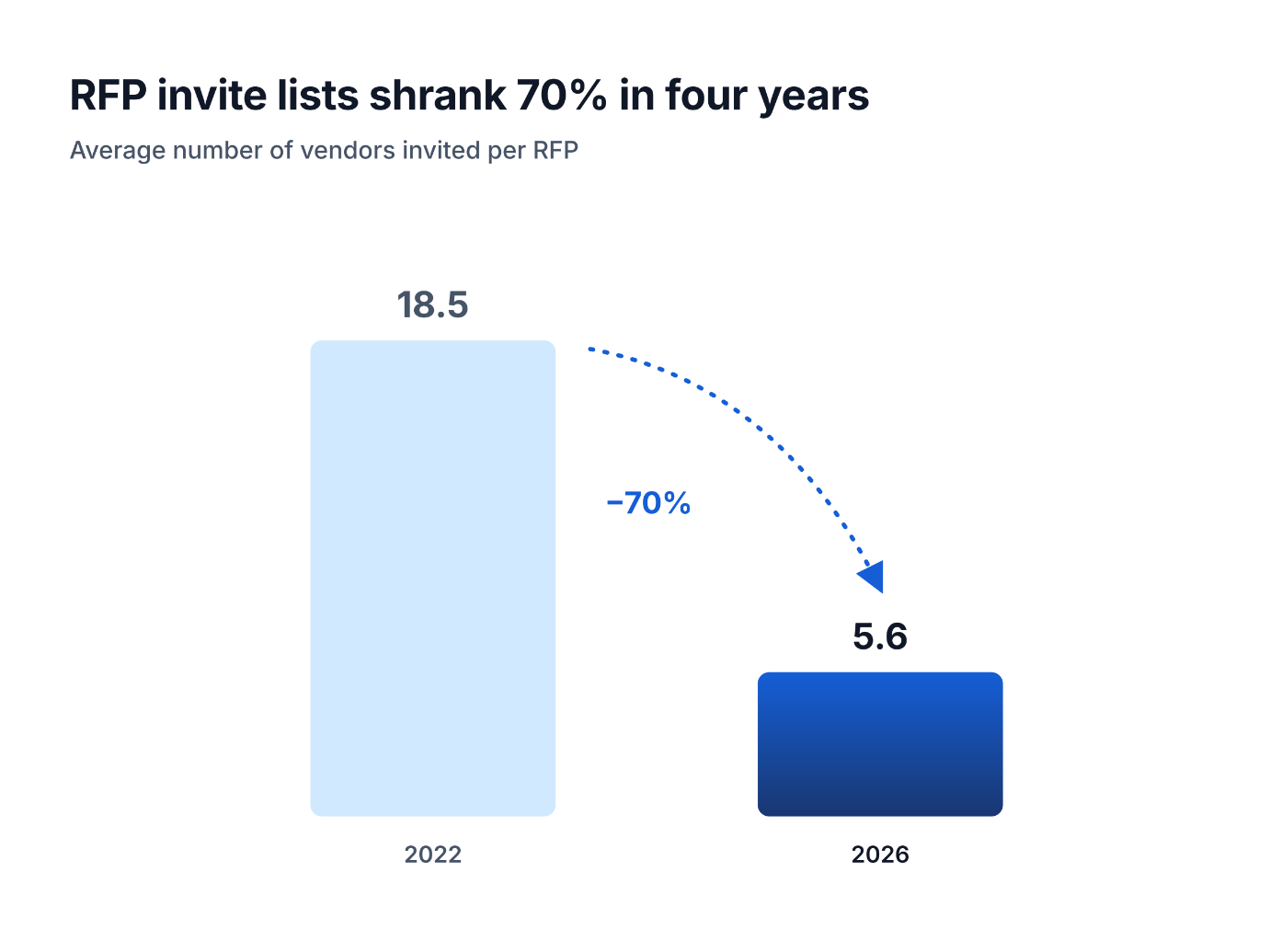
Shortlister data shows that the average number of vendors invited to an RFP fell from 18.5 in 2022 to 5.6 in 2026. That represents a 70% contraction over four years.

The shrinking shortlist is one of the clearest employee benefits trends of 2026, pointing to a convergence of forces restructuring the vendor selection process before the formal evaluation begins.

The RFP Shortlist Has Contracted Every Year

The decline in the RFP shortlist is a steady, multi-year pattern with no single market event behind it. 

Invitation lists have narrowed every year since 2022.

Year Average Vendors Invited Annual Change
2022 18.5 Baseline
2023 12.3 -33.50%
2024 8.8 -28.50%
2025 6.7 -23.90%
2026 YTD 5.6 -16.40%

Fewer RFP invitations could look like brokers and employers do less market research. Instead, Shortlister’s wider dataset points in the opposite direction.

Broker research intensity increased 74% over two years. Consultants conducted an average of 14.3 vendor searches per RFP in 2026, compared with 8.2 in 2023.

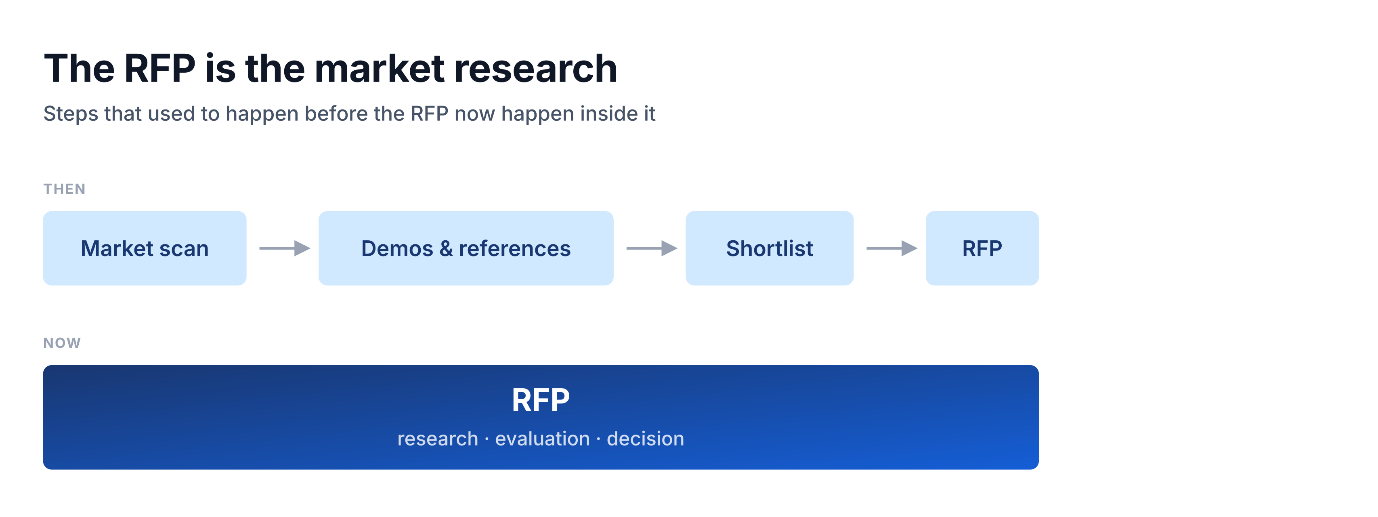
A closer look at the data shows that in 2023, consultants invited an average of 12.3 vendors to an RFP after conducting just 8.2 searches. In other words, the RFP itself was the market research.

By 2026, they had run nearly three searches for every invitation issued

Discovery still happens, only earlier, inside marketplace databases and AI research tools, rather than inside the RFP.

The RFP Now Validates Rather Than Discovers

Front-loaded diligence appears to be one of the strongest explanations for the contraction.

Earlier RFPs often mixed discovery with evaluation. A long invitation list helped an employer learn who operated in the category and what the category could do.

Nowadays, buyers can answer much of that before contacting a vendor. 

Product-level profiles, more precise category taxonomies, outcomes data, and pricing structures now exist in marketplace databases that buyers can search long before drafting a single question.

Vendors who fail those screens never receive an invitation, however persuasive their proposal might have been.

Stage Earlier Model Current Model
Market discovery Broad RFP invitation Marketplace and AI-assisted research
Initial screening Vendor questionnaire Product-level profile
Formal RFP Discovery and comparison Validation of fit
Sales engagement Early education Detailed discussion with pre-qualified buyers

How early do vendor preferences form? 

Research from Bain’s 2026 analysis with LinkedIn shows that around 90% of buyers ultimately purchase from their day-one list of vendors.

AI Is Changing Who Gets Considered

The biggest change in recent years is the growing role of generative AI in independent research. Buyers can now scan broader markets, compare vendor claims, identify patterns, and surface potential candidates far faster than before.

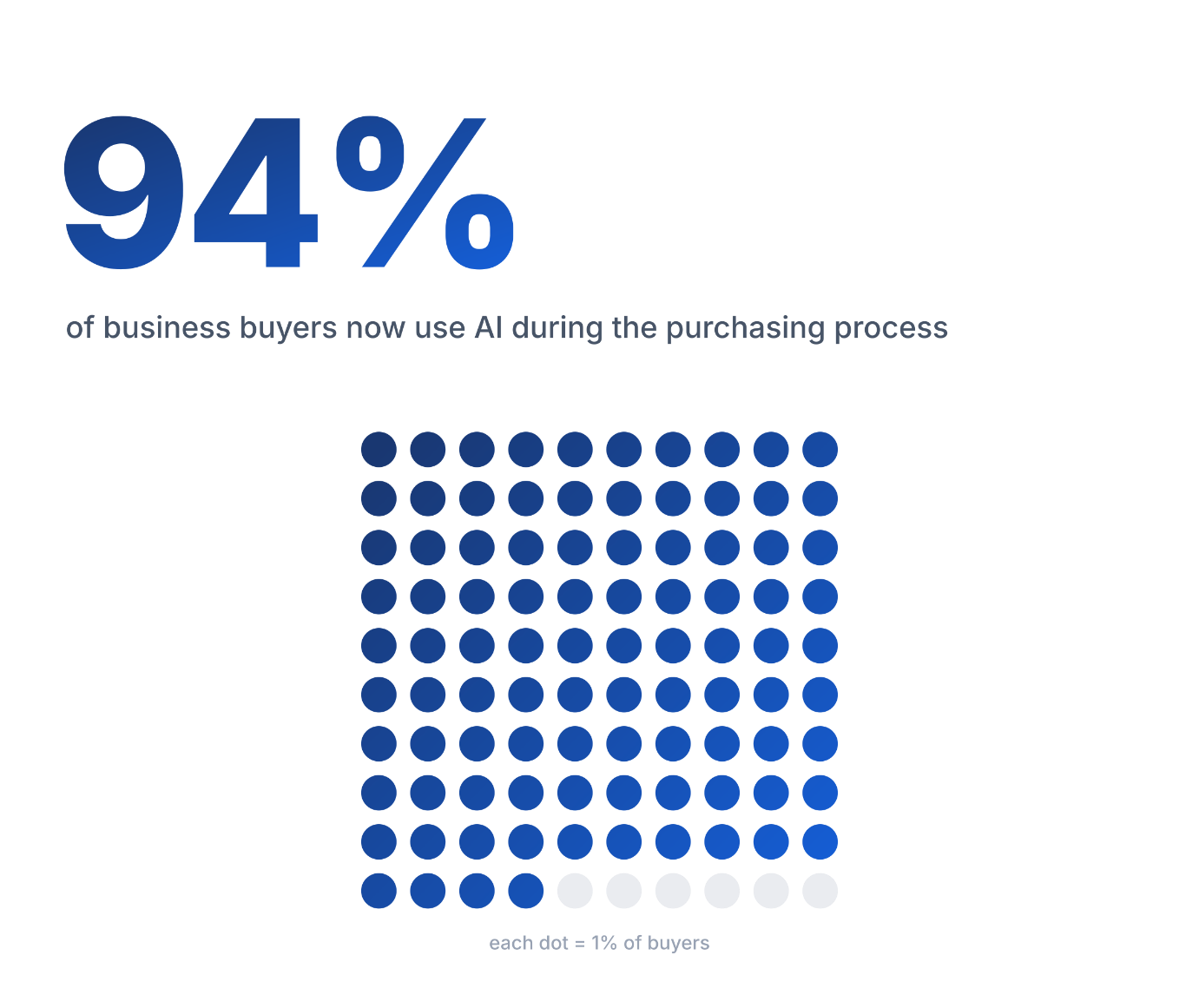
Forrester’s Buyers’ Journey Survey found that 94% of business buyers now use AI during the purchasing process.

The share ranking generative AI or conversational search as a more meaningful source of information than any other, including vendor websites and sales teams, doubled in a single year.

However, the same research revealed a trust gap. 

While 36% of buyers said AI made them more confident in their decisions, 20% reported the opposite, citing unreliable or inaccurate information. 

As a result, we now have a layered vendor selection process in which buyers increasingly use AI for speed and scope, then turn to peer reviews, industry experts, and direct vendor engagement to validate what the tools produce.

Crowded Portfolios Raise the Bar for New Vendors

In 2026, most employers are managing layers of point solutions added over several buying cycles, often with separate contracts, different reporting formats, and uneven employee adoption. 

The rise of benefits navigation services is partly a response to this fragmentation.

PwC’s Employer Benefits Perspective Survey found that one-quarter of employers’ work with more than twenty health and wellness vendors, while most others manage at least eight to ten.

With less room for another solution, brokers and employers are scrutinizing fit more closely before a vendor reaches the RFP. That means assessing not only capabilities, but also implementation demands, integration requirements, employee relevance, and overlap with existing partners.

Financial pressure makes that early filtering more important. 

Business Group on Health’s 2026 Employer Health Care Strategy Survey projects a median 9% health care cost increase. The same survey found that 51% of employers were changing or conducting an RFP for health and well-being vendor relationships. 

Employers are still spending, but the standard has risen. 

Each candidate is now measured against tighter cost discipline and performance proof, weighed against the option of adding nothing new.

Evaluation Capacity Limits the Field

Shortlister now tracks more than 290 active benefit categories, which means brokers are screening an increasingly broad market. 

However, benefits teams do not gain more procurement capacity because the market has created more choices. 

Shortlister’s observed enterprise evaluation cycles commonly run for 90 to 120 days. Assessing dozens of vendors across demonstrations, security reviews, implementation planning, outcomes analysis, and contract terms would consume hundreds of hours.

Most internal benefits teams cannot support an evaluation of that scale. 

Brokers are therefore expected to narrow the field in advance and present only the vendors that appear most closely aligned with the employer’s needs.

How Vendor Mergers Affect the Numbers

Buyer behavior is only one side of the explanation. 

Over the last few years, the supply side has also been reorganized through acquisitions and platform consolidation.

Rock Health recorded 195 digital health M&A deals in 2025, a 61% jump from 2024. Digital health companies themselves drove two-thirds of those acquisitions, with private equity accounting for another 10%. Shortlister’s monthly industry coverage tracks this steady flow of acquisitions, mergers, and product combinations across benefit categories.

Growth-stage companies are increasingly acquiring smaller players for their talent and customer bases. Private equity, meanwhile, is consolidating fragmented categories into larger platforms. 

Consolidation also reshapes how employers buy. 

When a single platform can address what once required several point solutions, the appetite for separate evaluations fades. As a result, in some categories, consolidation may reduce the number of distinct vendors available for invitation.

What a Shorter Shortlist Means for Vendors

Much of the contraction sits outside any vendor’s control – changing buyer behavior, limited evaluation capacity, or market consolidations.

What remains within a vendor’s control is better visibility at the point of research.

In a process where buyers reach the RFP with a shortlist already in mind, marketing has greater influence than sales over who earns an invitation. Product profiles, webinars, case studies, and other educational content often shape that decision before a sales conversation begins.

Incomplete profiles, outdated claims, and vague differentiation can remove a vendor from consideration without its team ever knowing an opportunity existed. 

Vendors should therefore use every available opportunity to demonstrate what their product does, who it serves, and why it deserves a place on the shortlist.

On a Final Note

The benefits shortlist is shrinking because several filters now operate before the RFP begins. Brokers conduct more research, employers want fewer vendor relationships, and mergers are changing which companies remain distinct competitors.

Once an RFP contains only a handful of credible finalists, the commercial advantage belongs to the companies that were easy to find and credible before the invitation was issued.

Written by Ivana Radevska

Senior Content Writer at Shortlister

Benefits Navigation

Browse our curated list of vendors to find the best solution for your needs.

Stay Informed

Subscribe to our newsletter for the latest trends, expert tips, and workplace insights!

Related Posts

The Shrinking Shortlist

Shortlister data shows that the average RFP now includes fewer than six vendors. The vendor selection process has moved upstream, where research and AI increasingly decide who reaches the formal evaluation.