Why Long Sales Cycles Are the New Normal in Benefits?
From multi-month to multi-stakeholder evaluations, long sales cycles reflect a market that has fundamentally changed, favoring vendors that choose preparation over pressure.
Much of the infrastructure around benefits vendor selection assumes cost drives decisions. It’s the easiest variable to compare across competing proposals, and often the first line item a buyer sees.
A competitive price is alluring on a first look, but Shortlister data shows that other vendor selection criteria actually shape the final decision.
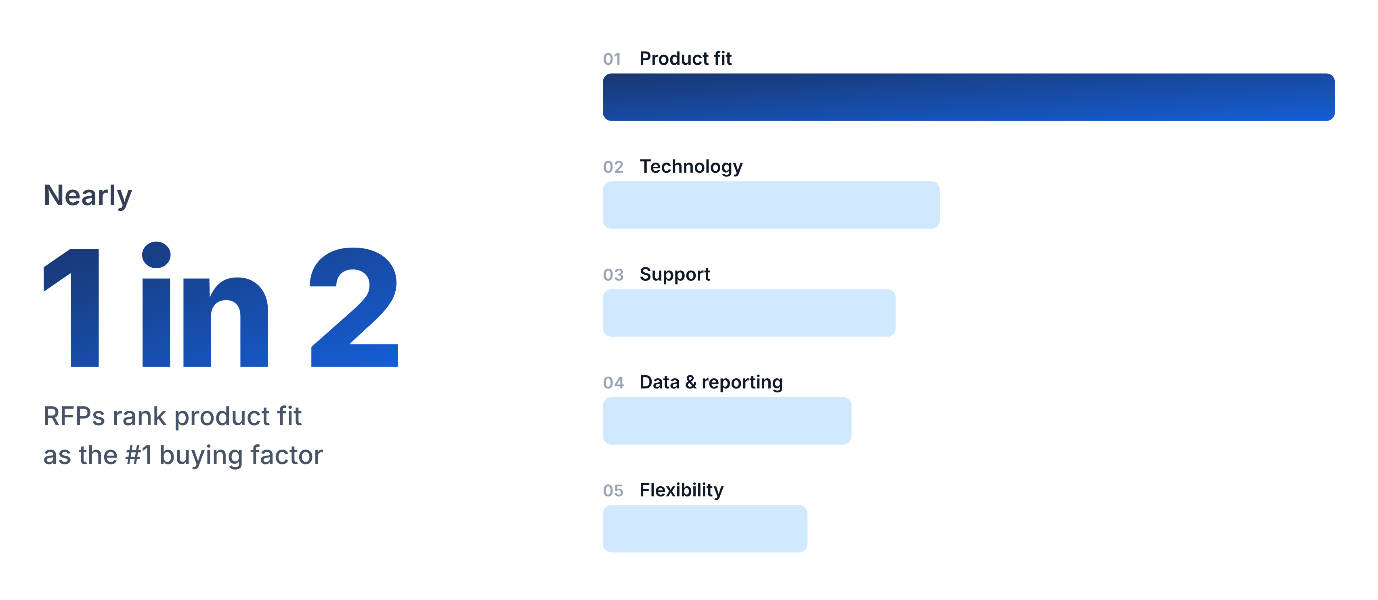
Product fit was the top-ranked factor in almost half of all recent RFPs on the platform, followed by technology, support, data and reporting, and flexibility.
Employers evaluate solutions across multiple scopes, weighing immediate requirements against long-term impact. And price is often a qualifying factor, but once a vendor’s cost falls within an acceptable range, the evaluation shifts to criteria that predict performance.
In the nearly 230 RFPs Shortlister examined, product fit was the top consideration 103 times, just under 45% of the total.
Technology ranked second, cited as the top factor in 47 RFPs.
Customer support, data and reporting, and flexibility also mattered, but to a lesser extent.
The expansion of categories and point solutions has changed how employers choose benefits vendors. With more options to weigh, buyers now spend more time on diligence during the sales cycle, letting product-level criteria, rather than price alone, decide the outcome.
Product fit is a broad label for a specific question: does the vendor’s solution match the operational realities of the environment it’s being sold into?
The answer is subjective and depends on how well it solves the problem.
A wellness platform built for a remote-first workforce addresses a different need than one built for an in-person manufacturing workforce. Both can be well-designed and priced comparably yet perform very differently once deployed.
The degree to which the solution aligns with the company’s workforce, HR processes, benefits strategies, existing technology, and long-term goals becomes the real differentiator.
For employers, this determines the value they receive.
For vendors, it changes what a strong pitch looks like.
Demonstrating fit means specific evidence: similar clients, plan structures, and populations served, rather than general capability claims. A vendor that can answer the fit question stands in a stronger position than one that leads with price.
Price is the easiest variable to standardize in RFP.
It’s comparable across vendors and negotiable, which has made it the default basis for how vendors position themselves.
Fit, on the other hand, is harder to standardize because it depends on judgment rather than a single feature. That’s exactly what makes it more consequential.
Choosing the wrong product is arguably more expensive.
A vendor can win on price and still raise the buyer’s total cost of ownership, through low utilization or added administrative burden. In employee benefits, those costs accumulate over time, making fit a stronger predictor of long-term value than price.
Product fit outranking other vendor selection criteria suggests buyers are willing to spend more time evaluating solutions, because the alternative costs more.
The first cost is administrative.
Employers already spend an average of 24 hours a week managing vendors and benefits, according to Evernorth. That baseline burden exists regardless of fit.
A product that doesn’t fit its population adds friction on top of it. HR teams end up manually compensating for gaps.
The second cost shows up in utilization.
Hartford’s 2025 Future of Benefits Study found that low utilization affects 75% of employers, largely because employees are dissatisfied with their benefits or don’t understand how to use them. When employees disengage from their benefits, employers keep paying for programs that never deliver their intended value.
A vendor that wins on price and loses on fit doesn’t eliminate that cost. It defers it to a point in the relationship where it’s harder to see and walk away from.
Fit and technology lead the list, but price still matters greatly.
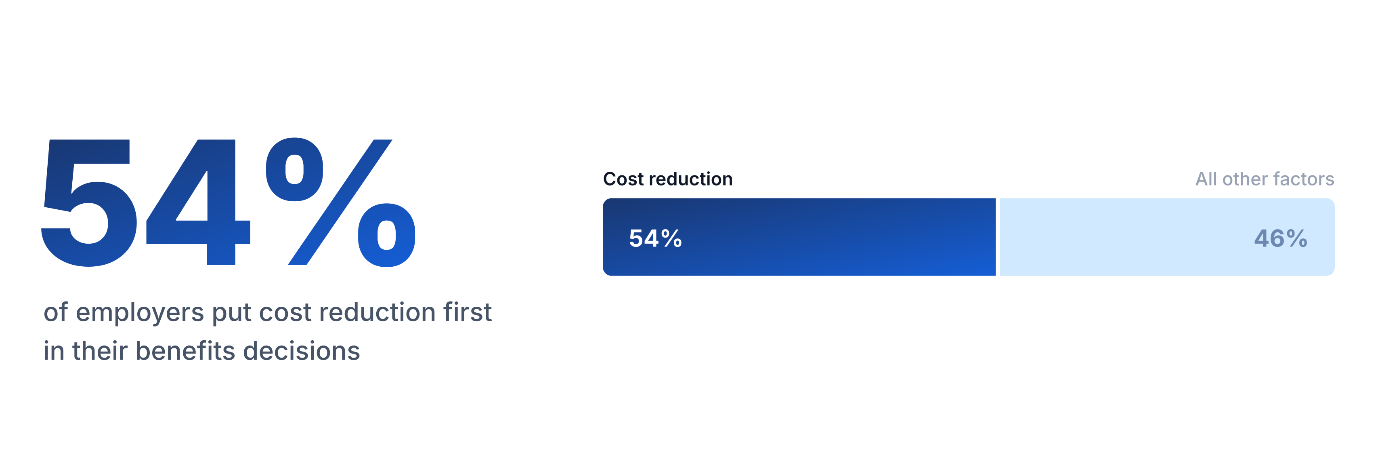
Lockton’s 2026 National Benefits Survey found that 54% of employers identify cost reduction as the most important factor in their benefits decisions, up from 38% the year before, driven by sustained increases in health care cost trends heading into 2027.
According to Deloitte’s 2025 Global Chief Procurement Officer Survey, improving margins through cost reduction was the top enterprise priority for 2025, cited by 72% of respondents.
Cost gets a vendor into the RFP and fit decides whether it stays there.
A cost-driven trigger and a fit-driven decision sit at different stages of the same process, which is why both numbers can be true without contradicting each other.
Technology ranked second, cited as the top factor in 47 out of 230 RFPs.
There’s more to its runner-up finish than the ranking alone suggests.
Once a buyer confirms a vendor can meet functional requirements, attention shifts to technical fit, or how well the solution operates inside the buyer’s existing environment.
A strong product can lose value if the implementation is complex or creates extra overhead.
Technology has also become inseparable from the employee experience.
Employers expect solutions that integrate with HRIS, payroll, performance management, and benefits administration systems, and every manual workaround adds cost and erodes confidence.
Technology’s second-place finish is really an extension of fit, which lines up with a broader shift in how vendors present themselves.
Artificial intelligence is becoming one of the most visible tests of technology readiness in benefits RFPs.
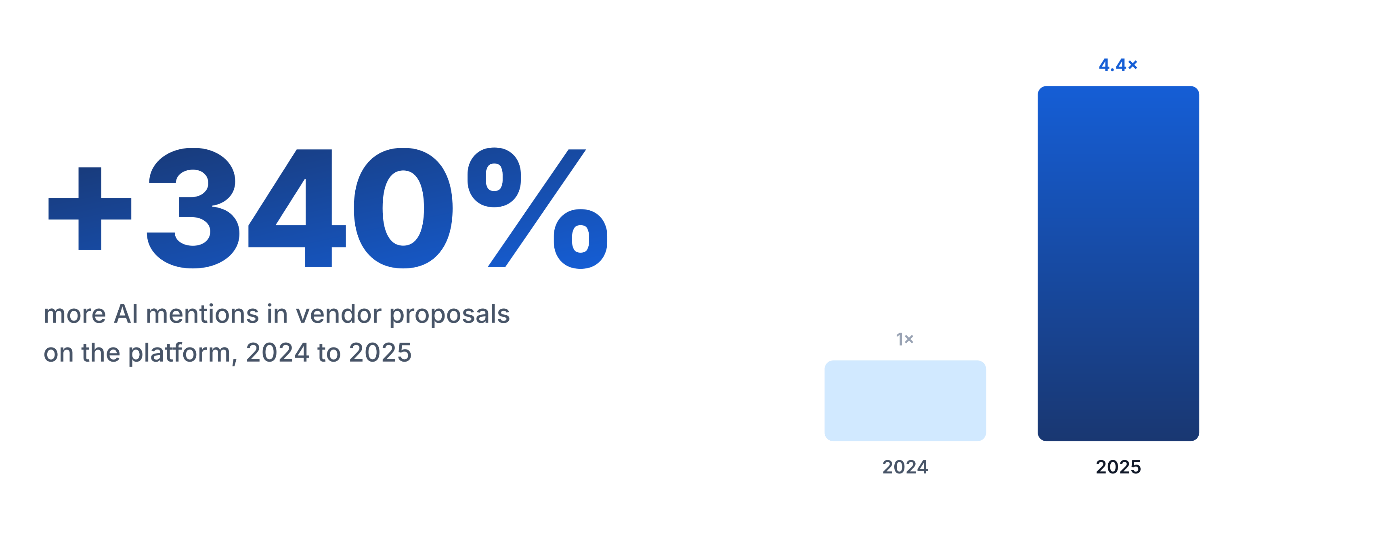
Shortlister’s 2026 Wellness Trends Report tracked a 340% increase in AI mentions across vendor proposals on the platform between 2024 and 2025. The report also found that employers now routinely expect AI-driven targeting and recommendations as standard in finalist evaluations.
A few years ago, AI features set a vendor apart from competitors, but this advantage has narrowed.
Now, it’s a baseline requirement, and those without a specific, substantiated AI story risk elimination in early evaluation rounds.
This creates a more difficult problem than simply adding AI language to the proposal.
Vague claims about AI-powered features can hurt a vendor’s prospects more than leaving AI out of the proposal, particularly with benefits buyers who research extensively before an RFP.
The solution is specificity.
Even a single measurable result holds more weight than a general AI description or unsupported claims about efficiency and automation.
Product fit and technology outrank support and flexibility in stated priority. That doesn’t mean support and flexibility matter less.
The Kano Model, a framework for how product attributes affect satisfaction, offers a useful way to understand why. It separates features into categories, one of which is the “must-be”, or attributes that earn little credit when present but cause real dissatisfaction when missing.
Support and flexibility fit that description closely.
Employers rarely choose a vendor based on exceptional support.
However, they notice unresponsiveness immediately, and that absence can outweigh strengths in other areas. Flexibility works the same way once a workforce’s needs shift and the platform can’t keep up.
This helps explain why these criteria rank lower in stated priority, even though their consequences are high.
Harvard Business Review’s B2B Elements of Value Research found a gap between what buyers say drives their decisions and what actually predicts loyalty.
When asked directly, more than 2,300 corporate decision-makers ranked cost reduction as their top priority. But when the researchers ran the statistical analysis, cost reduction ranked 27th out of 36 elements.
The strongest loyalty predictors were product quality, vendor expertise, and responsiveness, elements that sit closer to support and ease of doing business than to price.
The pattern held for repurchase, too.
Seven of the ten elements most predictive of retention sat in the “ease of doing business” tier, and product quality, vendor expertise, and responsiveness again topped the list, even though respondents hadn’t named them as priorities up front.
There is an overlap in vendor selection criteria and turnover.
From 2019 through 2023, product fit, technology, and support responsiveness were the top three reasons for changing benefits vendors, according to Shortlister data.
These factors are nearly identical to those that determined which ones were selected in the first place.
Vendor selection is ultimately a long-term test of the original decision. What employees look for in benefits vendors during evaluation becomes the standard for their retention.
Cost pressure isn’t going away, but employers are changing how they respond to it.
WTW’s 2025 Benefits Trends Survey found that employers are renegotiating contracts, shifting to preferred provider networks, testing new pricing models, pushing for transparency, and seeking partners that deliver measurable outcomes.
That changes what a winning RFP response looks like:
As employers place greater emphasis on long-term value, the most successful vendors will be those that show how their solution can support the workforce beyond the initial purchase decision.
Content Writer at Shortlister
Browse our curated list of vendors to find the best solution for your needs.
Subscribe to our newsletter for the latest trends, expert tips, and workplace insights!

From multi-month to multi-stakeholder evaluations, long sales cycles reflect a market that has fundamentally changed, favoring vendors that choose preparation over pressure.

With half of all benefits contracts spanning three years, the stakes and long-term value of the outcome become much higher for buyers and vendors alike.

Over 290 categories later, the market is turning with more urgency to solutions whose primary function is to make sense of all the others.

Across nearly 230 recent RFPs, product fit ranked as the top vendor selection criterion by a wide margin. That pattern should change how vendors build their pitch.
We're working hard to make it easy for you. Sign up for news, trends and insights.