Shortlister Data

The GLP-1 Ripple is Showing up in Buying Behavior

High demand for GLP-1s creates pressure to investigate coverage, but it does not determine in which category the eventual RFP will land in.
In This Post:

Shortlister’s marketplace activity offers an early indication of where benefits spending may move next.

When it comes to GLP-1 employer coverage, our data signals a widening gap between interest and commitment.

Broker demand is accelerating, but formal purchasing decisions are developing more cautiously as employers confront harder questions about cost, clinical support, outcomes, and long-term program design.

Broker Interest Has Reached a New High

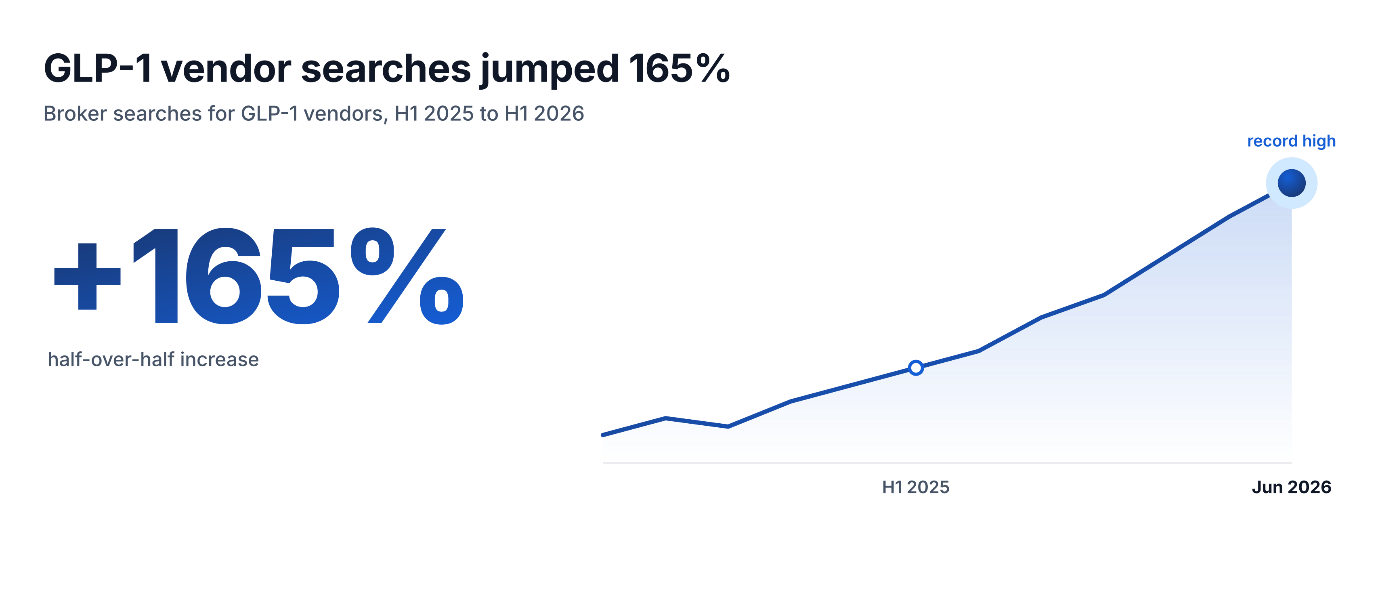
Broker searches for GLP-1 vendors for employers increased 165% between the first half of 2025 and the first half of 2026. June 2026 recorded the highest monthly search volume on Shortlister. 

Over the same period, cardiometabolic health moved from no RFP activity to the fastest-growing RFP category on the platform.

The rise in marketplace activity corresponds with wider GLP-1 adoption.

Gallup reported in July 2026 that 11% of U.S. adults currently take a GLP-1 medication for weight loss, up from 3% in 2024. 

PwC reported in June 2026 that roughly one in five U.S. households (21%) included a current GLP-1 user, up from 9% in January 2025.

As the medications become more common, brokers are being asked to identify available vendors, compare service models, and determine where GLP-1 support belongs within the existing benefits portfolio.

In short, demand for GLP-1 medications is sustained, measurable, and growing. Yet the Shortlister data reveals a more complicated buying pattern. 

So, what is slowing buyers down just as GLP-1 interest peaks?

What the Search-to-RFP Gap Actually Measures

Part of the gap is vocabulary, not intent. 

A search often begins with the most recognizable term. For brokers scoping the market, “GLP-1” is the natural starting point.

However, a GLP-1-specific RFP may be too narrow once employers begin evaluating prescribing, ongoing treatment support, and integration with existing benefits.

Marketplace signal Change What it captures
GLP-1 vendor searches Up 165% Early research around medication access and support
Cardiometabolic health RFPs Fastest-growing RFP category Formal evaluation of a broader condition-management model

On the other hand, purchasing several point solutions can create the opposite problem by dividing responsibility across multiple vendors and contracts.

Cardiometabolic care has emerged as a solution with a more workable frame. 

It allows brokers to evaluate medication access alongside obesity, diabetes, cardiovascular risk, and the coordination required between them.

The Drug Has Outgrown Its Original Benefit Category

Another contributing factor is that coverage, and by extension RFP design, was once easier to divide by diagnosis.

Diabetes treatment sat within established diabetes management and chronic care programs, while obesity was typically addressed through weight-management benefits. 

However, as GLP-1s have expanded across more conditions, the boundaries between traditional benefit categories have become less clear.

For example, the FDA has approved Wegovy to reduce serious cardiovascular events in some adults with obesity or overweight, and to treat a serious liver disease. 

Zepbound is approved to treat obstructive sleep apnea in adults with obesity. Ozempic slows kidney disease progression and reduces cardiovascular death risk in type 2 diabetes with chronic kidney disease.

A new indication does not automatically mean coverage. It does, however, increase the pressure to provide it.

The Persistent Effect of High Costs

The widening clinical scope problem is also a potential cost problem. 

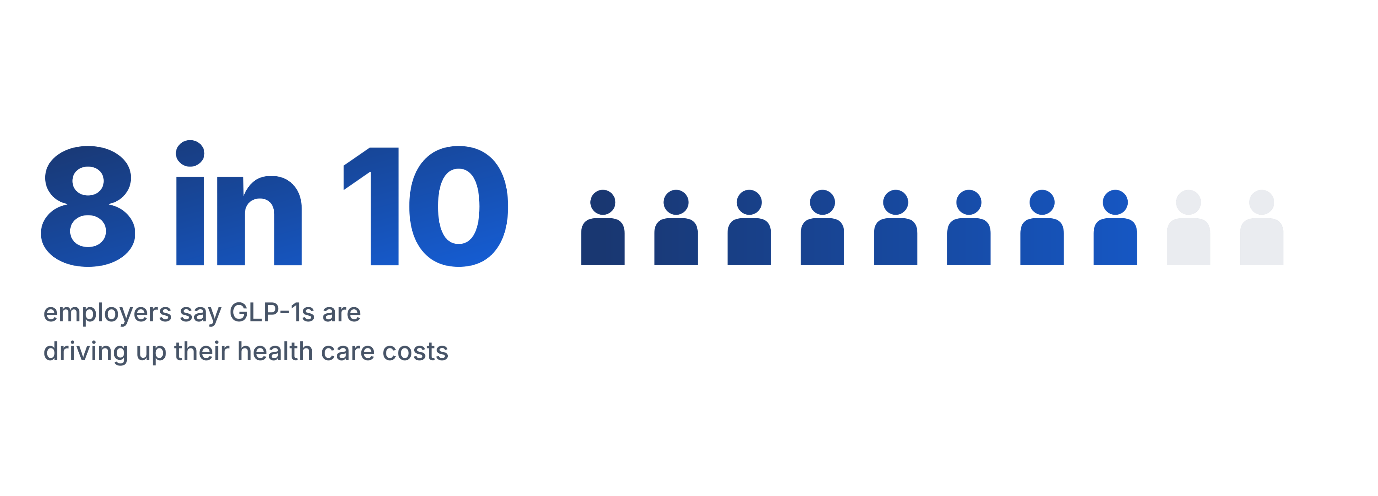
A 2026 Business Group on Health survey found that nearly eight in ten employers said GLP-1s were increasing their health care costs.

Although 67% covered the medications for weight management, only 72% of that group said they were likely to continue coverage in 2027. Another 10% said they were likely not to.

Rising research activity may therefore reflect cost pressure as much as expansion.

Employers may be evaluating vendors to preserve coverage under tighter rules, replace an existing arrangement, assess a broader clinical model, or determine whether the benefit remains sustainable.

Cost Control Moves into Program Design

Financial pressure has pushed employers to also build more GLP-1 coverage controls into plan design and vendor contracts. 

The Business Group on Health survey found employers validating eligibility through:

  • Objective biometric data 
  • Required participation in weight-management programs 
  • Prescriptions limited to selected providers 
  • Formulary exclusions for certain medications

The pressure on these controls is likely to grow now that oral GLP-1 options are widening access. Wegovy tablets became the first oral GLP-1 approved in the U.S. for weight management in late 2025, and Eli Lilly’s pill Foundayo followed shortly after.

Employers expect the convenience of a pill to increase demand without bringing comparable price relief. Some 87% of employers expect oral options to raise demand, while only 9% expected prices to fall. 

Vendors will therefore need to demonstrate how their clinical models manage demand and costs rather than relying on lower drug prices.

The ROI Evidence Arrives Later Than the Cost

GLP-1 spending begins as soon as members fill out their prescriptions. 

The outcomes employers hope will offset that expense, such as fewer complications, lower cardiovascular risk, and reduced medical claims, may take several years to become visible.

That mismatch in expectations is already visible in the data. 

Research found that more than half of employers covering GLP-1s for weight management expect significant clinical benefits

However, few had seen those effects in their aggregated claims.

That gap helps explain why buying remains cautious. Employers are paying in the current plan year for value that sits outside it.

Evidence window Useful measures What the evidence can support
Near term Eligibility accuracy, engagement, treatment persistence, clinical change and medication spending Program performance and early clinical value
Longer term Durability, complications avoided and total medical cost Financial value across the covered population

Near-term evidence gives employers something to track while the longer-term case builds. Vendors demonstrate their value better when they state plainly what they measured, which comparison group they used, which costs they counted, and over what period.

What Buyers Need to Define Before an RFP

The purchase becomes easier to evaluate once four questions have clear answers:

  • Which members and approved indications fall within scope?
  • Who owns the treatment pathway, including prescribing, clinical support, and coordination with existing benefits?
  • Which controls manage access and cost, and what trade-offs do they create?
  • Which near-term measures will be used before longer-term claims outcomes become visible?

For GLP-1 vendors, a defined scope sells better than a broad claim. GLP-1 point solutions need to show how medication access connects with clinical management and financial controls.

Vendors selling wider metabolic health benefits need to explain where medication fits alongside existing diabetes and chronic care programs.

On a Final Note

The search-to-RFP gap is not hesitation about whether GLP-1s matter. It reflects a market still deciding what  durable purchase looks like – a drug benefit, a condition-management program, or something in between. 

Vendors that make that model clear will be better positioned to turn interest into formal evaluations.

Written by Ivana Radevska

Senior Content Writer at Shortlister

GLP-1 Companies

Browse our curated list of vendors to find the best solution for your needs.

Stay Informed

Subscribe to our newsletter for the latest trends, expert tips, and workplace insights!

Related Posts