
What are Health Advocacy Programs?
In response to the demand for an improved consumer experience, both employers and insurers recognized and addressed the need for health advocacy programs.

Despite being illegal and a violation of human rights, research shows that sexual harassment in the workplace has not decreased over time, even with growing awareness.
It often begins quietly, through hints, small comments, or subtle forms of coercion.
However, when these situations intersect with authority over employment decisions, the impact becomes even more profound.
Such power imbalances often leave employees vulnerable, raising an important question: What is quid pro quo harassment in the workplace, and how can leaders respond to address it?
Quid pro quo harassment refers to a specific form of misconduct that happens when someone in a position of authority demands sexual favors from a subordinate in exchange for other “benefits” (e.g., hiring, promotion, or avoiding punishment).
The phrase itself represents an exchange in which one thing is offered in return for another, often implying a favor or benefit. It originates from the Latin “quid pro quo,” which means “something for something” or “this for that.”
An example of quid pro quo harassment is when a manager threatens to fire an employee unless they agree to a sexual advance, or a professor offers better grades in exchange for unwelcome sexual conduct.
Fundamentally, environments with uneven power distribution, such as the workplace, are particularly susceptible to this form of misconduct.
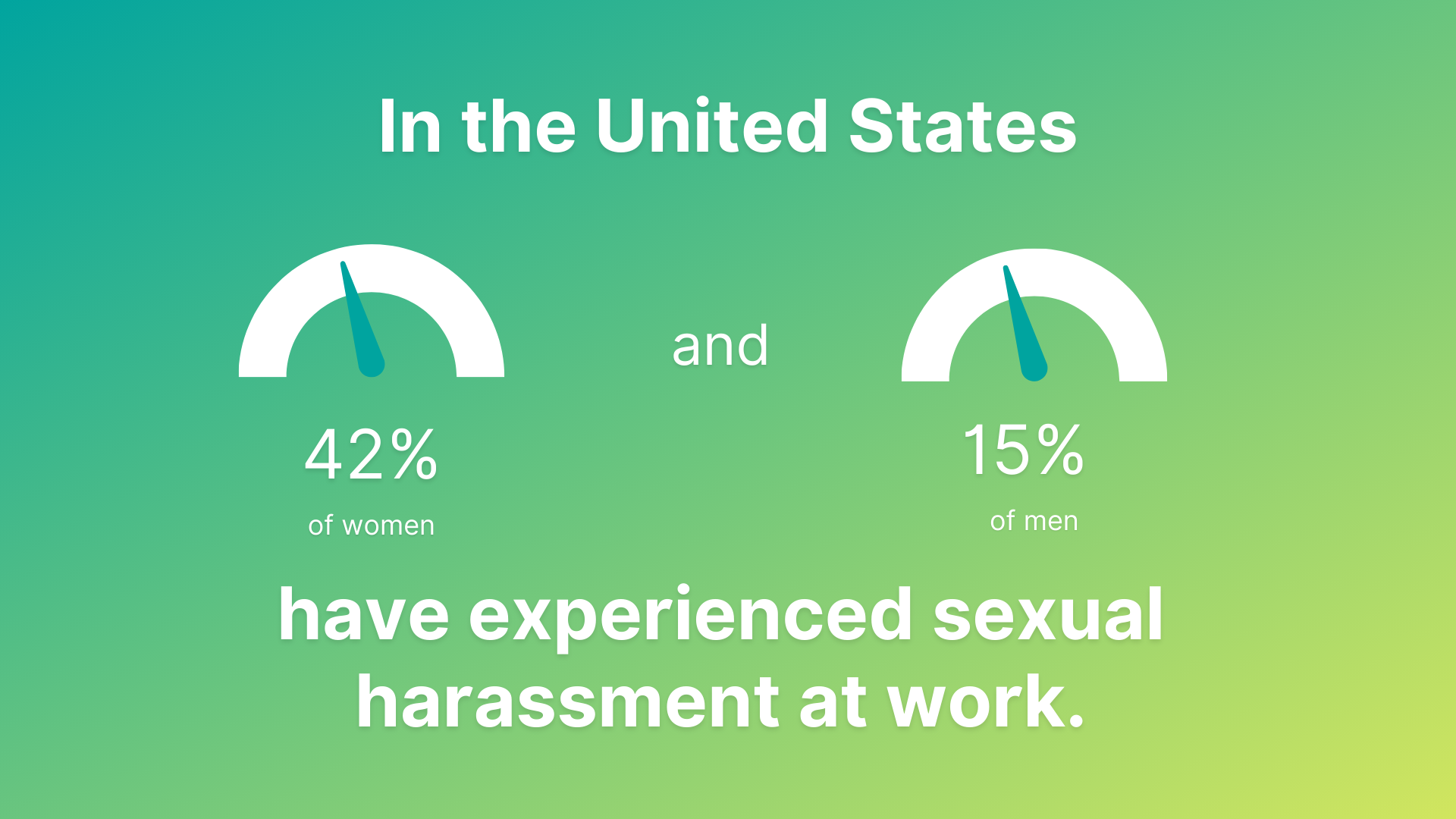
In the United States, approximately 42% of women and 15% of men have experienced sexual harassment at work.
Research also found that women in male-dominated occupations were 2.4 times more likely to be harassed by a supervisor.
Awareness of this abuse of power can help prevent harm to the company and, more importantly, to its employees.
So, what is quid pro quo harassment in the workplace, and what exactly does it look like?
Abusive workplace behavior comes in many forms, ranging from verbal to physical. Broadly defined, it’s unwelcome conduct that affects an employee’s ability to perform their job or influences employment decisions.
Quid pro quo harassment falls under the category of sexual harassment in the workplace. It can be spoken, visual, or physical abuse, all of which are forms of discrimination.
However, in each of its forms, its defining feature is conditionality.
A person in a position of authority uses their power to offer advantages, such as promotions or job security, or they threaten adverse outcomes in exchange for personal or sexual compliance.
Unlike other forms of harassment (e.g., a hostile work environment), it isn’t defined by repeated behavior. In fact, a single incident can be sufficient to trigger it. Therefore, quid pro quo harassment is particularly challenging to identify and prevent, posing a significant liability for the company.
Authority and power sit at the core of quid pro quo harassment.
The individual engaging in misconduct typically holds real or perceived control over another person’s employment conditions. This control may include decision-making authority or influence over those who make final decisions.
Due to this imbalance, the law imposes a heightened responsibility on those in power to act appropriately. Leaders must recognize how their position affects others and refrain from behavior that could be perceived as conditional or coercive.
The exchange element is what legally defines quid pro quo harassment.
There is an explicit or implicit bargain (or threat) in which an employee is expected to provide something personal in return for a job-related benefit or to avoid a negative outcome.
This exchange may be stated directly or suggested through tone, context, or repeated behavior.
The law recognizes both exchanges as actionable.
It’s important to note that the exchange does not require acceptance, meaning that even when the employee refuses and suffers no immediate harm, the attempt itself can still constitute as quid pro quo harassment.
Workplace harassment can take various forms, typically categorized as verbal, visual, or physical. Quid pro quo harassment examples for each include:
In other words, an example of quid pro quo harassment is any situation in which an employer, supervisor, manager, or senior employee uses their authority in job-related decisions as leverage to obtain compliance from the employee.
Quid quo pro harassment and a hostile work environment are both types of workplace sexual harassment.
The first typically centers around conditional employment actions and threats.
Hostile work environment harassment, on the other hand, refers to pervasive or severe conduct that creates an intimidating or abusive work environment. It can be based on sex, race, religion, or other protected characteristics.
Legally, they are two separate concepts, but they share some similarities and can occur together, making their distinction a critical aspect of addressing employee harassment.
| Quid Pro Quo Harassment | Hostile Work Environment | |
|---|---|---|
| Legal definition | Employment decisions are conditioned on submission to unwelcome sexual conduct | Unwelcome conduct based on a protected characteristic creates an abusive work environment |
| Who commits it | Usually, a supervisor or someone with authority | The harasser can be anyone (supervisor, colleague, or third party) |
| Basis | Submission or rejection affects employment decisions | Harassing conduct interferes with work performance |
| Frequency | Often, a single incident is enough | Usually repeated or pervasive behavior |
| Employment impact | Direct, tangible job consequences | Psychological or emotional harm affecting work |
| Protected basis | Typically, sexual conduct | Any protected class, including sex, race, religion, etc. |
| Employer liability | Strict liability if proven | Depends on the employer's knowledge and response |
| Common examples | Threat of termination for refusing sexual advances | Repeated slurs, insults, sexual jokes or comments, unwanted sexual displays, etc. |
Although they differ legally, both forms of sexual harassment can easily overlap.
An employee may experience ongoing inappropriate conduct that creates a hostile work environment while also facing conditional threats or promises tied to job status.
In such cases, companies may face liabilities under both standards.
Therefore, a clear distinction helps ensure proper response and HR investigation.
Prevention strategies for both cases of harassment may overlap, but the legal thresholds differ. Each involves different elements of proof, liability standards, and employer responsibilities.
Since courts analyze these claims under different legal frameworks, understanding what quid pro quo harassment is and properly distinguishing it from a hostile work environment determines the evidence required and the defenses available to the employer.
Also, addressing one doesn’t automatically resolve the other, and comprehensive anti-harassment polices should clearly define both forms and explain how employees can report concerns without fear of retaliation.
The U.S. Equal Employment Opportunity Commission (EEOC) defines workplace harassment as a “form of employment discrimination that violates Title VII of the Civil Rights Act of 1964, the Age Discrimination in Employment Act of 1967 (ADEA), and the Americans with Disabilities Act of 1990 (ADA).”
More specifically, quid pro quo harassment is illegal under Title VII of the Civil Rights Act, which prohibits sexual harassment in the workplace, including unwelcome sexual advances, unwanted touching, offensive sex-based remarks, and requests for sexual behavior.
Hostile work environment, as another form of sexual harassment, is also illegal under Title VII.
Victims, regardless of sex or sexual orientation, can pursue legal action with evidence of threats. They must file a complaint with the appropriate agency within the required time limits.
Employers may be subject to punitive damages if they are aware of the violation but fail to address or prevent it properly.
Employees who experience any form of harassment should report it immediately through the available internal channels, such as human resources or a designated manager identified in the company’s anti-harassment policy.
They should follow internal procedures first, particularly when the employer has policies and safeguards against retaliation.
In this stage, clear facts are paramount.
The worker must convey what was said or done, who was involved, a clear timeline of events, and how it affected a job-related decision. Written records, including emails and messages, as well as witnesses, can support the report.
When internal reporting is ineffective or feels unsafe, one can file a “Charge of Discrimination” with the EEOC as an external enforcement body in the United States.
The time limit for this is 180 days (but may be extended by state laws), or 45 days for federal employees.
Employees can also seek legal counsel to understand all of their options under the specific circumstances of their situation.
Regardless of the reporting route, workers have legal protection against retaliation.
Therefore, employers who discourage or penalize individuals for raising concerns may face additional legal consequences.
It’s essential to note that the laws also apply to job applicants, as they may be subject to quid pro quo harassment during the recruitment phase.
Liability for harassment is strict and well established under EEOC guidance.
An employer is automatically responsible when a supervisor’s inappropriate behavior results in tangible employment action, such as termination, failure to promote, refusal to hire, or loss of pay.
Therefore, in quid pro quo harassment cases, employer intent or prior knowledge is not required for liability.
However, when misconduct results in a hostile work environment without a direct employment action, liability is usually more limited.
In such cases, employers can rely on the Faragher-Ellerth Defense. This legal defense enables them to limit liability by demonstrating that they took reasonable steps to prevent and promptly correct the behavior, and that the employee failed to utilize available reporting channels.
The Faragher-Ellerth defense does not apply to quid pro quo harassment cases because a tangible employment action is involved. When job outcomes are conditioned on unwelcome conduct, reactive measures alone are not sufficient to avoid responsibility.
The severity of sexual harassment, especially quid pro quo, demands a proactive approach, primarily through higher awareness.
Unfortunately, there’s a significant gap in this area.
Although at least one in three women has been harassed at work, research shows that up to 75% believe sexual harassment is not common. The findings also indicate that this is a far more prevalent issue than most realize, disproportionately affecting young women ages 18-29.
Addressing it after it happens rarely prevents harm to employees or the company entirely.Therefore, recognizing the early signs is paramount.
They may differ depending on perspective, but often share common themes of the misuse of power and conditional treatment.
Employees should be aware of behaviors that suggest job outcomes are being influenced by personal or sexual compliance, which include:
Leadership and HR should be alert for patterns of favoritism in the workplace or signs that may indicate abuse of authority:
In larger companies, these patterns may not appear in isolation but rather emerge through a broader review of feedback and HR records to identify suspicious employment decisions. Therefore, it’s important to use multiple sources for tracking (e.g., manager input, internal audits, and employee feedback) supported by tools such as HRIS or internal reporting portals.
Prevention begins with clear expectations and consistent enforcement.
In addition to overall awareness and recognition of early signs, strong policies, targeted leadership training work together to establish expectations, identify risks early, reinforce accountability throughout the company, and create a safe environment for all employees.
An effective anti-harassment policy clearly defines what quid pro quo harassment is and distinguishes it from other forms of workplace misconduct. As such, it should contain:
To remain effective, policies must apply equally to all employees, including executives, and must clearly state that there are consequences for violations, regardless of seniority.
With a formal policy in place, another crucial step is to improve education on this sensitive topic, which companies can achieve through consistent, targeted training that addresses the potential misuse of power.
Executive training programs can strengthen leadership skills, but they should have a specific focus on how authority and influence can, intentionally or unintentionally, create coercive situations.
Supervisors and managers must understand that their conduct is held to a higher standard, while leadership should recognize early warning signs and respond appropriately to concerns.
Prevention efforts fail when employees don’t feel safe coming forward.
Research consistently shows that victims underreport sexual harassment or pursue legal remedies, despite widespread laws.
One of the reasons for this is fear of retaliation and worsening their work conditions.
Therefore, addressing this issue goes beyond formal policies or ongoing training and requires an environment where speaking up is treated as a protected and respected act.
Leaders play a central role by setting expectations that reports will be taken seriously and handled with discretion. Clear communication about anti-retaliation protection and a visible accountability signal that the company has a zero-tolerance culture for harassment.
Practical safeguards also reinforce this culture.
Confidential reporting channels and well-documented investigations help remove uncertainty for employees considering whether to come forward, and make it easier for them to seek help before misconduct escalates.
Any form of harassment or discrimination undermines workplace fairness and leadership integrity. However, sexual harassment is even more destructive, since it’s widespread, costly, severely underreported, and persistent despite being illegal in most developed countries.
Understanding what quid pro quo harassment is and how to prevent it becomes the foundation for companies that want to protect their employees. It reinforces workplace ethics and sets a standard that authority and power should never be used for personal gain.
Content Writer at Shortlister
Browse our curated list of vendors to find the best solution for your needs.
Subscribe to our newsletter for the latest trends, expert tips, and workplace insights!
In response to the demand for an improved consumer experience, both employers and insurers recognized and addressed the need for health advocacy programs.

Explore the concept of imputed income, its tax implications, and the importance of accurate reporting to understand how employers handle imputed income on pay stubs and tax forms.

If two different people with the same prescription medicine get two different bills for the same medicine, it makes you wonder – how is the price of the prescription medicine determined?

While the federal minimum wage sparks a debate about whether or not it needs to be increased, one thing is certain – business owners must stay up-to-date with the latest labor law changes.
We're working hard to make it easy for you. Sign up for news, trends and insights.