Fair Workplace Practices

Best Practices for Managing the Employee Exit Process

If endings shape the whole memory, why treat the exit process like admin work instead of strategy?
In This Post:
Expert Contributors:
Picture of Jeffrey Zhou

Jeffrey Zhou

CEO & Founder of Fig Loans

Picture of Joern Meissner

Joern Meissner

Founder & Chairman, Manhattan Review

Picture of Matthew Crook

Matthew Crook

General Manager, PeopleHR Evo

Picture of Tracey Beveridge

Tracey Beveridge

HR Director, Personnel Checks

Picture of Brian Nguyen

Brian Nguyen

Managing Partner, Universal Law Group

The employee exit process is one of the few moments when an organization is watched by three audiences at once: the person leaving, the team staying, and the future candidates reading reviews.

Despite this, the employee exit process has been an afterthought for decades, and a growing body of research shows us exactly what that neglect costs. 

So, what does an employee exit process look like when it’s done right, and why do so many smart companies still get it wrong?

What Is the Employee Exit Process?

What is the employee exit process? The textbook answer includes everything from resignation to last-day paperwork, but the real scope is much broader than that.

As Joern Meissner, Founder & Chairman of Manhattan Review, explains, “Everything that happens between an employee’s resignation or termination notification, their last day on the job, and any subsequent actions is part of the employee exit process.”

The reality is that for most organizations, the exit process of an employee is reduced to logistics: laptop returned, badge revoked, payroll processed.

But behavioral economists have long understood that endings disproportionately shape how people remember entire experiences.

Why the Final Weeks Outweigh the Years

There’s a concept in behavioral psychology called the “peak-end rule,” first described by Nobel laureate Daniel Kahneman. It suggests people judge an experience largely based on how they felt at its most intense point and at its end. 

Applied to employment, this means an employee’s final weeks can reshape their entire perception of years spent at a company.

A decade of good work can be overshadowed by a cold or disorganized final two weeks. In the end, it is that memory that the former employee carries into Glassdoor reviews, LinkedIn updates, and decisions about whether to ever return.

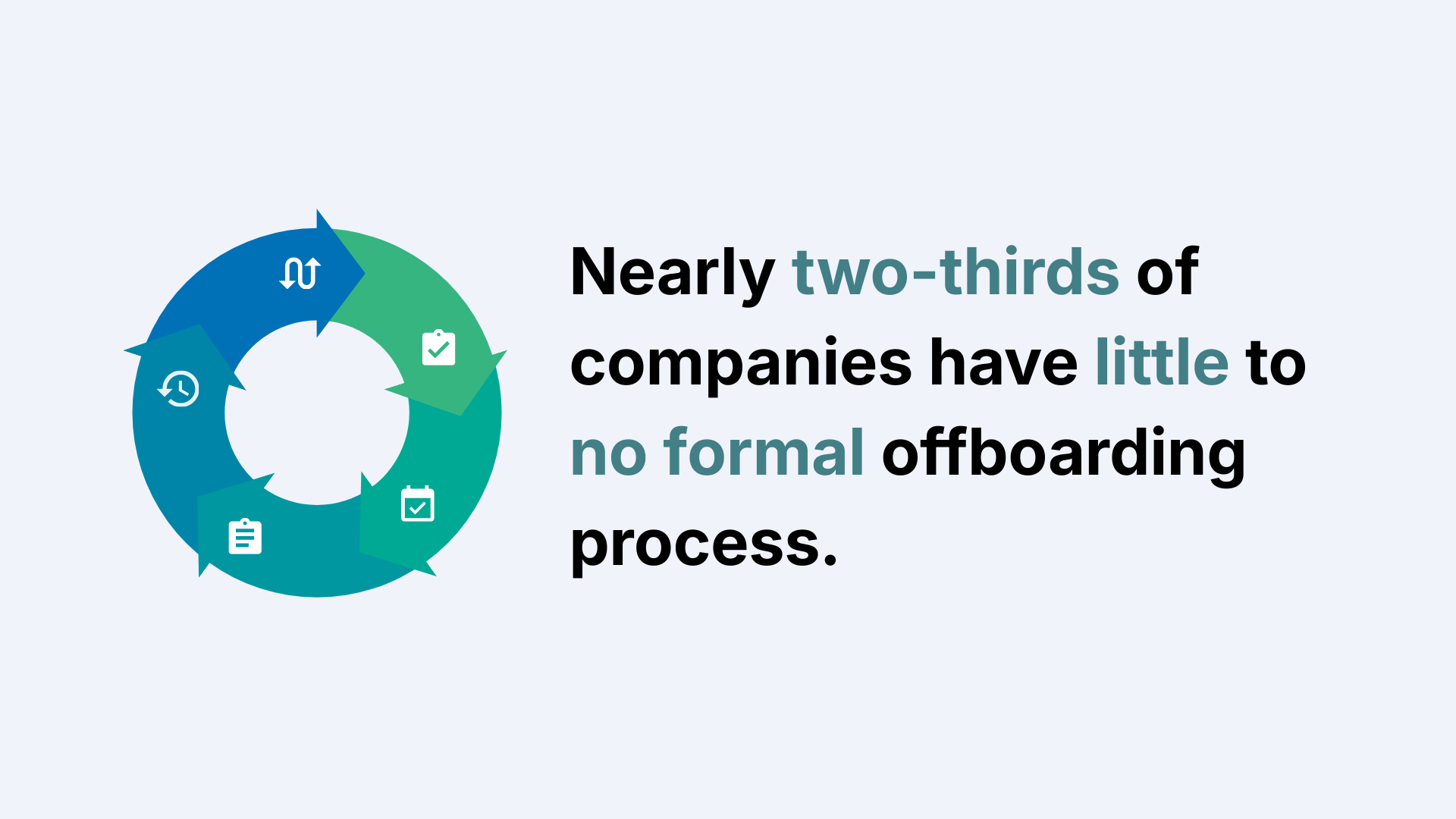
Despite the high stakes, a Panopto report found that nearly two-thirds of companies have little to no formal offboarding process at all. In other words, the employee exit procedure at most organizations is essentially improvised every single time.

What a Poor Employee Exit Procedure Really Costs

Most companies budget carefully for hiring employees. However, very few have any idea what they’re spending when someone leaves. 

In reality, the actual cost of a poor employee exit process shows up in many areas.

The Replacement Math

Research from SHRM estimates that replacing a single employee in 2025 can cost between 50% to 200% of that person’s annual salary, depending on seniority.

Gallup breaks this down further, stating that replacing executives and managers costs approximately 200% of their annual pay, technical professionals about 80%, and frontline staff around 40%.

Those numbers capture recruitment, employee onboarding, and ramp-up time. What they often miss is the cost of the transition itself. Amongst many other issues, a poorly managed employee exit prolongs the vacancy, burdens the remaining team, and erodes confidence in leadership – all adding up in hidden costs. 

The Boomerang Effect

According to ADP Research, 35% of all new hires in March 2025 were boomerang employees returning to previous employers, up from 31% a year earlier and the highest share ADP has tracked since 2018. 

What makes this relevant to exit costs? Every boomerang hire the company doesn’t get back is a replacement it has to source, interview, and train from scratch. 

Gallup’s exit experience research found that among employees who were extremely satisfied with their exit process, 24% said they’d be extremely likely to accept a future job offer from their former employer. 

Among those who weren’t satisfied, the number drops to just 4%. The exit process, in other words, is a future recruitment channel.

Legal Exposure

The financial damage goes beyond recruitment costs when an exit meeting goes sideways. Brian Nguyen, Managing Partner at Universal Law Group, has seen firsthand what a careless HR exit conversation can cost.

"I've represented clients who lost five-figure settlements because a supervisor said something like 'finally getting rid of you' or made comments about the employee's age during termination. One case involved a manager who got frustrated and mentioned the employee 'couldn't keep up anymore.' That single phrase during a 10-minute meeting cost the company $40,000 to settle an age discrimination claim."
Brian Nguyen
Managing Partner, Universal Law Group

Nguyen adds a useful diagnostic, saying, “The clearest signal an exit went wrong is when former employees immediately lawyer up or file complaints with the EEOC or TWC within days. When exits go right, you hear nothing.” 

The Knowledge Drain

Replacement costs assume the new hire can eventually do the same work, but what happens when the knowledge that made the departing employee effective was never written down?

Matthew Crook, General Manager of PeopleHR Evo, identifies the core issue, stating, “The most common pitfall of the exit process is the failure to complete a comprehensive knowledge transfer. New hires will be forced to start from scratch, which can lead to bad habits, lost efficiency, project delays, and missed institutional knowledge.”

Indeed, Harvard Business Review research found that the cost of losing subject matter experts can be up to 20 times higher than typical recruitment and training costs. 

In practice, an organization might replace the person in six weeks but spend months trying to reconstruct what the previous person knew.

The Vanishing Social Network

When a valued employee leaves, the disruption goes far deeper than simply the loss of knowledge. Jeffrey Zhou, CEO and Founder of Fig Loans, explains, “The main reason a team slows down when a high-performer leaves is that employees function as nodes in a social network. In addition to taking their knowledge and experience with them, they’re also removing the informal ‘bridges’ that exist between various departments. Work usually gets done through these unofficial relationships that don’t show up on a formal flowchart, and when that network breaks, the new hire ends up hitting every single bureaucratic bump.”

Zhou provides a practical solution: have the departing employee create a list of every person they interact with to get their work done.

The Security Gap

In a world of SaaS sprawl and remote work, the exit process of an employee has become a cybersecurity event, whether companies treat it as one or not.

According to an Osterman Research study, 89% of employees could still access sensitive corporate applications after their departure. A Beyond Identity study found that 83% of former employees still had access to digital assets at their previous employer, and 56% of those who retained access admitted to using it to harm their former company.

Modern HRIS systems can automate deprovisioning workflows, but only if the offboarding process is structured enough to trigger them.

Common Pitfalls That Derail the Offboarding Process

Even well-meaning organizations tend to make the same handful of mistakes. Some come down to process, others to culture, but nearly all can be avoided.

Delayed or Missing Communication

Ideally, departure news should be communicated immediately once finalized.

Matthew Crook warns that, “The failure on the part of management to inform teams or clients of a departure can lead to an erosion of trust and uncontrollable workplace gossip.” Every day of silence gives remaining employees more room to fill the gap with speculation.

The instinct to keep resignations quiet is surprisingly common, and even understandable to a degree. But inevitably, word gets out anyway, and when it does, the team loses trust in leadership’s transparency.

Untrained Managers in Exit Conversations

Manager training on termination and exit conversations should be as standardized as interview training. In most organizations, it barely exists.

Brian Nguyen‘s observation here is worth noting, as he shares, “Companies who mess up exits once tend to repeat the pattern, because they never trained managers on what not to say when someone’s walking out the door.” 

Far too frequently, companies invest weeks preparing managers to conduct hiring interviews and nothing at all in preparing them for the conversation on the other end.

Ignoring the Morale of the Remaining Team

Gallup’s research found that 24% of voluntary leavers encountered rudeness or hostility from their manager during the exit process. Current employees watch how the company treats their departing colleagues and draw conclusions.

Are the remaining team members being asked about their workload after a departure? Are they given clarity about what happens next? When multiple employees leave without a clear communication plan, uncertainty and burnout runs rampant among remaining staff, often triggering additional departures.

Building a Better Employee Exit Checklist

So, what does a well-run employee exit checklist include?

Tracey Beveridge, HR Director at Personnel Checks, reinforces the importance of preparation, saying, “The level of prior planning is what gives an immediate signal on whether an exit is successful. Those who have had exit processes in place from the outset and have built businesses for exit typically then see a smoother process, because they’ve had those plans from the start.”

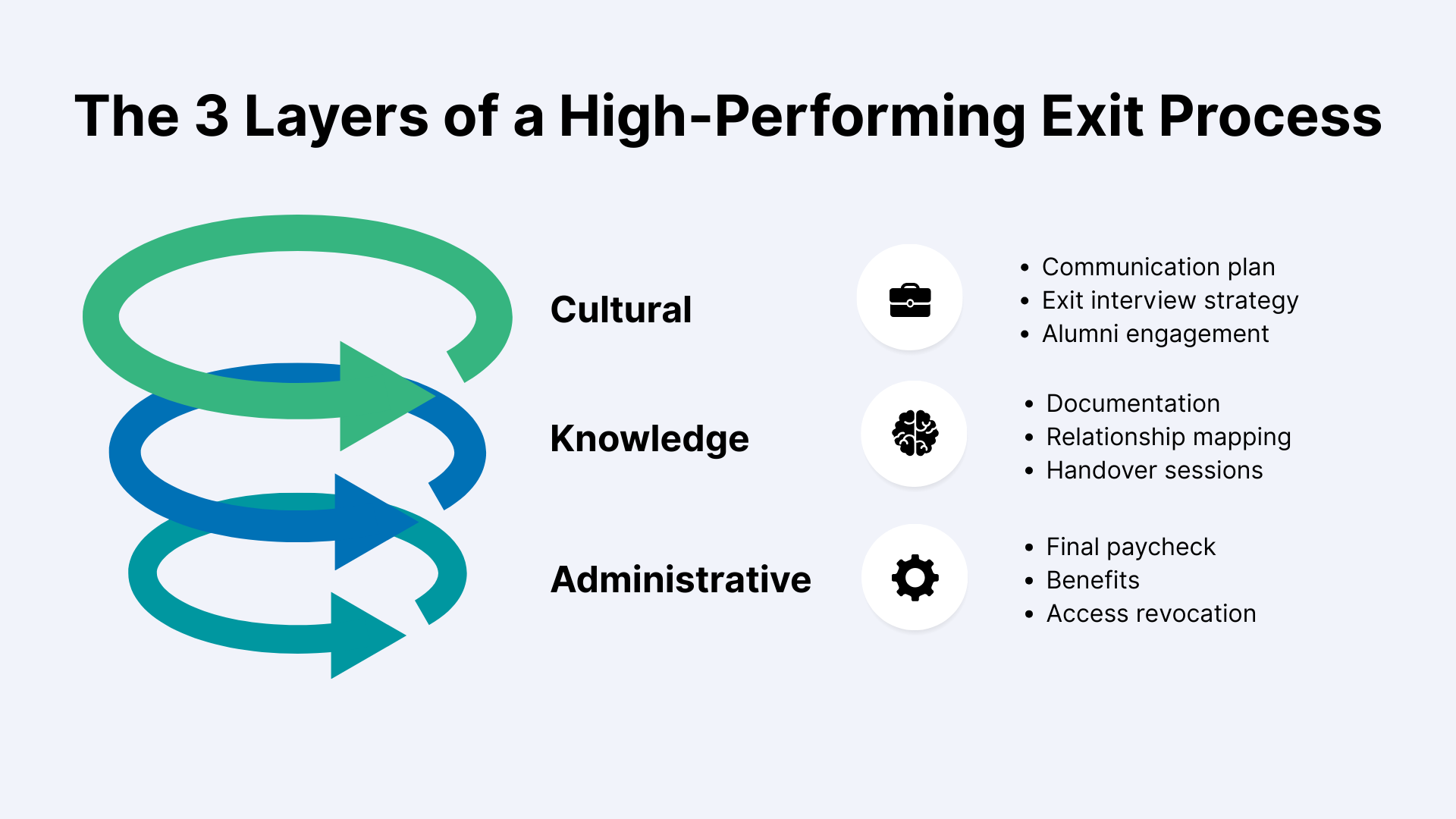
A comprehensive employee exit checklist should address three layers:

  • Administrative – Final paycheck, benefits continuation (COBRA administration), equipment return, system deprovisioning, NDA review
  • Knowledge – Process documentation, relationship mapping, project handover meetings, access to shared drives and institutional knowledge bases
  • Cultural – Internal communication plan, team morale check-ins, exit interview scheduling, and alumni relationship strategy

Most staff exit checklists cover only the first layer. The second and third are where the actual value resides, and where most companies leave the biggest gaps.

"The level of prior planning is what gives an immediate signal on whether an exit is successful. Those who have had exit processes in place from the outset and have built businesses for exit typically then see a smoother process, because they've had those plans from the start."
Tracey Beveridge
HR Director at Personnel Checks

Rethinking the Exit Interview

One Robert Walters survey found that nearly one in four employers simply file exit interview feedback away with the resignation letter and never act on it. Among executives surveyed by HBR, fewer than a third could name a specific action their company took as a result of exit interview data.

Part of the problem is the questions themselves. Most exit interviews ask some variation of “What made you leave?”, which sounds reasonable but functions poorly.

The departing employee has already made their decision. They have little incentive to offer thoughtful consulting for free, and every reason to keep things polite to avoid burning bridges. A better exit interview question is, “What would make someone in your role stay longer?”, which turns the departing employee into a strategic advisor for the person who comes next.

Even the right questions fall flat without follow-through. Joern Meissner highlights this as the real gap, saying, “The incorporation of departing employees’ suggestions is an essential part of the exit process. HR must examine the data, extract useful insights, and modify internal policies and procedures.” 

Gathering feedback without acting on it creates a performative ritual that departing employees see through immediately. A simple quarterly review of exit interview themes, shared with leadership, can turn a compliance exercise into a genuine feedback loop.

The Exit Is the Strategy

Every organization has a hiring strategy and most have an onboarding program, yet very few have an exit strategy that reflects the same level of intentionality.

The employee exit process sits at the intersection of nearly everything that matters in people operations. It affects retention, recruiting, legal exposure, cybersecurity, knowledge continuity, and even revenue. Still, less than half of departing employees (45%) say they were satisfied with how their organization handled their departure.

Ultimately, companies that invest in the beginning of the employee journey but neglect the end are leaving talent, knowledge, and money on the table every single time an employee departs.

Frequently Asked Questions

What Should Be on an Employee Exit Checklist?

A thorough employee exit checklist covers three areas: administrative tasks (final paycheck, benefits, equipment return, system access revocation), knowledge transfer (documentation, relationship mapping, project handover), and cultural actions (team communication, exit interviews, alumni engagement planning).

What Is the Difference Between an Offboarding Checklist and a Staff Exit Checklist?

The terms are often used interchangeably. An offboarding checklist typically emphasizes operational and IT steps (deprovisioning accounts, collecting devices), while a staff exit checklist may also cover broader HR tasks such as exit interviews, benefits counseling, and communication planning.  

Why Do Exit Interviews Often Fail to Produce Results?

Exit interviews fail primarily because organizations collect the feedback but never analyze or act on it. The questions themselves are often too vague, and departing employees have little incentive to be candid. Better-designed exit interviews ask specific, forward-looking questions and feed results into a quarterly review cycle.

Written by Ivana Radevska

Senior Content Writer at Shortlister

HRIS Systems

Browse our curated list of vendors to find the best solution for your needs.

Stay Informed

Subscribe to our newsletter for the latest trends, expert tips, and workplace insights!

Related Posts

Corporate Responsibility & Human Rights

When we talk about human rights violations, we often picture distant places with dictatorial regimes. But the truth is, human rights concerns aren’t confined to remote corners of the globe.

60+ Affirmative Action Statistics

Explore the comprehensive affirmative action statistics, gaining valuable insights into the impact and effectiveness of affirmative action policies in promoting diversity, equity, and inclusion in various sectors.