
Does Rage Applying Really Work?
Is rage applying just another short-lived TikTok trend or a promising employee strategy for landing a better job?


CEO & Founder of Fig Loans

Founder, eLearning Industry Inc

Managing Director at Electric Wheelchairs
Every interaction in the hiring process leaves an impression on candidates. From initial outreach to the final offer, consistency and clarity can make the difference between securing top talent and coming up short.
Full-cycle recruiting sustains this by managing all stages under a single, accountable workflow.
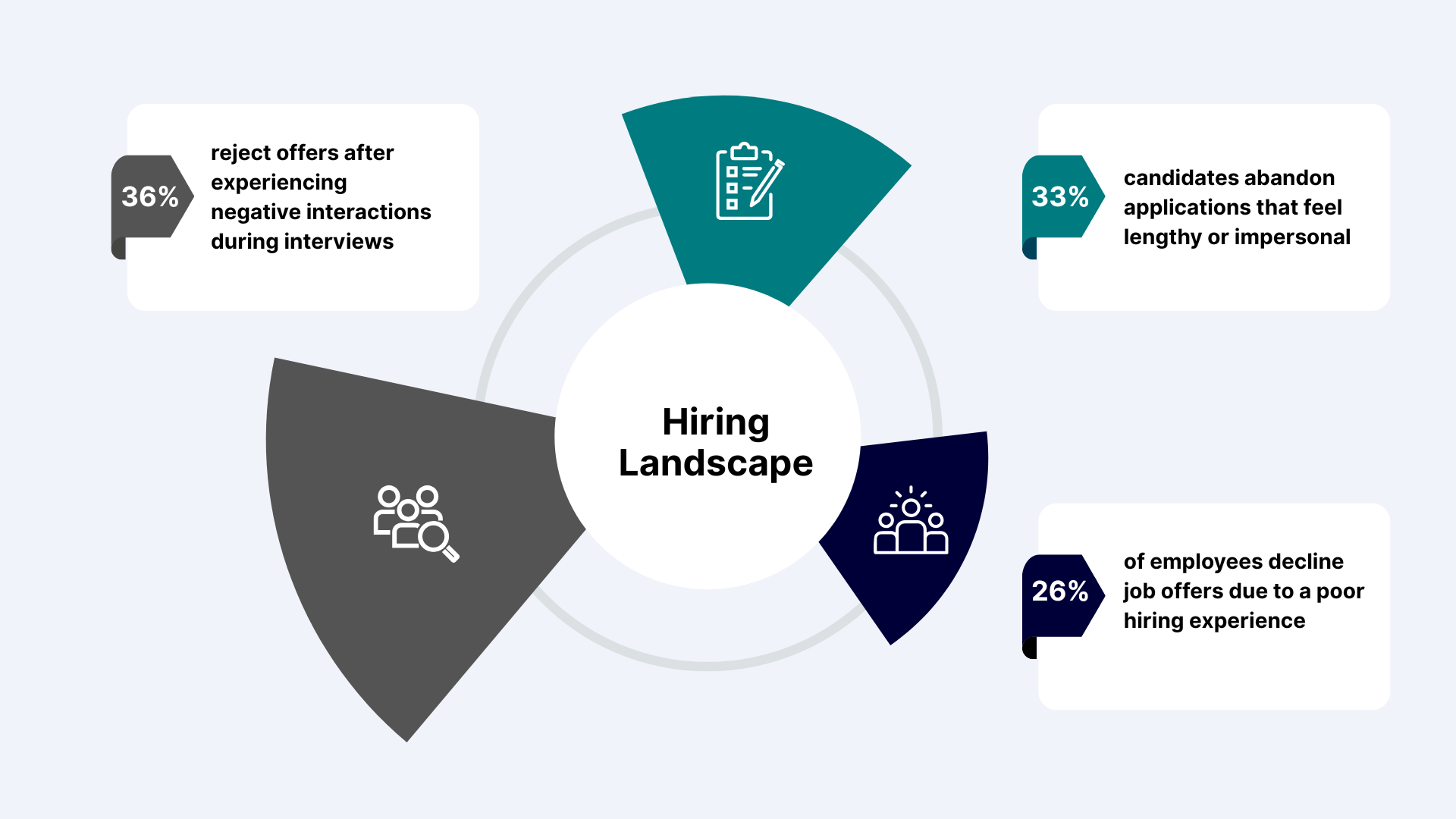
It addresses a fragmented hiring landscape, where, according to CareerPlug’s 2025 Candidate Experience Report, 26% of employees decline job offers due to poor experiences, such as unclear expectations or inadequate communication.
Findings from the report also show that candidates respond sharply to the design of the process. In fact, 33% abandon applications that feel lengthy or impersonal, and 36% reject offers after experiencing negative interactions during interviews.
End-to-end ownership provides recruiters with a clear view of the candidate journey. This visibility enables them to identify inefficiencies and ensure that every step – from preparation to sourcing, screening, interviewing, hiring, and onboarding – reinforces a positive experience.
A closer look at each step and how they work together uncovers the subtle ways consistency and attention can make hiring more effective.
Before diving into each step, we break down the fundamentals: what is full-cycle recruiting, and how does it differ from conventional, department-based recruiting models?
Full-cycle recruiting is a hiring approach in which a single recruiter manages the recruitment process from start to finish.
It’s also commonly referred to as end-to-end or 360 recruitment because it encompasses the “full circle” of responsibilities, navigating every stage from planning to onboarding, while maintaining ownership of the entire process in one place.
Unlike fragmented models that divide tasks across departments or roles, this approach ensures continuity and visibility across all touchpoints.
Recruiters become partners, not intermediaries, and play a central role in shaping the candidate experience from first contact to successful integration into the company.
Full-life cycle recruiting reimagines hiring as a connected journey rather than a series of isolated tasks. Recruiters guide candidates from first contact to onboarding, providing continuity, insight, and accountability.
Traditional recruiting often fragments this responsibility. Although it has its own benefits, this model relies on handoffs between teams, which can occasionally slow progress and weaken the candidate experience.
Recognizing the strengths and trade-offs of each approach provides a clearer perspective on how hiring processes impact both talent and business outcomes.
| Traditional Recruiting | 360 Recruiting | |
|---|---|---|
| Ownership | Divided across multiple teams or roles, allowing specialized focus | Typically managed end-to-end by one recruiter, offering continuity |
| Candidate Experience | Inconsistent and fragmented touchpoints | Continuous, personalized experience |
| Efficiency | Handoffs can slow the process, but they also allow for parallel task management | Streamlined end-to-end, but relies on recruiter capacity |
| Accountability | Shared responsibility can distribute risk | Clear ownership with measurable outcomes |
| Expertise | Each specialist provides deep knowledge in their area | A broad knowledge is required across all steps |
| Flexibility | Can scale easily across multiple roles and teams | Provides consistency, but may be harder to scale for large hiring volumes |
| Risk Management | Less dependent on a single individual | Dependent on one recruiter’s judgment and availability |
Hiring the right person is one of the most critical decisions a company makes. It’s a complex process with multiple stages, and errors at any point can have significant consequences.
According to McKinsey metrics, a skill gap can reduce productivity by 22%, while inefficiencies, such as an hour of unproductive labor per week, can cost roughly $15,000 annually.
Replacing a full-time employee adds an average of $52,000 in attrition and vacancy costs.
Full-cycle recruiting addresses these challenges by overseeing every stage of the hiring process within a single framework. Doing so promotes efficiency and consistency, which can lead to making a better hire.
However, the benefits emerge not from the individual steps, which largely mirror any hiring process, but from how they interconnect when properly managed. What follows is an exploration of the strategic value, common pitfalls, and overlooked opportunities within each phase.
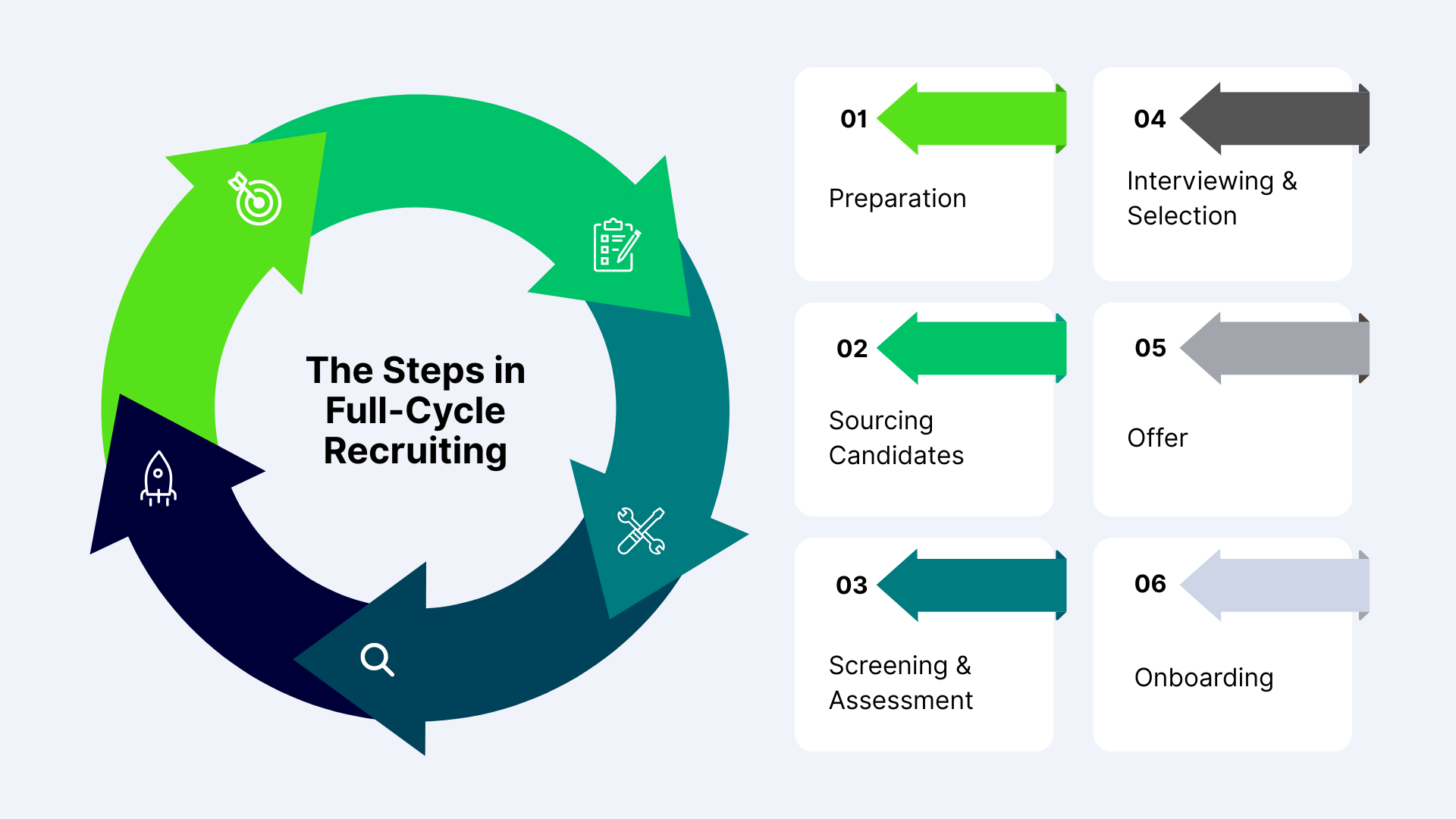
The preparation phase sets the foundation for a successful hire.
It begins with aligning stakeholders on the problem this role will solve, and the qualities needed to achieve this goal.
Rather than simply collecting a list of desired skills, adequate preparation involves everyone understanding the business context and why this position exists. It also answers how the role supports the broader team and company objectives.
Once this alignment is in place, planning can begin. This typically means creating a job description, defining salary ranges, outlining the ideal candidate profile, and establishing timelines based on the role’s complexity and market conditions.
When everyone shares the exact definition of success, sourcing becomes focused and avoids the late-stage misalignment that can derail recruitment.
Best Practices: When creating job descriptions, include pay upfront. CareerPlug’s report indicates that 47% of job seekers expect salary transparency, which builds trust and attracts more applicants.
Mistakes to Avoid: Most hiring mistakes begin with poor preparation. Skipping intake meetings or failing to define technical skills, experience, and team fit can lead to unclear expectations and inconsistent candidate evaluation.
Once the role is clearly defined, sourcing begins, which is a stage where recruiters identify and attract potential candidates.
However, while access to candidates has never been easier (LinkedIn, job boards, social networks, professional communities, etc.), finding the right ones has arguably never been harder.
Traditional sourcing still leans heavily on cold outreach, which is slow, complex, and yields low engagement. Therefore, this step is often susceptible to efficiency gaps.
According to Findem’s 2025 State of Sourcing Channel Performance report, warm sourcing channels far outperform traditional methods. Candidates with existing connections, such as past applicants, referrals, or internal employees, tend to be more responsive and engaged.
The study also found that rediscovering past applicants through an applicant tracking system (ATS) delivers the strongest results. In fact, this led to 138% higher reply rates, 188% higher interest, and 37% faster responses compared to cold-sourced candidates.
By tapping into existing talent pools, recruiters can build stronger pipelines and significantly reduce time-to-fill while improving the candidate experience.
Best Practices: Reconnect with past applicants and internal talent, tracking referrals and sourcing in your ATS. Personalize outreach messages by referencing specific aspects of candidates’ backgrounds that align with your role, building a network for future hiring needs.
Mistakes to Avoid: Relying too heavily on cold outreach wastes time and resources. Ignoring existing databases and networks often means overlooking top candidates already familiar with your brand.


Once candidates are sourced, screening narrows the pool to those best suited for the role.
This stage verifies skills, experience, and cultural fit while assessing motivation and potential, typically through a resume review followed by a short phone or video screen.
It’s also the candidate’s first substantive interaction with your company, making it a critical point for shaping their experience. How this stage is handled can determine whether top talent continues in the process or quietly withdraws.
Therefore, the full-cycle recruiter must ensure clear communication and timely feedback.
While human judgment drives the assessment, technology can support the process.
An ATS can help organize applications, track candidate progress, and automate basic filtering, allowing recruiters to free up time for meaningful evaluation and interaction.
Best Practices: Develop a set of consistent screening questions and a scoring system to evaluate all candidates objectively. In addition, give timely follow-ups even to candidates who won’t advance in order to maintain a positive employer brand.
Mistakes to Avoid: Rushing through screening or relying solely on resumes can lead to poor matches. Additionally, allowing unconscious bias to influence judgments based on names, schools, or employment gaps can result in the loss of qualified candidates.
The interview stage often reveals whether the previous three steps were efficient.
It introduces an in-depth evaluation of candidates’ skills, experience, and cultural fit through multiple rounds, usually supplemented by pre-employment assessment tools that provide objective insights into their suitability for the role.
A structured process with standardized questions and scoring metrics maintains fairness and reduces bias, while behavioral and situational exercises reveal how candidates might perform on the job.
Although the full-cycle recruiter often owns the process end-to-end, interviewing and selection require collaboration with a hiring manager or other relevant team members to ensure consensus on the hire. Multi-stakeholder decisions can be complex, and the recruiter’s role is to clarify evaluation criteria upfront and establish who has decision authority.
Another decisive factor in this stage is the candidate experience.
What separates good interviewing from great interviewing in full-cycle recruiting is the continuity of the relationship the recruiter provides.
Christopher Pappas, founder of eLearning Industry, explains, “We view candidate experience as a shared responsibility, ensuring communication remains transparent and respectful.”
He adds, “Continuous feedback between candidates, recruiters, and hiring managers builds trust and promotes improvement at every stage. This approach transforms recruitment into a dynamic system that evolves with experience and data.”
Timing also matters.
Research shows that 42% of candidates will leave a process if scheduling takes too long, while 57% prefer automated systems that minimize back-and-forth communiction. Nearly half also say poor scheduling reduces their likelihood of recommending the employer, underscoring how efficiency in this stage shapes long-term success.
Best Practices: Prepare candidates for each interview by explaining who they’ll meet and what to expect. Afterward, provide interview feedback to reinforce their positive experience.
Mistakes to Avoid: Slow or confusing scheduling processes risk disengaging talent and harming the employer brand.

Hiring typically involves negotiation and the offer process.
After getting approval, the full-cycle recruiter, who has built rapport throughout, tailors the offer to what matters most to the candidate in terms of salary, benefits, or development.
Negotiation happens after the initial offer is shared but before finalizing acceptance, allowing both sides to discuss adjustments without delaying the process.
Treating this step as a continuation of the trust established during the end-to-end recruitment process is critical, as many companies lose top talent by approaching it as a transaction.
Collaborative negotiation ensures the final terms are fair and mutually agreeable.
Once agreements are reached, the recruiter should promptly share the finalized offer to maintain momentum and engagement.
Ultimately, the goal is to convert your selected candidate into a committed new hire who feels excited about joining rather than uncertain or pressured.
Best Practices: Present offers via personal phone calls, where you can explain the components and answer questions, followed by formal documentation. Utilize an ATS or recruitment software to track approvals and generate offer letters efficiently.
Mistakes to Avoid: Delaying offers and providing vague terms can lead to disengagement or rejection of the offer. At the same time, going silent after acceptance creates doubt and undermines the candidate’s confidence in their decision.
The candidate experience doesn’t end with a signed offer.
Employee onboarding is where engagement turns into retention, with CareerPlug’s report showing that nearly 75% of workers see effective onboarding as essential to long-term success. The full-cycle recruiter ensures that the experience promised during hiring continues into how new hires are welcomed, trained, and supported.
Consistency and connection are key to making this stage successful.
Partnering with HR, managers, and IT ensures that new hires have what they need before their first day, while regular check-ins throughout the first 90 days help identify challenges early.
Onboarding software can support this process by automating administrative tasks, allowing recruiters (and managers) to focus on building relationships with the new hires.
Best Practices: Implement a 30-60-90-day plan to guide new hires. It includes helping them learn their role and tools (days 1-30), integrating with the team and company goals (days 31-60), and strengthening engagement through goal setting, structured feedback, and early recognition (days 61-90).
Mistakes to Avoid: Don’t rush or shorten this step. Onboarding statistics indicate that only 37% of companies run programs longer than a month, and many focus only on the first week. Yet, extended programs can help employees reach complete competence 34 times faster.
Few roles demand such a wide range of responsibilities as that of the full-cycle recruiter, who acts as strategist, marketer, negotiator, and guide.
They are the connecting point across the end-to-end recruitment process, ensuring each step builds seamlessly toward the next.
Therefore, success in this position depends on skill versatility and deep industry expertise.
Planning sessions involve strategic thinking, aligning stakeholders on business needs and success criteria. Sourcing demands marketing creativity, while screening shifts the focus to analytical judgment. Interviewing relies on good social and coordination skills, whereas hiring requires negotiation expertise.
Moving between these competencies throughout the day makes the role dynamic, demanding, and profoundly influential.
Although not without challenges, such as the constant pressure to juggle priorities and the risk of burnout, the full-cycle recruiter shapes talent and business trajectory from a position of continuous influence.
Navigating the process end-to-end reveals patterns and strategic potential. Therefore, the role becomes less about filling vacancies and more about shaping how talent moves and grows within the organization.
This complexity explains why companies adopting this model experience tangible gains in efficiency and the quality of their talent decisions.
Leaving everything to one individual may not always be the standard approach, yet managing the recruitment process end-to-end offers clear advantages.
Gartner reports that 65% of HR leaders expect flat or reduced budgets in 2025, making this approach a good way for companies to utilize resources efficiently while maintaining a smooth and consistent process.
Full-cycle recruiting accelerates hiring without compromising candidate quality.
Recruiting statistics indicate that top prospects leave the market within ten days, while the average time to fill a role spans two to four weeks, with sourcing alone taking up to seven to ten days.
A single recruiter managing the entire process eliminates handoff delays between teams. Sourcing, interviews, feedback, and offers flow seamlessly from one stage to the next, allowing companies to move decisively on high-potential candidates before competitors do.
This speed advantage doesn’t sacrifice quality.
With end-to-end ownership, the recruiter maintains consistent evaluation standards throughout the process, ensuring that faster decisions are also better-informed ones.
Aside from fast hiring, one of the most significant advantages of full-cycle recruiting is its impact on the candidate journey.
By being involved throughout the entire process, recruiters can develop meaningful relationships with potential hires and provide timely guidance. This consistent, personalized approach helps candidates feel recognized and confident in their decision to join the company.
More importantly, according to Gallup, a focused candidate experience pays off in the long term. Their data shows that employees with exceptional experience during the hiring process were:
A strong candidate experience also strengthens the employer brand, which is increasingly necessary in a highly competitive talent market.
Ultimately, managing the entire hiring journey offers recruiters valuable insights. They learn which sourcing channels, screening criteria, and onboarding practices truly predict success.
This intelligence informs future decisions, improving quality over time.
Full-cycle recruiters can also pivot quickly when priorities change, adjusting strategies without the coordination challenges that slow specialized teams.
The same design that creates alignment in full-cycle recruiting also exposes several operational and strategic challenges.
As businesses grow and hiring demands increase, the model often strains under the weight of competing priorities.
The way forward is to offer greater support and structure.
Companies should encourage recruiter development while investing in technology for automating repetitive tasks. In doing so, they preserve the personalized experience that makes full-cycle recruiting valuable in the first place.
Full-cycle recruiting isn’t universally ideal. Its effectiveness depends heavily on organizational or industry context, hiring volume, and business needs.
Understanding where this model creates the most value helps companies make informed decisions about their recruiting approach, rather than following trends that may not align with their reality.
Smaller businesses and startups often benefit most from end-to-end recruiting. With limited hiring volume and tight budgets, a single full-cycle recruiter can handle all needs while maintaining the quality relationships early-stage companies require.
Some mid-sized businesses may also find balance in the model. They have enough volume to justify dedicated recruiters, yet still benefit from the accountability and continuity that full-cycle ownership provides.
However, for large enterprises, full-cycle recruitment becomes more selective, often reserved for senior or niche roles where trust, depth, and candidate experience significantly influence outcomes over volume metrics.
Across industries, the benefits follow a similar logic.
Sectors that rely on relationship-based hiring, such as technology, healthcare, consulting, and professional services, can see strong results from end-to-end recruitment. Their success depends on skill alignment and cultural fit, making continuity throughout the process essential.
High-volume industries, such as retail or logistics, may adopt hybrid models that combine automation with dedicated recruiter oversight to strike a balance between speed and engagement.
Understanding how well end-to-end recruitment works for your business type or size requires measuring its effectiveness.
This means evaluating efficiency and quality at every stage.
Metrics such as time-to-hire, cost-per-hire, quality of hire, and retention rate demonstrate the success of the process, while candidate feedback shows consistency and experience.
As Christopher Pappas explains, “Full-cycle recruiting becomes most effective when treated as a strategic journey rather than a checklist,” adding that his company ensures clarity of purpose by understanding the “why” behind every action.
“Our team tracks KPIs like quality of hire and sourcing efficiency to uncover insights that help refine our approach.
Technology supports efficiency and consistency, but human judgment shapes the outcome.”
His view reinforces that measurable results come from intentional, insight-driven actions rather than isolated steps.
Kellon Ambrose, Managing Director at Electric Wheelchairs USA, also emphasizes the importance of this balance.
“I manage full-cycle recruiting through a dual CRM-ATS setup that keeps both efficiency and relationship quality in check,” he shares.
By tracking engagement indicators such as content interactions, email responses, and follow-up consistency, Ambrose’s team uses a “relationship health score” to predict and prevent candidate drop-offs. Combined with core metrics such as time-to-hire and offer acceptance rate, this approach provides a comprehensive picture of process performance and fit.
“Since adopting this system, our ghosting rate has dropped sharply, and recruiters have become more strategic, focusing on meaningful engagement instead of just volume. It has turned our recruitment cycle into a relationship-driven engine that attracts talent ready to commit,” concludes Ambrose.
Ultimately, measuring this process is about connecting data to decisions. When metrics, technology, and human insight work together, recruiting shifts from a reactive approach to filling roles to a proactive strategy that drives sustainable talent growth.
Recruitment is as much about insight as it is about execution, and technology is the bridge between the two.
In a full-cycle approach, tools such as applicant tracking systems, recruitment platforms, or HR software do more than automation. They create visibility, allowing one recruiter to follow each candidate’s journey in real time and respond with clarity and intent.
The use of artificial intelligence adds another dimension.
According to LinkedIn’s 2025 Future of Recruiting report, 37% of organizations are already integrating or experimenting with generative AI in hiring, which helps recruiters save approximately 20% of their workweek. Doing so also allows them to focus on higher-value tasks, such as relationship building, a skill now 54 times more likely to appear in recruiter job postings than it was last year.
Companies using AI-assisted tools are also 9% more likely to make a quality hire, demonstrating how data-driven insights enhance decision-making.
CEO and founder of Fig Loans, Jeffrey Zhou, uses this technology, specifically low-code platforms, to build what he calls “recruiter operating systems”.
“Each recruiter gets a custom dashboard that connects directly to our ATS, showing daily priorities, pipeline health, and candidate milestones in real time. It cuts out the noise—no more jumping between spreadsheets, inboxes, and chat threads. Recruiters can focus on real conversations instead of data wrangling,” says Zhou.
According to him, this efficiency also extends to the candidate experience, making it feel more personal and responsive as automation quietly manages reminders, follow-ups, and scheduling in the background.
“The result is a recruiting process that feels both human and precise—scalable without losing its soul,” concludes Zhou.
Full-cycle recruiting lays out the sequence of hiring, but its effectiveness hinges on the support behind each stage.
Technology can aid in automation, while training can enhance the versatile skills recruiters need to navigate each step. Aligning resources with hiring needs is equally important, since some roles are better served by shared responsibilities rather than a single recruiter managing the entire process.
When companies provide these foundations, full-cycle recruiting transforms from a model into a competitive advantage, one that attracts exceptional talent and turns candidate experience into lasting retention.
Content Writer at Shortlister
Browse our curated list of vendors to find the best solution for your needs.
Subscribe to our newsletter for the latest trends, expert tips, and workplace insights!
Is rage applying just another short-lived TikTok trend or a promising employee strategy for landing a better job?

Avoid the financial drain of a bad hire by implementing effective recruitment strategies that will contribute to your team’s success.
For many candidates, the journey to full-time employment begins at the first internship info session, through the interactions that transpire.

As top talent is becoming more scarce, is hiring from within becoming a critical business objective for growth?
We're working hard to make it easy for you. Sign up for news, trends and insights.