
Hire & Keep Top Talent with High-Performance Management
In an ever-changing global economy, how can employers create a workplace culture that supports and encourages high levels of employee productivity, satisfaction, and retention?


CEO, Invensis Technologies

Managing Partner, Universal Law Group

CEO, Edstellar

General Manager, PeopleHR Evo
Managing legal matters is one of the least visible functions in a business, until something goes wrong.
Employment disputes, contract renewals, compliance deadlines, and vendor agreements all carry real business risks. Yet for many companies, oversight of these matters remains either manual or fragmented, making it difficult to scale.
So, while the work is complex and consequential, the systems holding it together are often improvised at best.
Introducing the right technology is one of the most direct ways to address this problem. From matter and deadline tracking to legal spend visibility, we examine the practical value of matter management software or a corporate “legal tracker” and the challenges of its absence.
A legal tracker refers broadly to the systems and tools organizations use to centralize and manage their internal legal activities. It’s a function in the industry that is more formally categorized under enterprise legal management (ELM), specifically its subset, matter management software.
While the term has become closely associated with specific products, the underlying need it describes is universal: a structured way to monitor open matters, deadlines, contracts, disputes, and compliance obligations across teams.
For many companies, these do not originate within the legal department itself.
They begin in other parts of the business, such as when HR receives a complaint or compliance teams identify a potential regulatory concern. This introduces the need for tools that can create a clear record of how work moves through the legal function, who is responsible for what, and where things stand at any given moment.
An example of this, explains Anupa Rongala, CEO of Invensis Technologies, is employee grievance cases that require coordination between HR and legal teams.
“When managed informally through emails or spreadsheets, important details like investigation timelines or compliance checkpoints can be missed. A structured tracker ensures every stage—from complaint to resolution—is documented and visible, reducing compliance exposure and supporting defensible records during audits or disputes,” says Rongala.
This visibility is the foundation of effective legal operations and what separates a legal matter tracker from fragmented, manual tracking or a general project management tool.
At their most fundamental level, these solutions handle legal matters throughout the entire lifecycle.
When the in-house team receives a legal request, the system captures it, assigns it, categorizes it by matter type, and places it into a managed workflow. From that point, the case has a status, an owner, a timeline, and a documented history.
“Structured legal trackers provide clear value by creating a single source of truth for legal workflows,” explains Anupa Rongala.
“Tracking deadlines, approvals, and document histories helps teams identify risks early and maintain regulatory readiness.”
Legal matter management software simplifies the previously manual or dispersed project management. It also tracks outside counsel engagement and spend, and generates reports that give legal leadership and the broader business meaningful insight into what the legal function is actually handling.
Between tracking tasks or assigning dates and ownership, it’s easy to assume that project management tools can serve the same purpose as matter tracking solutions.
However, they are not designed with legal-specific requirements in mind.
Legal work often involves confidential information and strict regulatory obligations or documentation requirements, requiring tools that support these tasks natively. Therefore, purpose-built legal tracking systems place greater emphasis on these needs and address them by design rather than by configuration.
As a company grows, so does the volume and complexity of its operations.
“Legal matter tracking may seem manageable in the early stages of business growth, but challenges appear as organizations scale and regulatory demands increase,” explains Anupa Rongala.
For example, an in-house legal department that manages matters for a small team may struggle when the workforce doubles. The matter volume increases, the regulatory surface area expands, and the number of stakeholders requesting legal support multiplies.
“When legal teams handle dozens of matters across contracts, compliance reviews, employee disputes, and vendor agreements, spreadsheets and email chains quickly become inefficient,” adds Rongala.
Amid all this, legal departments often work with limited resources.
According to the 2024 Legal Department Operations Index, 79% of respondents report rising matter volumes, while many continue to operate with flat budgets and limited headcount.
Operational inefficiencies further complicate internal legal management.
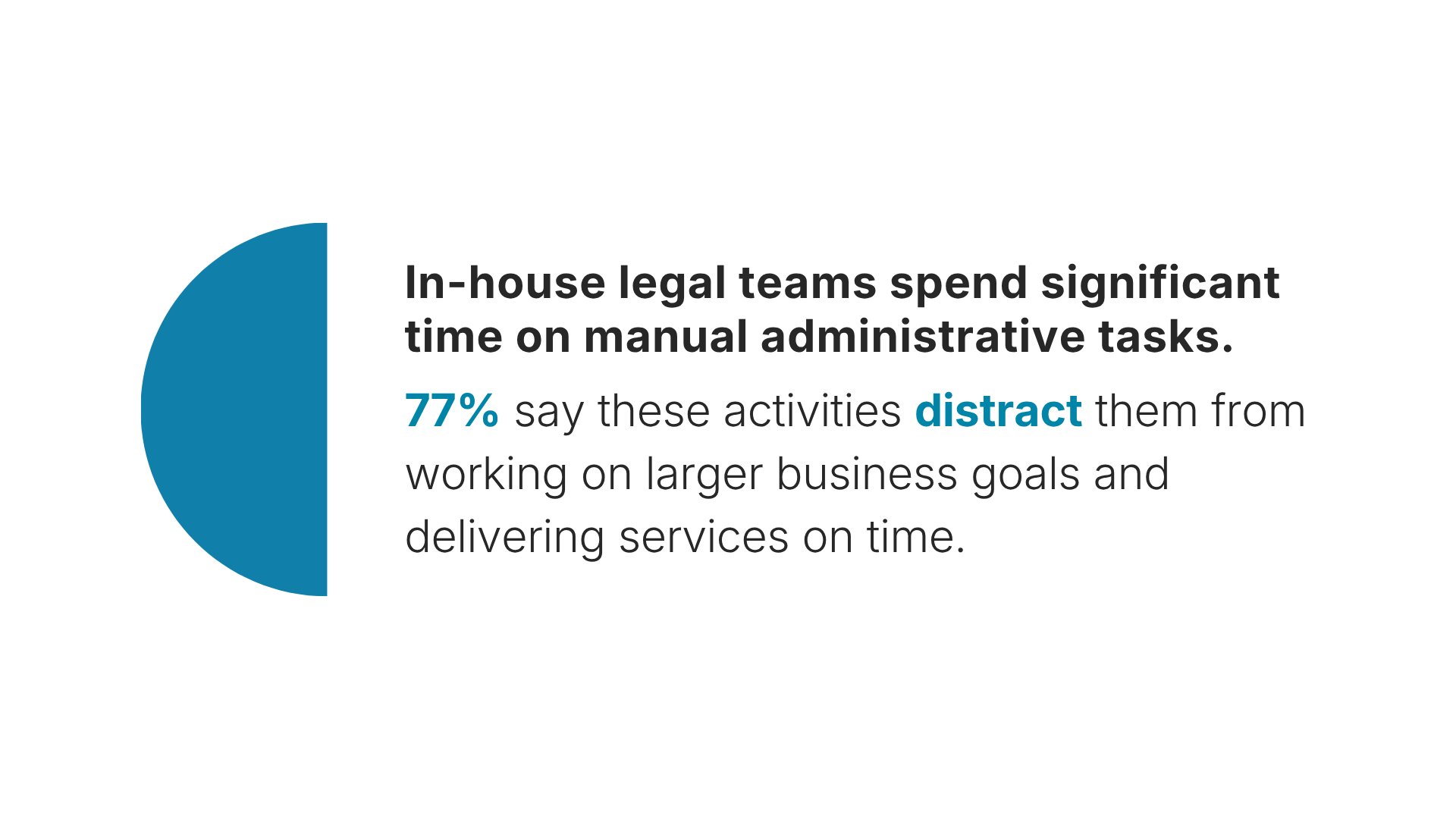
The 2024 In-House Legal Technology Report found that:
At the same time, legal departments rely on a patchwork of tools to manage their work. The report also revealed that 42% of in-house teams use 4 or more software solutions, often combining document management systems, spreadsheets, and e-signature tools, raising concerns about data and information security.
Together, these challenges illustrate where internal legal management often breaks down: growing workloads, limited resources, administrative challenges, and a fragmented system that makes it difficult to maintain structured oversight of legal matters.
Legal work does not belong to one team.
Employment matters involve HR, vendor contract management touches finance, and regulatory obligations affect operations.
In many companies, each of these functions manages its piece of the legal workload independently, with no shared system connecting them.
“The breaking point for our team came when a single employment matter touched criminal exposure, civil liability, and an internal HR investigation at the same time,” describes Brian Nguyen, the managing partner at Universal Law Group, explaining that the greatest risk wasn’t losing the case but losing the timeline.
“Without a shared tracking structure, we had three people updating three different documents, and a key response deadline nearly slipped through entirely. That near-miss was enough,” says Nguyen, pointing at a structured tracker as their solution for overlapping matters.
Centralizing legal matters with a structured tracking system can help address two persistent challenges we mentioned earlier:
By capturing key developments, responsive stakeholders, deadlines, and documentation in a single record, companies can reduce this operational friction while ensuring that important information is documented and accessible when needed.
In practice, this structured approach is supported by a set of core capabilities that enable legal teams to monitor matters more closely, maintain records, and generate insights into legal activity across the business.
Legal tracking technology introduces solutions that support in-house teams as they navigate day-to-day tasks. While specific features vary across companies and legal operation platforms, most systems share a consistent set of capabilities that help legal maintain oversight of active matters, manage documentation, track deadlines, and generate insights to support risk management.
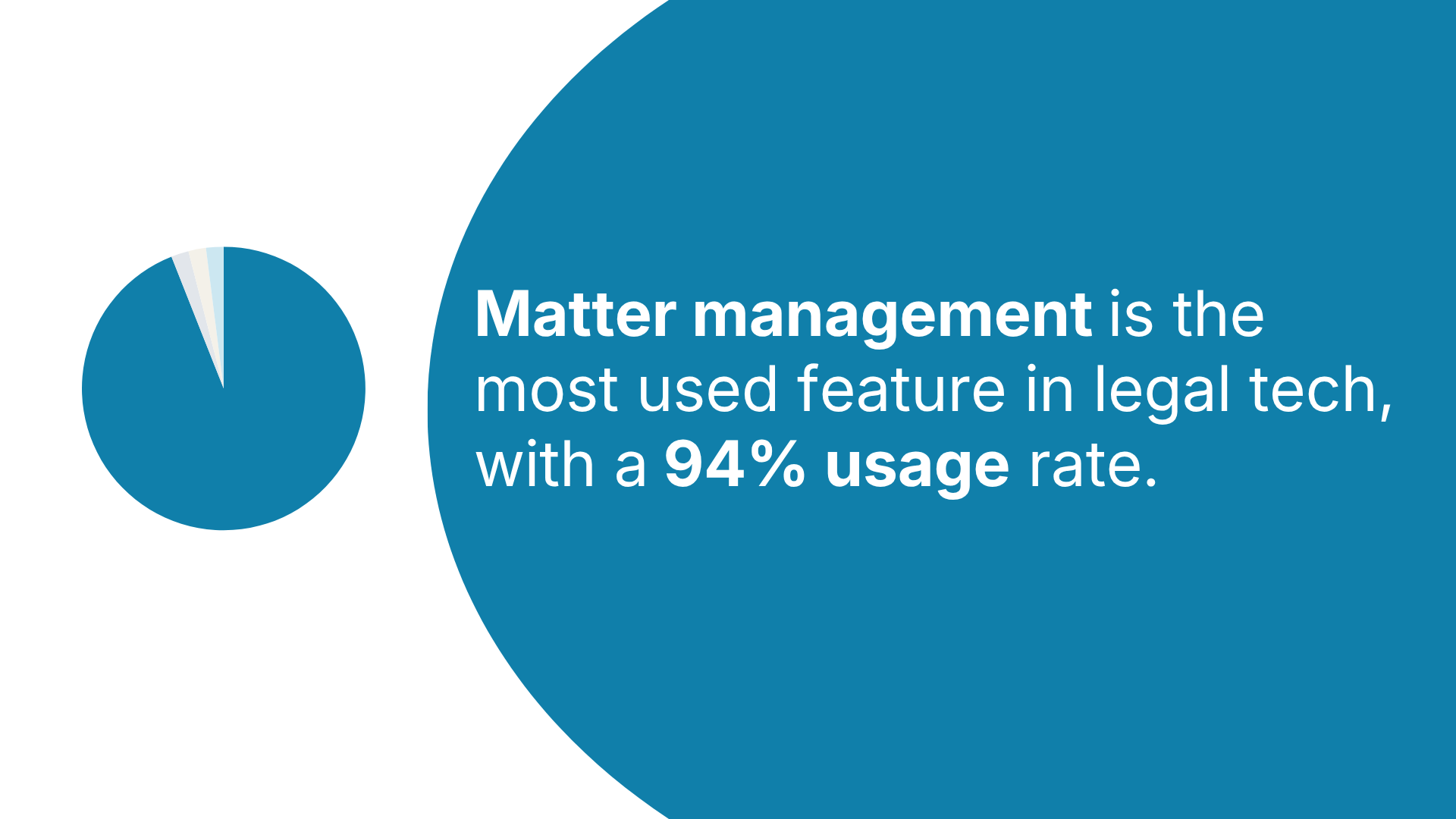
The operational center of any legal-specific software is its matter management functionality.
According to the survey, The State of In-House Legal Teams in 2025, it’s also the most widely used feature in legal tech, with a 94% usage rate.
Matter tracking usually covers the full lifecycle of a legal matter, including intake, categorization, assignment, status tracking, and closure. Usually, the software organizes the cases by type, and each workflow carries its own structure and requirements.
Legal matters rarely unfold in a single document or email thread.
As an issue develops, it generates contracts, correspondence, investigation records, and regulatory filings that must be organized and easily accessible.
A legal tracker should eliminate the disconnect between these files and the matters to which they belong. Centralizing all information also supports a clear historical record of all actions and decisions, which can be useful for creating audit trails for internal or regulatory reviews.
For contracts specifically, a legal matter tracker provides visibility that covers drafting, review, execution, and renewal. That last stage is where informal systems most often fail, as contract expiration dates get missed without automated alerts or dedicated tracking.
Missed deadlines are among the most consequential failures in legal operations, but are also the most preventable.
According to Arvind Rongala, CEO of Edstellar, missing regulatory deadlines is one of the main risks from relying on disconnected spreadsheets, along with version-control errors and limited visibility for leadership teams.
Therefore, efficient deadline management becomes another core capability in legal tech, enabling in-house teams to track and monitor these obligations. Usually, this involves integrations with calendars, reminders, and automated alerts to ensure key dates remain visible across teams.
“From a strategic standpoint, structured legal trackers transform legal management from reactive documentation into a proactive risk-management function,” concludes Rongala.
In addition to managing individual matters, an in-house legal operations platform should also support broader organizational oversight. A reporting and analytics feature brings transparency to the volume and types of legal matters being handled. For legal teams and employers, this can reveal patterns that could help prevent legal risk or allocate resources more effectively.
The decision to adopt a legal tracking technology represents an operational change that affects how the company documents, coordinates, and monitors its legal processes. Therefore, its execution becomes paramount, determining whether the platform delivers its expected value or stalls in partial adoption.
Data shows that a striking 77% of in-house lawyers had experienced at least one failed technology implementation, and over two-fifths (43%) had experienced more than one.
Technology alone is rarely to blame for those failures.
According to the findings, the most common issues were:
Organizational factors also played a role, including resistance to change and the challenge of coordinating multiple internal stakeholders during implementation.
So how can companies avoid these challenges?
A structured rollout typically progresses through the following five phases:
Implementation begins with an assessment of existing processes, tools, and records. The goal is to migrate data while ensuring it’s accurate and structured to support the operational workflow moving forward. In practice, this means mapping records and removing inconsistent, duplicate, or outdated data before the migration begins.
This phase sets the quality ceiling for everything that follows, as misconfigured or poorly migrated data can undermine subsequent phases.
With clean data in place, the second phase is configuring the system to reflect how the legal team actually operates – defining matter types, workflows, permissions, and reporting structures. Strategically, this step is where the technology either earns or loses its users’ trust. Excessive customization complexity often signals that the product was not built with the end user in mind.
A legal tracker does not operate in isolation. Its significance increases when it connects to the other systems the business relies on. For most organizations, this means integration with e-billing platforms, contract management tools, HRIS systems for employment matters, and enterprise resource planning (ERP) or financial systems for spend reporting.
Platforms that support open APIs or pre-built integrations with common enterprise software reduce the total cost of managing the legal tech stack and eliminate data fragmentation that undermines reporting accuracy.
While the previous stages build the system infrastructure, the onboarding step determines how the in-house team will use the legal tracker.
Structured training ensures that employees across departments understand how to navigate the technology and what their roles are in managing legal matters.
Skipping this step rarely saves time. Instead, it typically defers the cost into months of low adoption, inconsistent data, and retraining.
The real strategic value emerges when legal operations leaders define what success looks like from the outset. Which matters are closing faster? Where are workflows stalling? Is the data being maintained consistently across the team?
Therefore, the fifth and final phase is measurement, which consists of establishing baseline metrics in the first 30 days, then tracking progress against those metrics at 60 and 90 days.
Reporting on early outcomes provides leadership with the data to validate the investment and adjust the configuration as needed. This shift, from the system being a cost consideration to a strategic contributor, is what a well-measured implementation makes possible.
The shift away from email threads and spreadsheets is already well underway.
According to a 2025 global survey we mentioned earlier on the state of in-house legal teams, 88% now rely on technology daily, a significant departure from just a few years ago, when nearly half were still operating on email and spreadsheets.
The next frontier is automation.
Legal teams are prioritizing tools that reduce manual work, connect exciting systems, and eliminate repetitive tasks.
“As companies grow, the ability to maintain compliance and meet legal deadlines can be hampered by silos and bureaucracy. It’s for this reason that adopting automation tools to cover administrative overload can be critical in maintaining regulatory oversight while businesses grow,” explains Matthew Crook, General Manager at PeopleHR Evo.
Meanwhile, with technology becoming increasingly important, its latest development – the use of artificial intelligence in the workplace – is cautious but deliberate.
Although 78% of professionals are either adopting it or actively exploring AI, expectations remain grounded. In-house legal professionals mainly want to use it for measurable tasks such as contract review, document summarisation, and automated intake routing, rather than broad or ambitious transformations.
For companies and legal teams at any stage of this journey, the priority remains the same: build a strong operational foundation. Often, that begins with a simple system, such as a reliable legal tracker, that provides clear visibility into matters and priorities and lays the foundation for a more structured way of managing internal legal operations.
Technology is becoming increasingly important in how companies manage risk, document, and collaborate across departments. If you have additional questions about the role of corporate legal trackers in internal legal management, we answer the most commonly asked ones regarding their purpose, structure, and importance.
A legal management system should provide structured oversight of legal matters across the company. This typically includes the ability to record and track legal issues, store supporting documentation, monitor deadlines, and maintain clear records of actions and decisions.
The goal is to give legal teams greater visibility into ongoing matters while ensuring information is organized and easily accessible.
As a company scales, legal work becomes difficult to manage through email threads, spreadsheets, or across multiple systems. Growth in regulatory requirements and increasing contract volumes can drive the need for structured tracking, thus introducing a formal legal matter management system.
Most systems support operational functions that help legal teams manage their workload efficiently. Common features include intake and tracking of matters, centralized document management, deadline monitoring, workflow coordination across departments, and reporting and analytics tools that provide insight into legal activity and risk trends.
Even smaller legal departments can benefit from maintaining organized records of legal matters and decisions. Structured tracking helps ensure continuity and reduces the risk that important information remains siloed with individual team members.
A corporate legal tracker for in-house matter management allows companies to monitor issues more systematically, thus identifying patterns. Over time, this visibility can help leadership recognize recurring risks, improve internal processes and spending, and respond more proactively to legal and compliance challenges.
Content Writer at Shortlister
Browse our curated list of vendors to find the best solution for your needs.
Subscribe to our newsletter for the latest trends, expert tips, and workplace insights!
In an ever-changing global economy, how can employers create a workplace culture that supports and encourages high levels of employee productivity, satisfaction, and retention?

From streamlining administrative and bureaucratic tasks to boosting motivation and productivity – the benefits of HRIS within an organization are extensive, making the investment worth it for both HR departments and companies.

Unlock the strategies to drive your organization toward peak productivity and success through effective performance management practices.

Find a suitable platform to connect and engage with your global audience at no cost.
We're working hard to make it easy for you. Sign up for news, trends and insights.