
4 Steps of Risk Management Process in Project Management
From identification through mitigation to monitoring and reporting – master the techniques to ensure successful project outcomes.

Feedback is a powerful driver of employee performance, yet its delivery remains one of the most challenging aspects of leadership.
Gallup found that 80% of workers who received meaningful feedback felt fully engaged, and when it happened daily, they were 3.6 times more likely to feel motivated to do outstanding work.
But what happens when that feedback is negative?
Criticism often triggers defensiveness, even when grounded in good intentions, which can shut down communication and impede performance. For managers, hesitating to deliver it because it feels uncomfortable can be just as harmful, leaving employees unclear on how to improve.
Overcoming these challenges requires being mindful in delivery and understanding that different circumstances require different approaches.
A closer look at negative feedback samples across various industries and use cases shows how important it is for companies to balance honesty and encouragement while avoiding the damaging effects of poorly delivered criticism.
Companies use performance feedback as a development practice to support employee growth and guide administrative decisions. While positive criticism is usually well-received, negative feedback is often misunderstood, triggering fear and adverse reactions among employees.
Research shows that workers who received only negative feedback exhibited increased negative emotions and lower motivation, which decreased their performance over time.
However, when paired with coaching elements, such as guidance, support, and development-focused suggestions, negative feedback led to the opposite: a positive emotional response and higher motivation.
The results suggest that how feedback is delivered is as crucial as its context.
Constructive criticism, even when negative, provides employees with the direction they need to improve. It focuses on behaviors and outcomes they can change instead of undermining their confidence or skills.
Managers set the tone, and their goal should always be to move negative assessments toward constructive outcomes.
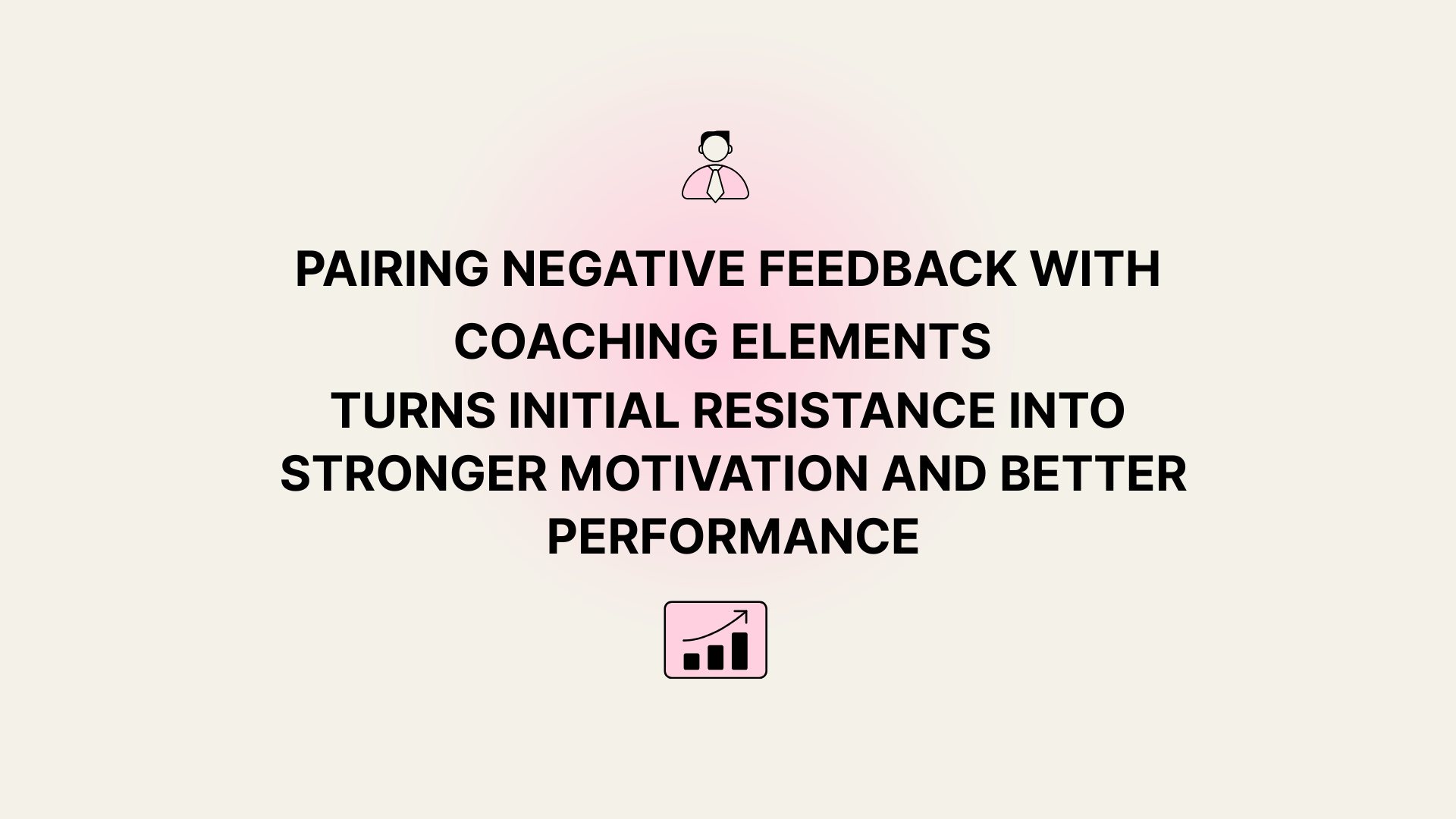
Negative feedback is central to growth. It allows employees to identify areas for improvement and companies to guide talent development.
A study researching its role frames it as a “necessary evil,” meaning that even if it’s uncomfortable or demotivating, it’s essential for learning and performance.
The findings show that the tone and context of delivery significantly affected reception.
Feedback was most effective when delivered constructively or when it was specific, actionable, and focused on behaviors rather than personal traits.
Another study found that while negative feedback can frustrate employees and lower their confidence in the moment, it can also increase their motivation in subsequent tasks, allowing them to regain a sense of competence.
The findings from both examples suggest that workers are more likely to respond positively when feedback is used as an opportunity for growth rather than a punitive measure.
Therefore, this assessment can be instrumental in personal and professional development when delivered constructively and within a supportive environment.
For managers, the takeaway is to pair critical feedback with follow-up tasks that allow employees to succeed and rebuild confidence rather than relying solely on criticism.
Clear and timely communication is central to individual development and organizational success.
Employee communication statistics reveal that regular and ongoing manager feedback leads to a workforce that’s 3.2 times more likely to do a great job and 2.7 times more likely to be more engaged.
This principle will hold true even when an observation points out shortcomings.
For employees, it removes uncertainty and provides direction for skill-building. Many workers prefer candid feedback over ambiguity, allowing them to focus their efforts where improvement is most needed.
For employers, consistent feedback prevents minor issues from escalating into major setbacks and helps maintain performance standards.
When done right, it can also strengthen the manager-employee relationship, demonstrating that managers are invested in their team’s success and willing to have difficult conversations to support growth.
Avoiding having uncomfortable conversations in the workplace may seem easier, but the risks of doing so accumulate quickly.
Unaddressed performance issues rarely resolve themselves. Instead, they escalate, reducing team productivity and undermining morale. When colleagues see poor performance go unchecked, it can also lead to frustration and a decline in confidence in leadership.
From a legal standpoint, failing to document performance concerns leaves employers vulnerable should disciplinary action be required. Every employment decision must rest on documented evidence of the issue and the steps taken to resolve it.
Above all, the most significant risk lies in lost opportunity. The absence of feedback deprives employees of growth and companies of stronger results, as it allows correctable issues to take root and become lasting obstacles.
At its core, negative feedback isn’t inherently destructive. It simply points out a gap between expectations and performance delivery.
However, when communicated poorly, it can discourage and disengage.
The key is approaching it thoughtfully, framing observations to encourage improvement rather than creating defensiveness.
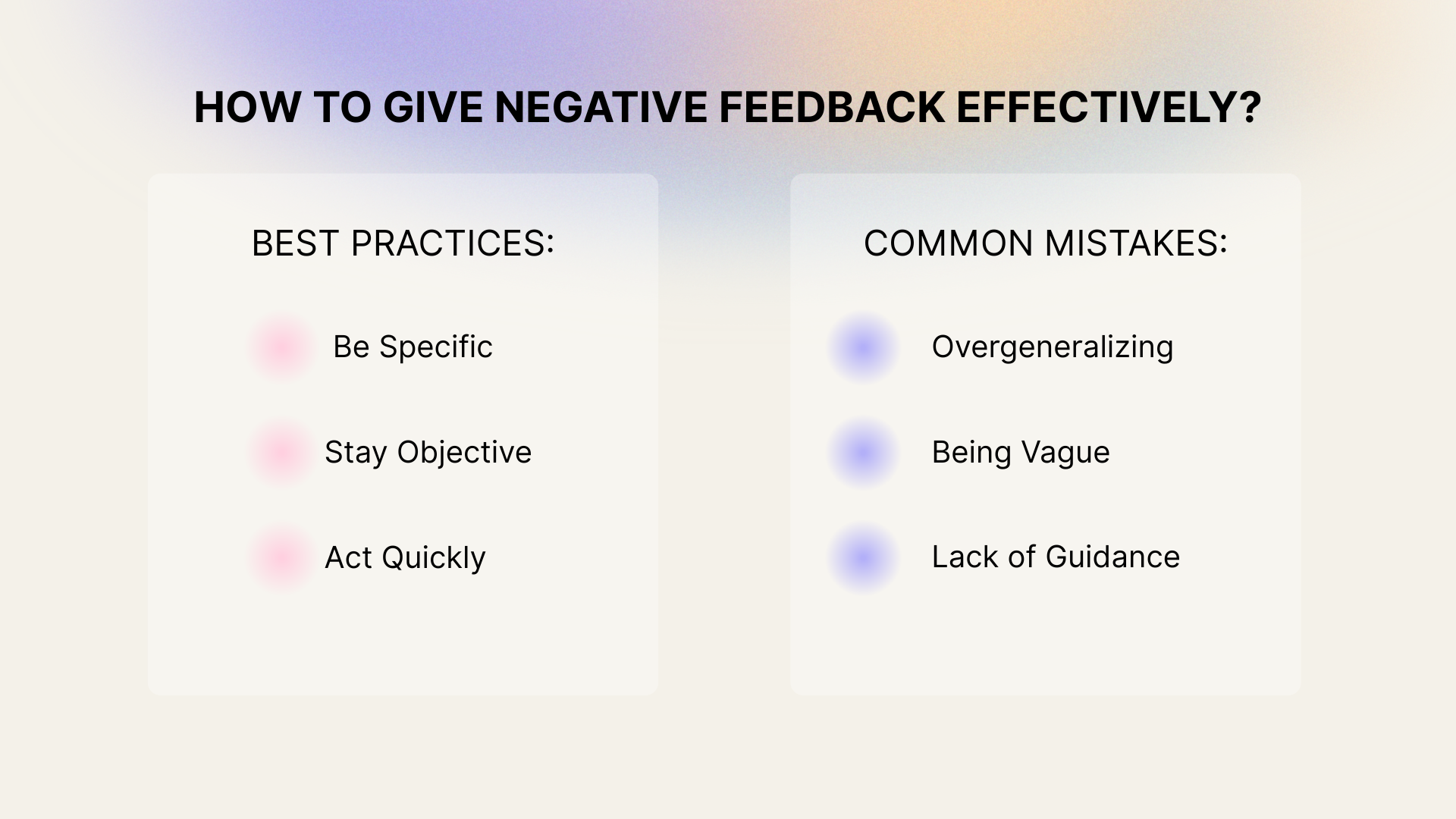
Mastering this approach comes down to understanding how to give negative feedback effectively and what potential mistakes to be mindful of.
Negative feedback is often delivered during performance evaluations, yet its impact is greater when it is part of continuous dialogue. Relying only on scheduled reviews can allow small problems to evolve.
To be effective, feedback should be:
Managers can benefit from executive training or communication coaching to strengthen their delivery and ensure that the feedback doesn’t stop at awareness but translates into real skill development and measurable growth.
From a psychological standpoint, receiving negative feedback activates the brain’s threat response, often triggering resistance. However, delivery style, trust in the source, balance with positive input, specificity, and fairness influence how we receive it.
Using these external factors to create psychological safety in the workplace allows workers to receive feedback without fear of humiliation or reprisal.
Examples include acknowledging an employee’s effort before pointing out areas for improvement, inviting them to share their perspective on what went wrong, and emphasizing that the goal is to solve the problem together.
Collaborative language also positions managers as partners in their improvement rather than as adversaries. Phrases like “let’s work together to address this” or “I want to support you in improving” set a constructive tone.
When employees no longer see negative feedback as a threat, they are more likely to apply it productively.
Providing negative feedback is inherently more challenging than offering positive recognition. Minor tone or wording missteps can produce the opposite of the intended effect, reducing engagement or creating defensiveness.
For example, overgeneralizing can make employees feel attacked and unclear about what needs improvement. Avoid words like “always,” “never,” or “constantly,” as these absolutes might trigger defensiveness and are rarely accurate.
Being vague, such as “you need to communicate better,” can leave employees without direction and increase frustration.
At the same time, delivering feedback without suggesting solutions or next steps also reduces its value, as employees may understand what went wrong but not how to fix it.
While the principles of constructive feedback are universal, the context often varies by industry.
For example, what works in healthcare, where feedback must be precise and urgent, may differ from retail, which values supportive guidance, or tech, which emphasizes adaptability and collaboration.
Tailoring the assessment to the environment makes it more relevant and actionable.
The following negative feedback examples demonstrate practical ways to deliver performance observations with a positive framing to preserve trust and maintain motivation.
These short templates can be used in multiple contexts, such as email communication, face-to-face conversations, and formal performance reviews, and they should be adjusted as needed to fit the specific situation.
Retail and customer service roles rely heavily on client interactions, which means feedback should balance client satisfaction and service standards with operational efficiency.
Managers should address issues privately rather than in front of customers or colleagues, since public criticism can feel undermining. In a fast-paced environment with customer pressure, feedback works best when it is clear, supportive, and focused on improvement.
Negative Feedback Sample: “I observed that [specific behavior or outcome] impacted the customer experience and team workflow. To address this, please [specific action or adjustment]. Let me know if you need any guidance or support to implement this change.”
The complexity of roles in healthcare demands precision and urgency in feedback, since even minor mistakes can have lasting consequences.
In this case, the emphasis should always be on patient safety and protocol adherence, while avoiding language that frames mistakes as the result of negligence or intentional oversight.
For instance, instead of a general comment like “you are not careful enough,” a better approach would be a clear statement that explicitly points to the behavior and offers a path for improvement.
Negative Feedback Sample: “I need to address a [specific situation] that occurred [when/where]. This is important because patient safety and care quality are our top priorities. When this happens, it can result in [specific consequences]. Moving forward, I need you to [specific behavioral change].”
Educators usually manage multiple roles (e.g., balancing administrative tasks with teaching responsibilities). Therefore, any performance assessment must be mindful and constructive, helping them see the link between their actions and what it means for their students.
Negative Feedback Sample: “How a class is structured greatly influences how students learn, and you excel at [teaching strengths]. However, recently, we noticed that [specific situation] stood out because it made it harder for students to stay engaged. Try approaching it by [specific action] so the lesson flows more smoothly for them.”
Negative performance feedback examples should be precise and actionable in a highly collaborative and detail-oriented environment, such as a tech team.
This approach helps employees understand the broader organizational impact of their mistakes and strengthens collaboration between individuals within the team and with other departments.
Negative Feedback Sample: “The quality and timeliness of tasks directly affect the success of the project and the team’s workflow. I noticed that [specific behavior or outcome] did not meet team standards and caused issues in the workflow. Let’s adjust this by [specific action or approach].”
Creative and marketing professionals operate in fast-paced environments where minor idea, visual, or messaging errors can harm customer relationships and weaken the brand’s perception.
Critique should be balanced to preserve individual creativity and avoid dismissive comments such as “this is not good” without explanation.
It’s important to note that the creative fields usually support more conversational and informal feedback, as long as it’s constructive.
Negative Feedback Sample: “I appreciate the energy and fresh perspectives you bring to the project, but I noticed [specific issue or behavior]. Tweaking this by [specific adjustment] will help the work land as intended while keeping your unique style intact. I’m confident this small change can make a noticeable difference in the final result.”
With over 18 million employees in office and administrative roles, or roughly 12.2% of the U.S. workforce, these positions are the backbone of everyday operations.
Employees often serve as the first line of coordination, keeping everything aligned, managing communications, and ensuring project progress. In such roles, even minor oversights can quickly frustrate colleagues and impact client relationships.
Therefore, feedback works best when it is direct and tied to real situations.
Instead of abstract performance metrics, pointing out specific behaviors and their immediate consequences helps employees understand the real-world impact of their actions.
Negative Feedback Sample: “I noticed that [specific issue or behavior], which caused [brief description of impact, e.g., delays, miscommunication, or confusion]. Revising by [specific action] will help prevent similar issues and keep workflows and team collaboration on track. I’m confident that with this adjustment, your contributions will continue to support the team effectively.”
According to the National Association of Manufacturers, U.S. manufacturing companies perform 52.9% of all private-sector R&D, driving more innovation than any other sector.
At the same time, every dollar spent in manufacturing has a total impact of $2.64 on the overall U.S. economy. This figure represents one of the biggest sectoral multipliers in the economy.
However, innovation and growth only work when the fundamentals are strong.
The small margin for error in manufacturing and operations means that any oversight can have ripple effects on production and innovation, or even compromise worker safety. Therefore, understanding how to give negative feedback in this setting requires pointing out what went wrong while reinforcing discipline and shared accountability.
Negative Feedback Sample: “Our work depends on consistent standards so that every part of the process runs smoothly. I noticed that [specific issue] led to [impact such as delays, quality concerns, or added risks]. To avoid this in the future, it will help to [specific adjustment]. When you carry out each step with care, it keeps the operation efficient, safe, and aligned with the level of quality our customers expect.”
Negative feedback plays out differently depending on the situation. Managers may need to address a missed deadline or poor communication, and each requires a slightly different approach.
The following templates, applicable in any industry, can help managers navigate the most common workplace challenges clearly and professionally.
Performance evaluations are among the most common situations where employees receive feedback on their work and development.
While performance management software can help identify inefficiencies where work is falling short, it is up to the manager to find the right approach to conveying the main issues and propose improvement solutions.
Negative performance feedback examples focusing on observable actions are far more effective than general statements like “you are underperforming.” This approach ensures employees understand the issue and have a clear path toward corrective action.
Negative Feedback Sample: “Your recent performance in [specific task] has not met the expected standard. I encourage you to focus on [specific skill or process] and let us set measurable goals to track your progress.”



Communication is a fundamental management tool that significantly influences organizational performance.
Research shows that open, transparent, and timely communication ensures that employees clearly understand their roles. It also helps prevent conflict and makes them feel more valued at work, thus allowing them to perform more efficiently.
These principles directly apply to the delivery of negative feedback.
Therefore, managers should avoid broad statements such as “you do not communicate well” as these are too personal and unhelpful.
Negative Feedback Sample: “I’ve noticed that [specific issue] has been causing [impact on customers/team]. I value your work here and want to understand what’s been happening from your perspective. Moving forward, I need you to [specific action], and I’m here to support you with the resources or guidance you may need. Let’s check in again [timeframe] to see how things are going.”
Teams often rely on project management software, collaboration tools, or team communication apps to stay coordinated and keep projects moving along, especially in remote environments. These solutions work best when everyone updates their progress and communicates clearly.
However, problems occur when, despite the solid infrastructure, tasks are completed in isolation, forcing teammates to chase information or redo work.
Constructive negative feedback examples indicate where these gaps occur and propose solutions for the observed behaviors.
Negative Feedback Sample: “You contributed less than expected during our group assignment. Your insights are valuable to the team, so please try to participate more actively in discussions and tasks.”
Regular feedback can turn growth into a natural part of the workplace experience.
Performance management statistics show that companies that adopted this practice outperformed competitors by 24%. They were also 39% better at attracting and 44% better at retaining top talent.
These results are not accidental. They show that feedback shapes a culture where improvement is expected and supported.
However, a cultural shift demands intentional leadership and structured approaches that make these conversations feel natural, even when negative. Managers or team leaders must go beyond annual reviews and create space for continuous dialogue in day-to-day work. For example, this can be brief check-ins after a shift or team reflections at the end of a project.
Equally important, they need to model the behavior they expect. When a manager openly asks, “How could I have handled that better?” it demonstrates accountability and encourages employees to view feedback as a two-way exchange.
Companies can also reinforce positive behavior through reward programs that celebrate when employees respond to feedback and show measurable improvement.
Acknowledging progress after a course correction builds confidence and signals that growth is valued just as much as initial success.
Over time, these habits become ingrained in routine workflows. Feedback appears in weekly check-ins, peer discussions, and project debriefs, where specific actions and outcomes are addressed directly.
The strongest growth cultures blend these informal practices with structured performance management, ensuring employees receive consistent and actionable guidance.
When it’s constructive and intentional, the goal of negative feedback isn’t to criticize but to correct behavior and guide improvement.
The key lies in preparation, intention, and follow-through.
In this context, an industry-specific negative feedback sample can provide a helpful framework for structuring difficult discussions. However, authentic, empathetic communication will consistently outperform perfectly worded scripts delivered without genuine care.
Therefore, while feedback should adapt to the specific context, its foundation remains the same: employees grow best when they feel genuinely supported in their development, not simply told what they did wrong.
Content Writer at Shortlister
Browse our curated list of vendors to find the best solution for your needs.
Subscribe to our newsletter for the latest trends, expert tips, and workplace insights!
From identification through mitigation to monitoring and reporting – master the techniques to ensure successful project outcomes.

Discover how, if done correctly, effective performance management can benefit both employers and employees.

Elevate your performance management strategies with essential statistics. Stay ahead in optimizing productivity, engagement, and success in the workplace.
Almost half of new managers feel unprepared for their role, and 87% wish they had more training before promotion. Management coaching identifies the areas where they struggle the most and provides support during this career transition.
We're working hard to make it easy for you. Sign up for news, trends and insights.