Fair Workplace Practices

Tracking Positive Performance Indicators in the Workplace

What if performance improves faster by tracking what employees do well instead of cataloging their failures?
In This Post:

How does your organization define success for its people? In most companies, performance is still measured through lagging indicators such as revenue, output, and traditional KPIs.  

While it is true that a lot can be learned from past failures, a growing body of research suggests that tracking what employees do well yields far greater returns than cataloging their failures. 

So, can companies achieve a more balanced approach by tracking positive performance indicators alongside traditional metrics?

What Are Positive Performance Indicators?

Positive performance indicators, or PPIs, are workplace metrics that assess the different aspects and behaviors that contribute to workplace efficiency and productivity.

So, the simplest answer to “what are positive performance indicators” is that they measure the conditions that make good performance likely. 

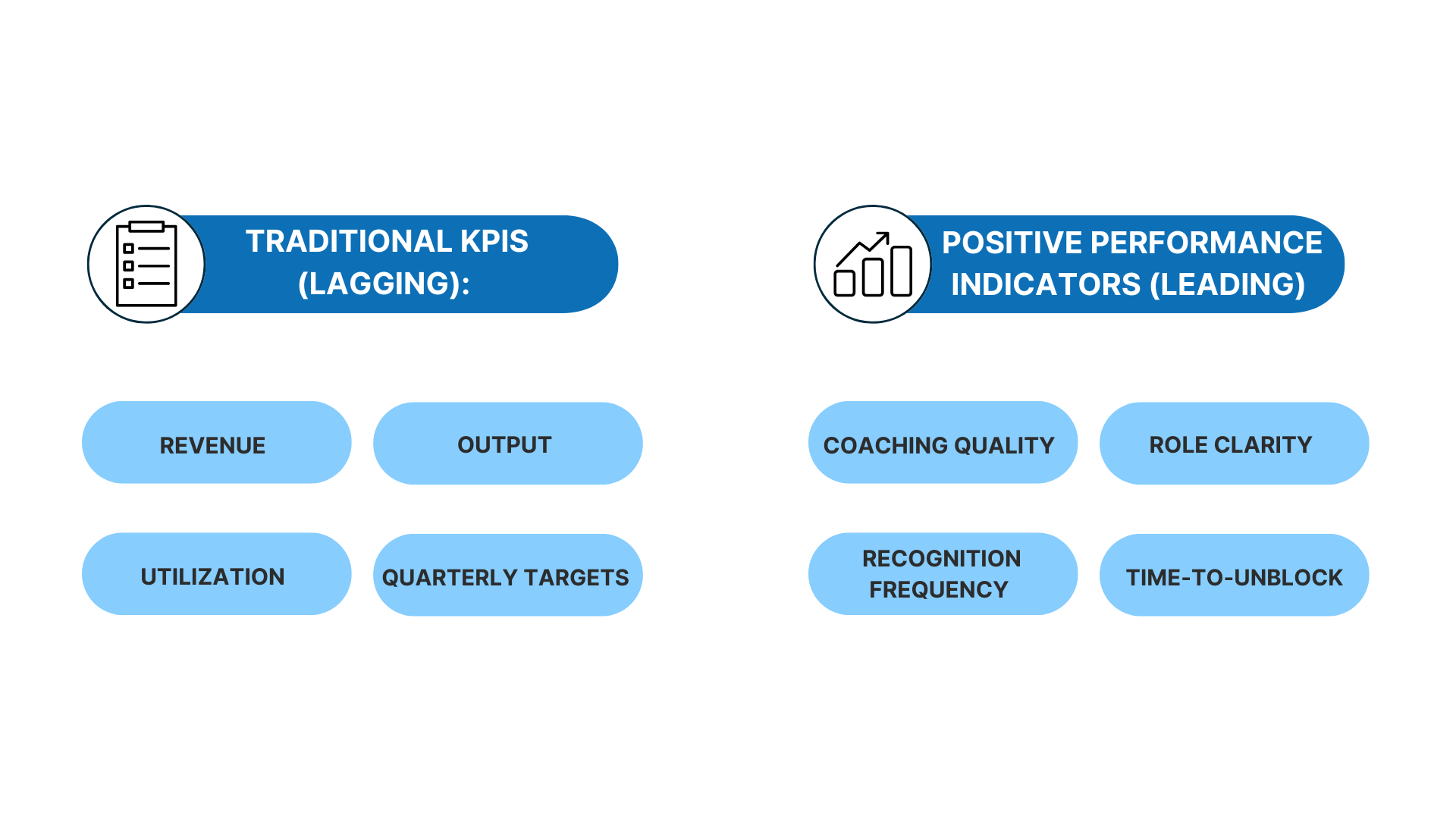
Unlike typical business KPIs that count outcomes like quarterly sales or units produced, PPIs examine the behaviors, systems, and workflows that determine whether results will be repeatable.

The idea is borrowed from safety management and OSHA regulations, where organizations track leading indicators specifically to prevent problems before they become incidents. 

What Actually Qualifies as a Positive Indicator?

Positive performance indicators are not simply the inverse of negative ones.

Tracking zero complaints is completely different from tracking customer compliments. In other words, the absence of failure is not the same as the presence of excellence.

This difference shapes how indicators should be built and used. When PPIs are designed to detect excellence, their value comes from pointing leaders toward behaviors worth reinforcing, instead of simply flagging risks to avoid.

Therefore, effective positive indicators share several characteristics. They must be:

  • Observable and verifiable through reasonable means
  • Within the employee’s control, or the team’s control, rather than dependent on luck or politics
  • Actionable within a week, so workers can adjust quickly
  • Connected to outcomes the organization values
  • Difficult to game without producing value
  • Stable enough to track over time

One way to pressure-test any metric is to ask two questions: Would a high performer recognize it as fair, and would a low performer know precisely how to improve it next week?

3 Performance Management Platforms to Know

Mitratech

Mitratech

Reviews pending
Mitratech provides global legal, risk, and HR tech to boost productivity and manage compliance ...
Deel

Deel

Reviews pending
Deel is the all-in-one platform for managing your global workforce.
Performyard

Performyard

Reviews pending
Complete employee performance toolkit to modernize your employee reviews, goals, feedback. and ...

From Traditional KPIs to Positive Indicators

The problem with traditional KPI systems is that they often over-value lagging outcomes because they are numeric and board-friendly. Modern dashboards make the numbers feel neat and controlled, even when they explain little about what drove the result.

However, these standard metrics, such as revenue, profit margins, or fulfillment time, all share the same blind spot. They say almost nothing about whether performance is sustainable or whether teams are burnt out at work. In addition, when results finally register as poor, organizations are already reacting to consequences rather than addressing the behaviors that caused them.

Positive performance indicators fill this gap. What are positive performance indicators if not leading signals of future performance? Instead of measuring only the output, PPIs look at the people and processes behind it.  

  • How collaborative is the team? 
  • Do employees feel supported by leadership? 
  • Are staff improving their skills year over year? 

Metrics like these shift the lens from pure output to the quality and durability of the structure that produced that result.

Examples of Positive Performance Indicators

Across progressive organizations, certain patterns show up consistently in how teams work, learn, and recover from friction. The positive performance indicators examples below show those patterns in measurable form:

  • Coaching consistency and quality – Not whether meetings happen, but whether employees report feeling heard and supported during them
  • Role clarity scores – Gallup’s Q12 survey identifies role clarity as vital for engagement; employees who strongly agree they know what’s expected of them perform measurably better
  • Psychological safety assessments – Harvard research shows new hires’ psychological safety erodes quickly without deliberate intervention
  • Time-to-unblock – Median time a request sits stuck; signals decision friction before delivery slows
  • Recognition frequency – How often employees receive meaningful acknowledgment for their contributions
  • Internal mobility participation – Whether employees pursue growth opportunities within the organization
  • Feedback coverage – Percentage of employees receiving specific feedback monthly, not just at review time
  • Learning momentum – Skill-building actions completed that map to role needs

Certain frameworks, like the CIPD Good Work Index, which is based on research with thousands of UK workers, suggest autonomy, task variety, and managerial support as dimensions worth tracking systematically.

Of course, every organization may have its own custom positive indicators. For example, a tech company might track the number of innovative ideas submitted by staff each quarter. 

The key is that these metrics highlight the net positive contributions employees make rather than just their output.

Why Tracking Positive Performance Indicators Matters

Why should busy HR and business leaders add another set of metrics?

Simply put, because negativity bias is not just a theory. People process negative experiences more intensely than positive ones, and that imbalance shows up clearly at work. Organizational psychology research consistently finds that negative workplace events carry far more emotional weight than positive experiences of similar scale.

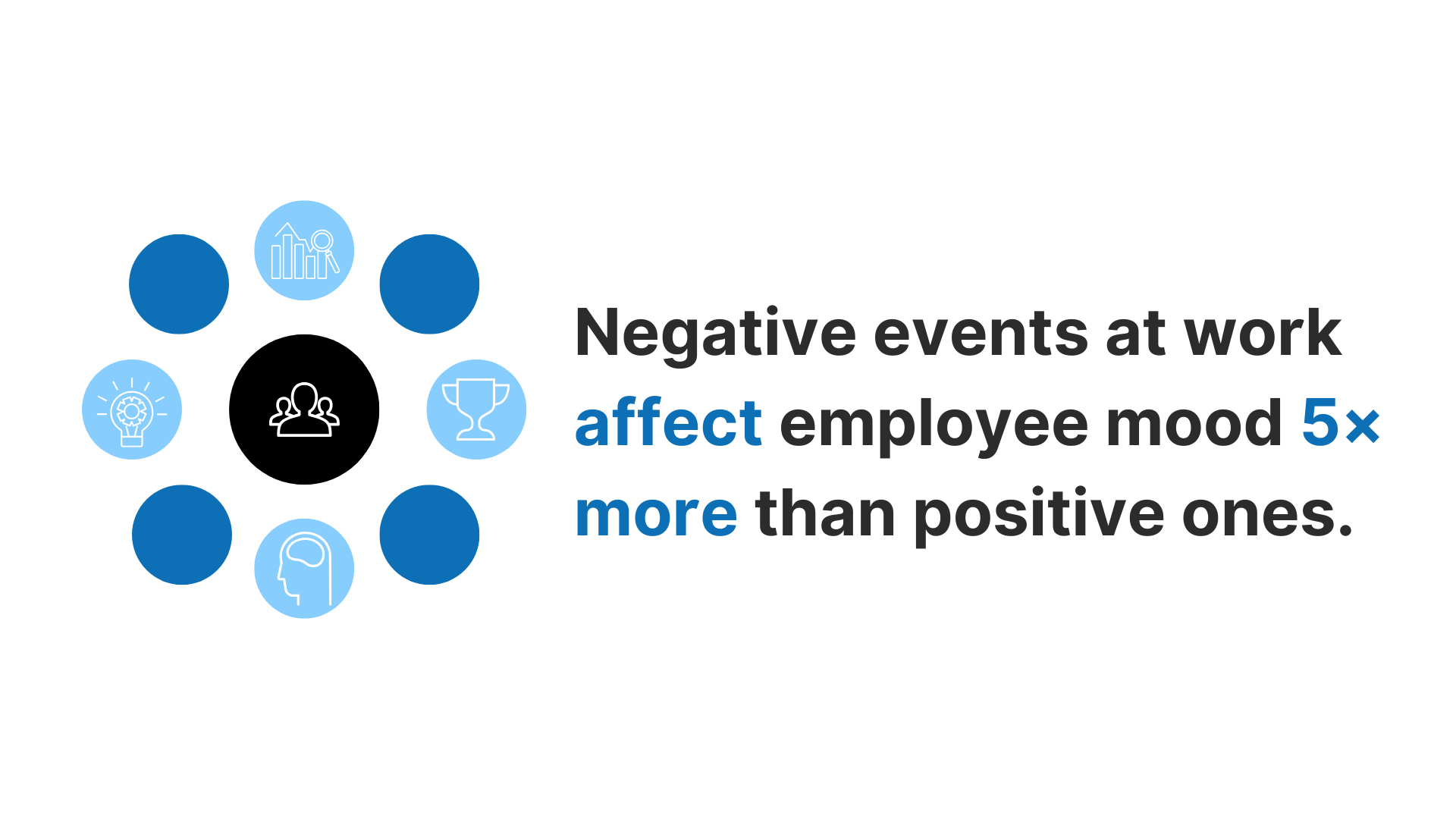
In particular, according to the affective events theory, negative events at work influence mood about five times more strongly than positive events of similar magnitude.

In fact, the quality of everyday interactions matters more than leaders often realize. In studies of team performance, higher-performing groups exhibit about five positive interactions for every negative one, whereas lower-performing groups fall well below this ratio. 

Naturally, poor employee experience leads to disengagement, which has many measurable financial consequences. Gallup estimates that low engagement costs the global economy roughly $8.8 trillion each year in lost productivity. 

When employees feel disconnected or are consistently evaluated through a negative lens, disengagement becomes almost an expected outcome.

Implementing Positive Performance Indicators

Knowing which PPIs to measure is the first step. The second and more complex step is setting up the infrastructure to measure it well.

Employers can start with tools designed for continuous feedback, such as performance management software. Modern platforms today have pulse surveys, real-time recognition tracking, and manager effectiveness dashboards that flag problems early.

Here’s a practical approach for implementation:

  1. Audit your current metrics – Which indicators are lagging (measuring past performance) versus leading (predicting future performance)?
  2. Identify two or three positive indicators to pilot – Don’t overhaul everything at once. Instead, pick one outcome KPI you care about (sales conversion, cycle time, customer satisfaction), then define 2-3 positive indicators that plausibly drive it.
  3. Build feedback loops – When you measure something, communicate what you’re doing about it. Conduct short check-ins that review indicators and agree on one adjustment, not a long performance meeting.
  4. Train managers on interpretation – Numbers without context can be misunderstood. Calibrate with managers so they understand what the indicators reveal and what actions to follow.

How Can Positive Indicators Remain Useful?

One unwritten rule to keep in mind when designing PPI is that incentives can change behavior quickly. Once a metric becomes a target, employees may, consciously or subconsciously, start managing the number rather than the work. 

In fact, this pattern is so consistent, it has a name – Goodhart’s Law. It states, “When a measure becomes a target, it ceases to be a good measure.”

Truthfully, gaming the system is something that many might be tempted to do. Call-center reps might stretch calls to hit satisfaction scripts, sales teams sandbag forecasts to beat their quota, and managers might schedule one-on-one meetings that exist as calendar proof rather than coaching moments.

The problem is that plenty of organizations claim they want high performance, then run systems that reward visibility rather than impact.

Knowing this, companies must make positive performance indicators hard to fake because the system is smart, not because managers are watching. Ultimately, the cleanest way is to balance each “effort” signal with a real-world result, so the metric stays honest.

Conclusion

The topic of high-performance management dominates leadership books, research, and conference stages, yet most organizations still do not measure any of the conditions that actually produce it. 

Most organizations already sit on data that could predict their next retention crisis, their next engagement decline, or their next wave of quiet quitting. They just aren’t tracking it.

The real risk, then, is not a lack of insight but a lack of attention. Until companies measure the positive performance indicators that sustain performance, they will keep reacting to outcomes that could have been predicted.

Written by Ivana Radevska

Senior Content Writer at Shortlister

Performance Management Software

Browse our curated list of vendors to find the best solution for your needs.

Stay Informed

Subscribe to our newsletter for the latest trends, expert tips, and workplace insights!

Related Posts

What is a Skip-Level Meeting?

In many companies, great ideas get lost between layers of management. Skip-level meetings bridge that gap by breaking down hierarchical barriers and creating a direct line between employees and their leadership.