





Employee Rights During HR Investigation
An HR investigation can easily turn into a stressful and uncomfortable experience, but your rights are your best defense. This Shortlister article helps you understand and use them.
CEO & Founder of Fig Loans
Head of Recruitment, Euristiq
COO, Bates Electric
CEO, Invensis Technologies
A job title doesn’t determine your legal rights. A contract label doesn’t determine your tax obligations. And calling someone a “freelancer” doesn’t make them one in the eyes of the federal government.
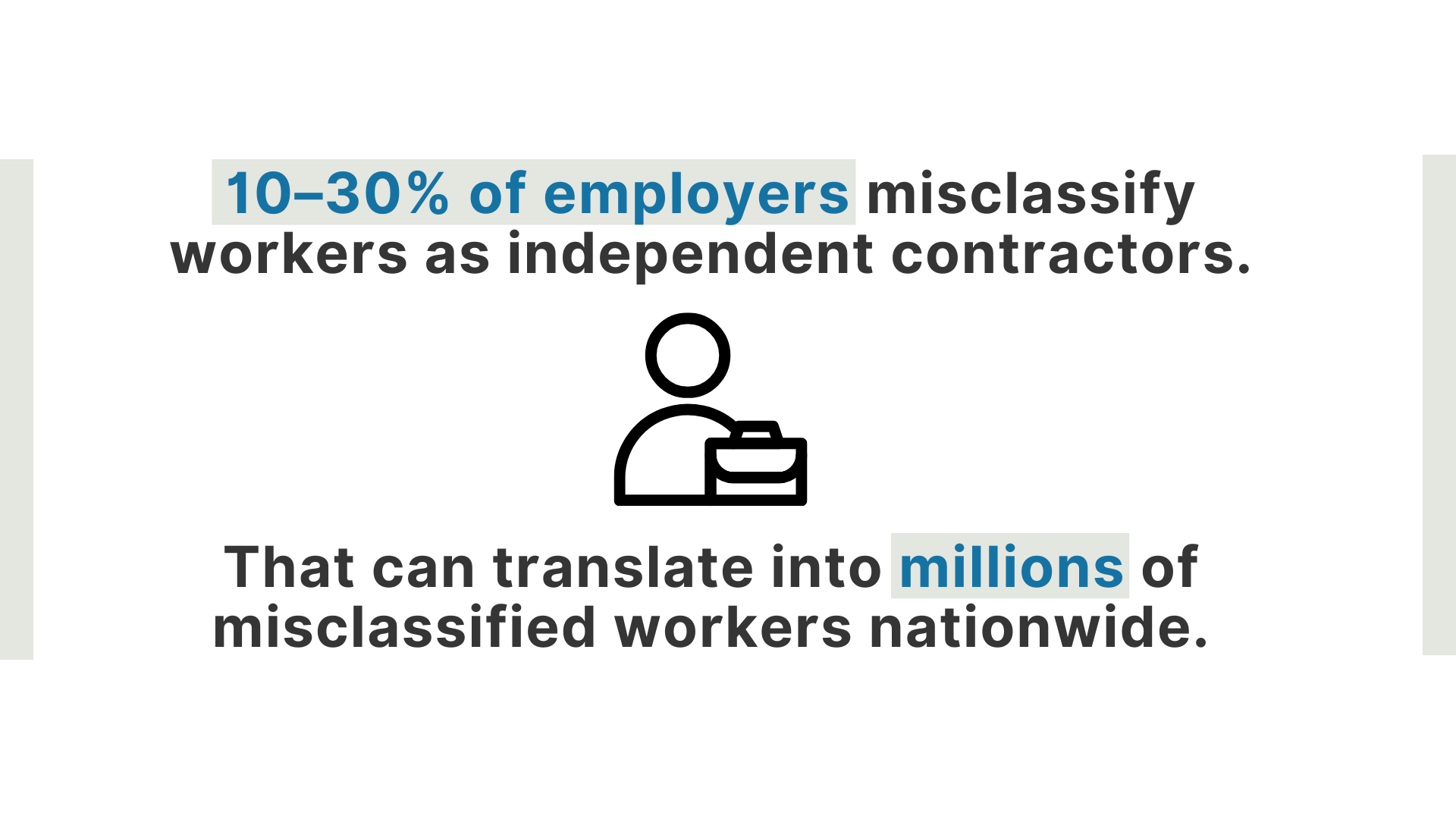
Yet every year, companies get this wrong on a staggering scale. The National Employment Law Project estimates that 10 to 30% of employers misclassify at least some of their workers. The consequences range from back taxes to multimillion-dollar lawsuits.
But why does this keep happening? Partially because of employer negligence, but also because employment law in the United States was built for a workforce that clocked in at 9 and clocked out at 5.
However, today over 72.9 million Americans freelance in some capacity, AI-driven scheduling tools assign shifts with no human manager involved, and fractional employment is on the rise.
So, given this environment, how can companies decide which types of employment contracts are suitable for their workforce?
At its core, a contract of employment is a mutual agreement that defines the terms of a working relationship. Both sides agree to specific obligations, and both sides take on risk when those obligations are broken.
A contract at work can be written, verbal, or even implied through conduct and company policies. In fact, under U.S. federal law, written employment contracts aren’t actually required.
In the United States, at-will employment is the default job contract agreement in 49 out of 50 states, where the relationship can be ended by either side, at any time, for almost any reason.
For this reason, the majority of American workers (74%) working under an at-will arrangement often operate with nothing more than a signed offer letter.
But what is on a contract of employment when one does exist?
Regardless of which type of employment agreements you use, certain elements should appear in every written contract or offer letter.
Here is what is typically recommended:
Many organizations now manage these documents through HRIS systems that centralize contract creation, storage, and compliance tracking.
The American workforce has undergone a structural transformation in the past decade, but employment contracts haven’t kept pace.
Over 72.9 million Americans now freelance in some capacity, equaling roughly 36% of the total workforce. Full-time independent workers more than doubled between 2020 and 2024, from 13.6 million to 27.7 million.
By 2027, freelancers are projected to make up over half of all U.S. workers.
Meanwhile, the legal frameworks governing these relationships were largely written for a single-employer, single-location model of work that no longer reflects how most companies operate. Federal statutes like the FLSA, NLRA, and Title VII establish a floor of protections, but they still assume a binary status of either employment or contractor.
So, what is a contract of employment in a labor market that barely resembles the one these laws were designed for? That exact question is the source of billions of dollars in litigation, back taxes, and regulatory penalties every year.
The legal and financial obligations attached to a working relationship depend almost entirely on how it’s structured. Below are the primary contract categories under federal law, what distinguishes each one, and where they tend to break down.
As mentioned, this is the most common arrangement in the United States by a wide margin. At-will means no fixed duration, no required cause for termination, and no obligation from either side to provide advance notice.
While at-will employment feels like having no contract at all, it doesn’t mean “no rules”. Federal protections under the Fair Labor Standards Act, the Civil Rights Act, and other statutes still apply. In fact, wrongful termination claims can still surface if a worker can demonstrate retaliation or discrimination.
Despite the no-strings-attached premise of at-will employment, around 34% of U.S. employees actually have some form of “just cause” protection, through union agreements, civil service rules, or individual contracts, that takes them outside the pure at-will category.
However, as workforce models grow more complex with remote and hybrid roles, the gap between “no contract” and “clear expectations” is increasingly becoming a liability.
The main problem is that employees today, especially in competitive labor markets, increasingly view at-will arrangements with skepticism. That is because some companies use at-will status as a blank check to avoid structured agreements.
Where at-will offers open-ended flexibility, fixed-term contracts draw clear boundaries. A defined start date and a defined end date.
When the term expires, the relationship concludes unless both parties agree to renew. Unlike in many European countries, U.S. federal law imposes no limit on the length or number of fixed-term contracts an employer can offer.
These types of work agreements are common in academia, project-based consulting, seasonal industries, and C-suite hiring.
For employers, fixed-term agreements offer predictability in headcount planning and budget forecasting. For employees, they provide a guaranteed period of employment.
Independent contractor agreements are technically not “employment” contracts at all. The worker is a separate business entity, responsible for their own taxes, benefits, and tools.
The appeal for businesses is obvious – lower overhead, no payroll taxes, and easy workforce scalability. But the legal risk is substantial.
“I’ve seen companies call their workers ‘contractors’ yet give them daily directions as if they were employees,” says Jeffrey Zhou, CEO and Founder of Fig Loans. “Federal guidelines assess whether a worker has control or is economically dependent on the employer, not the title.”
Indeed, federal agencies use different tests to determine whether someone is truly an independent contractor. The IRS applies a behavioral, financial, and relationship test. The DOL historically used a six-factor “economic realities” test under the FLSA, examining factors such as the degree of control, investment by the worker, and the permanence of the relationship.
Keeping track of the various methods and standards is challenging enough on its own, but the rise of gig platforms and AI-driven task management has made it even harder to draw a clean line between employee and contractor.
“Part-time” and “full-time” sound like standard contract types, but federal law doesn’t actually define them in a single consistent way.
For example, the IRS defines full-time as at least 30 hours of service per week (or 130 hours per month), and the measurement method can change the compliance outcome. Meanwhile, the FLSA has no hours-based threshold, and the ACA sets it at 30 hours per week for benefits eligibility.
What this means in practice is that the same worker can be classified differently depending on which federal statute is being applied.
The rise of a new work model, fractional employment, is adding another layer to an already complex landscape. The model – which breaks traditional full-time roles into modular components performed by multiple workers based on skill and availability – is gaining traction globally, particularly as ageing workforces and talent shortages push organizations to rethink rigid employment structures.
But from a compliance standpoint, these arrangements are creating yet another gray area that HR teams must navigate carefully.
Zero-hour contracts guarantee no minimum hours. The employer offers work as needed, and the worker can accept or decline.
In the U.S., these are less formally defined than in the UK, but the underlying arrangement is increasingly common in hospitality, retail, and gig platforms.
However, there is a lot of legal grey area with these types of work contracts. Namely, workers on zero-hour arrangements often lack access to unemployment insurance, employer-sponsored healthcare, and retirement benefits.
When combined with scheduling algorithms that optimize for employer flexibility over worker stability, these arrangements can create a workforce that’s technically employed but functionally precarious.
For businesses with genuinely unpredictable demand, casual contracts serve a real operational purpose. But leaning on them too heavily can erode employers’ branding and make it harder to recruit permanent talent.
Collective bargaining agreements (CBAs) are a fundamentally different kind of job contract agreement.
Rather than being negotiated between an employee and an employer, CBAs are the product of negotiations between a union and management, governed by the National Labor Relations Act. They cover wages, hours, grievance procedures, and working conditions for entire bargaining units.
While union membership in the private sector has declined to roughly 6% of workers, CBAs remain dominant in sectors like public education, healthcare, construction, and transportation. If an organization operates in these industries, understanding the obligations that come with CBAs is non-negotiable.
Even outside unionized settings, CBAs often shape market norms. Wage benchmarks and safety protocols often originate in collective agreements before becoming standard industry practice.
Even though worker misclassification is not a new problem, it is an accelerating and costly one.
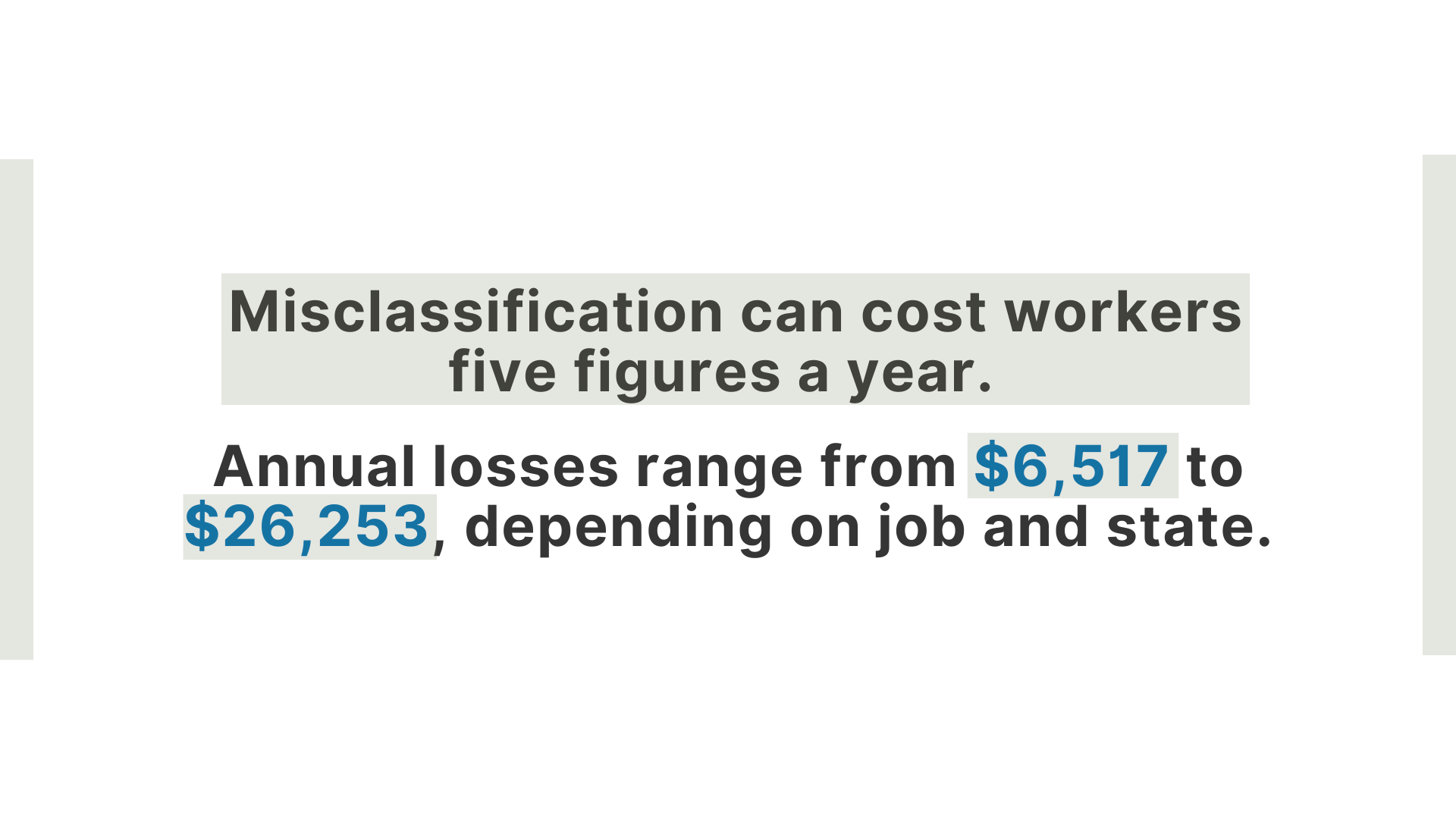
A January 2025 analysis from the Economic Policy Institute found that a misclassified construction worker loses up to $19,526 in income and benefits per year compared to a properly classified employee. A misclassified truck driver in New Jersey can lose up to $26,253 annually in compensation.
However, the cost is not just borne by workers. Misclassification deprives Social Security, Medicare, and state unemployment funds of billions in contributions each year.
The gig economy has further exacerbated this issue. Black and Latino workers make up about 29% of the U.S. workforce but represent 42% of app-based platform workers, according to the National Employment Law Project.
Therefore, misclassification is more than a simple compliance issue. It is an equity issue that disproportionately affects the most vulnerable workers in the labor market.
In other words, misclassification exposes these workers to exploitation and opens the door to abusive workplace practices.
For employers, misclassifying even a single worker can trigger audits from the IRS, Department of Labor, and state agencies simultaneously.
When a workforce is misclassified at scale, the organization may face back taxes, liquidated damages, penalties for unpaid overtime, and potential class-action exposure. Today, the question is no longer whether enforcement will reach a particular industry, but when.
In 2025 alone, a wave of high-profile settlements and judgments showed that regulators, courts, and state attorneys general are treating misclassification as a top priority:
Beyond the settlements themselves, these cases drained years of management attention, generated millions in legal fees, and left lasting reputational damage that no settlement check can undo.
The most frequent compliance failures follow a recognizable pattern – and the good news is that each one is fixable:
Behind each of these mistakes is usually a gap between policy and day-to-day practice.
Mariana Cherepanyn, Head of Recruitment at Euristiq, points out the strategic error clearly. “Employers most often violate federal employment law by misclassifying full-time workers as independent contractors to cut taxes and benefits. Under the economic reality test, control and integration into the core business matter more than contract labels.”
Perhaps the most significant emerging challenge for types of employment contracts is one that existing law was never designed to address – algorithmic management.
When an AI system assigns shifts, monitors productivity, adjusts pay rates in real time, and can effectively “terminate” a worker by reducing their task assignments to zero, who is exercising “control”?
The federal classification tests – both the IRS’s behavioral control test and the DOL’s economic realities test – were designed around the assumption that control is exercised by a human manager making identifiable decisions.
Platform companies have argued that algorithmic task assignment isn’t “control” in the traditional sense, because the worker can technically log off at any time. But courts and regulators are increasingly skeptical.
When an algorithm penalizes workers for declining assignments, sets non-negotiable pricing, and evaluates performance through opaque rating systems, the functional reality looks a lot like employment – even if no human supervisor is involved.
So, how should decision-makers actually go about choosing the most suitable type of employment contract? The answer isn’t about finding the cheapest classification. It’s simply about matching the structure to the work.
Anupa Rongala, CEO of Invensis Technologies, recommends starting with honesty, “Strategic workforce decisions should begin with an honest assessment of control, duration, and business dependency rather than cost alone. Employees suit core, long-term capabilities, contractors fit specialized or outcome-based work, and temporary workers help manage volatility without structural risk.”
Andrew Bates, COO of Bates Electric, offers a practical checklist for evaluation:
If most of those answers point back to your organization, you’re looking at an employee relationship, regardless of what the contract says.
Clearly, the future of the various types of employment contracts is largely being shaped by regulatory volatility.
The Trump administration’s DOL announced in 2025 that it would not enforce the Biden-era independent contractor classification rule, reverting to 2008 guidance while it develops a new framework.
But as the debate over worker classification continues at the federal level, a parallel discussion is gaining traction and is focused less on labels and more on what workers actually receive.
For years, the biggest disadvantage of an independent contractor status has been the benefits gap. They get no health insurance, no retirement contributions, and no paid leave. However, recent legislative changes are addressing these gaps.
Utah passed the first voluntary portable benefits law in 2023, and Alabama and Tennessee followed with their own versions in April 2025. The European Union has moved further, proposing rebuttable presumptions that platform workers are employees unless proven otherwise. Federal law will likely follow a similar path, even if slowly.
Zhou predicts continued pressure: “The trend in enforcement is expected to continue, focusing on misclassification from an economic dependency perspective. The best way to avoid surprises is to maintain clear documentation and aligned practices.”
In many ways, employment contracts are the architecture of the employer-employee relationship. They set expectations, allocate risk, and define what both sides owe each other.
But architecture that hasn’t been updated for the building it’s meant to support will eventually fail. The workforce of 2026 is not the workforce of 1977, or even 2019.
It is remote, algorithmically managed, multistate, and increasingly unwilling to accept the legal fiction that a full-time, fully controlled worker is a “contractor” because a piece of paper says so.
Choosing the right types of employment agreements isn’t a one-time decision. It’s an ongoing classification discipline – one that requires regular audits, honest assessments of how work is actually performed, and the willingness to reclassify when the facts demand it.
At-will employment, by a wide margin. Roughly 74% of American workers operate under at-will arrangements, where either party can end the relationship at any time for any lawful reason.
No single federal test answers this definitively. The IRS examines behavioral control, financial control, and the nature of the relationship. The DOL uses an “economic realities” test focused on whether the worker is economically dependent on the employer. A worker can be classified differently under different tests. When in doubt, the safer classification is employee.
They can be legally binding, but enforcing them is difficult. If a dispute arises, there’s no documentation to reference. Courts can also find implied contracts based on employer conduct or company handbooks.
No. U.S. federal law places no cap on the number or length of renewals. However, repeated renewals with the same worker can create legal risk if courts determine the pattern effectively creates an indefinite employment relationship.
Start with the role. Does it require long-term institutional knowledge, or is it project-based? Then evaluate the degree of control you need. The more control over schedule, methods, and tools, the stronger the case for employee classification.
Senior Content Writer at Shortlister
Browse our curated list of vendors to find the best solution for your needs.
Subscribe to our newsletter for the latest trends, expert tips, and workplace insights!

An HR investigation can easily turn into a stressful and uncomfortable experience, but your rights are your best defense. This Shortlister article helps you understand and use them.

Elevate inclusivity and diversity in the workplace by celebrating Pride Month. Discover practical tips to foster a supportive and affirming environment that radiates acceptance, support, and celebration for every member of the LGBTQ+ community.

Since the company’s culture has always been crucial in attracting and retaining talent, HR professionals might struggle with the dilemma: should they hire for culture add vs culture fit?

When the modern workplace is increasingly transactional, is employee loyalty just outdated? Explore the meaning of employee loyalty in the workplace and what’s truly needed to keep valuable employees.
Used by most of the top employee benefits consultants in the US, Shortlister is where you can find, research and select HR and benefits vendors for your clients.
Shortlister helps you reach your ideal prospects. Claim your free account to control your message and receive employer, consultant and health plan leads.