
The Correlation Between Talent Acquisition & Applicant Tracking Systems
Uncover the relationship between talent acquisition and applicant tracking systems (ATS), gaining insight into how these components can streamline your recruitment efforts.

Contingent workers sit between employment categories, quickly move in and out of assignments, and often operate across multiple teams and locations. With so many variables, companies face an increased risk of non-compliance and reduced operational oversight.
Technology fills these gaps in contingent workforce management by creating structure where complexity would otherwise overwhelm internal teams.
Below, we navigate the landscape of tools, both core and supportive, and explore how they can help businesses turn the unpredictable nature of external talent into a controlled and purposeful workforce strategy.
Employers are increasingly relying on freelancers, contractors, and temporary workers to perform specialized skills or adapt to shifting market demands.
However, managing this diverse workforce isn’t as simple as filling a short-term role.
It also involves finding the right individuals and quickly onboarding (and offboarding) them, while ensuring collaboration and performance across existing teams.
Understanding how companies can strategically navigate these processes, and which tools can assist them, begins with a closer examination of the contingent worker’s meaning and the broader landscape influencing this growing segment of the labor market.
A contingent worker is an individual who performs work for a company temporarily, without becoming a permanent employee.
Instead of being hired on an indefinite, full-time contract, they work under interim, project-based, or flexible arrangements.
Some are independent professionals who contract directly with the business, while others arrive through staffing agencies that act as their legal employer. Many arrive as consultants working under a statement of work (SOW), where a firm delivers a finished project rather than individual labor.
Although each differs in structure and legal status, contingent workers share a common purpose of helping businesses meet their short-term staffing needs or access specialized skills.
As companies expand or enter new markets, this flexible talent becomes an essential part in managing unpredictable workloads, while maintaining speed and expertise.
Managing a contingent workforce involves coordinating every aspect of how companies hire, engage, oversee, and offboard these non-permanent workers.
It brings consistency to a set of relationships that vary widely in legal rules and operational demands.
The specifics depend on the source of the contingent worker, meaning whether they are directly hired or sourced through external firms. In both cases, companies can use specialized tools to simplify the oversight of this workforce.
Contingent workforce management is far more complex than managing full-time employees because the relationships, legal responsibilities, and sometimes suppliers involved all differ.
While permanent employees typically adhere to a single set of internal policies, the external workforce varies significantly in this regard.
Therefore, the most important aspect is understanding that each type follows a different management path, with its own rules and risks.
For example, when a company hires independent contractors, it must ensure that they are genuinely “independent” under labor laws and managed as an external business. Otherwise, they risk penalties for misclassification.
On the other hand, staffing agency workers introduce a shared model of responsibility. In this approach, the agency handles employment, payroll, and HR matters, while the company manages daily operations and expenses.
Operational coordination is another core aspect.
Every contingent engagement requires the creation of a request (formally documenting the need for temporary labor), sourcing, screening, onboarding, access control, performance checks, and offboarding.
These tasks quickly multiply in workplaces that depend on many suppliers or large volumes of contractors. Therefore, the right technology becomes crucial and an inseparable part of contingent talent management.
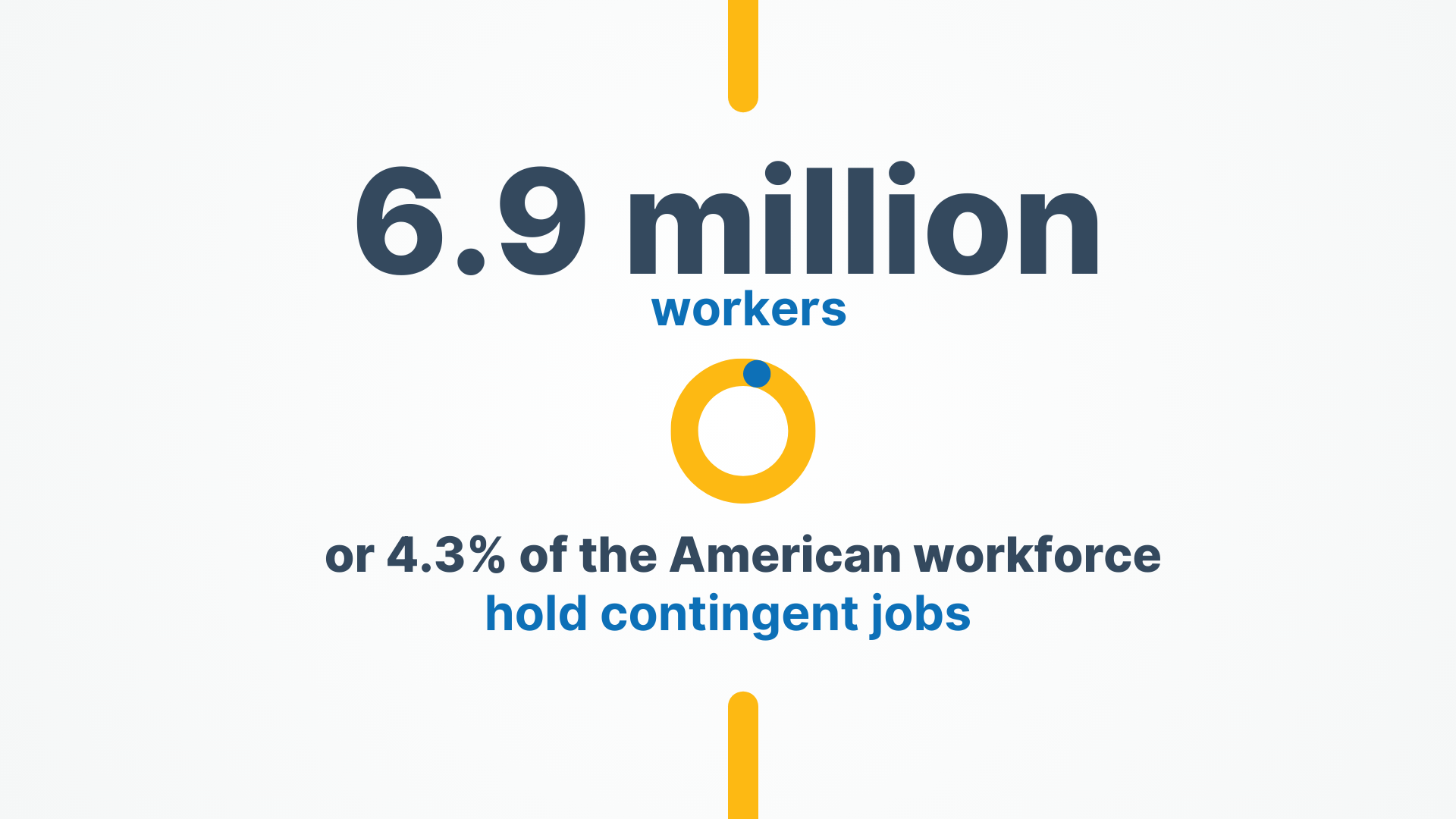
Data from the U.S. Bureau of Labor Statistics shows that 6.9 million workers, or 4.3% of the American workforce, hold contingent jobs, an increase from 3.8% since 2017, when the BLS conducted its last survey.
Additionally, there are 11.9 million independent contractors, 2.8 million on-call workers, 945,000 temporary help agency workers, and 862,000 workers provided by contract firms.
Some of these may overlap with contingency workers.
Regardless, millions of American workers are embracing interim roles, whether by choice or out of necessity.
Meanwhile, according to a Ceridian study, 65% of companies plan to increase their use of this dynamic, flexible workforce.
The same study also revealed that 44% of executives struggled to find contingent workers with the specific skills they needed, and for 70%, integrating them into the workforce was a significant challenge.
Between the heightened reliance on contingency workers and the challenges of sourcing and managing them, the need for specialized tools grows. Without these solutions, companies may struggle to address the complexities of an external workforce and risk falling behind in a competitive labor market.
Technology is an integral part of how businesses operate and manage their employees, whether they are contingent or not.
Between the growing reliance on external workers and the unique challenges they introduce in the workplace, tool adoption takes central stage in any contingent workforce management system.
External workers may fall under various legal and tax classifications, depending on the type of contract and the nature of their work. Therefore, accurate classification and compliance are among the most significant challenges.
For example, an average of at least 10-30% of employers misclassify their workers as independent contractors, affecting millions of employees and costing state and federal governments billions of dollars in lost tax revenue.
For companies, this poses a significant compliance risk that can result in fines, back taxes, or penalties. These challenges are even more pronounced when they manage a large, diverse workforce across multiple jurisdictions with varying labor laws.
Avoiding them requires a robust system with tools that can track worker status, location, and labor laws. The right contingent workforce solutions can also reduce human errors by flagging disparities and providing real-time updates on legal changes. Overall, this minimizes the risk of costly misclassification and compliance failures.
Managing payment and invoicing is another challenge that drives the adoption of tools in contingent talent management.
When dealing with hundreds or even thousands of contractors, inconsistencies in invoicing, delays in payments, or errors in payment amounts can cause frustration for employees and disruption in operations for companies.
Therefore, using technology that connects workers, managers, procurement, and finance offers a solution for a process that can quickly become logistically overwhelming if handled manually.
Another argument in favor of using technology for contingent workforce management is the “nature” of the job.
External employees often operate on more flexible schedules or, in some cases, remotely, making it challenging for companies to maintain consistent quality control and monitor performance.
Without tools that track and measure performance, managers may struggle to assess whether a worker’s output aligns with company standards or project goals.
Managing external talent can be an incredibly complex task, as companies must balance staffing for these roles or overseeing multiple suppliers (if using staffing agencies) with short-term engagements and diverse contract types.
Specialized technology can coordinate the many steps involved in this process, from sourcing workers to maintaining compliance and processing payments for non-employee talent.
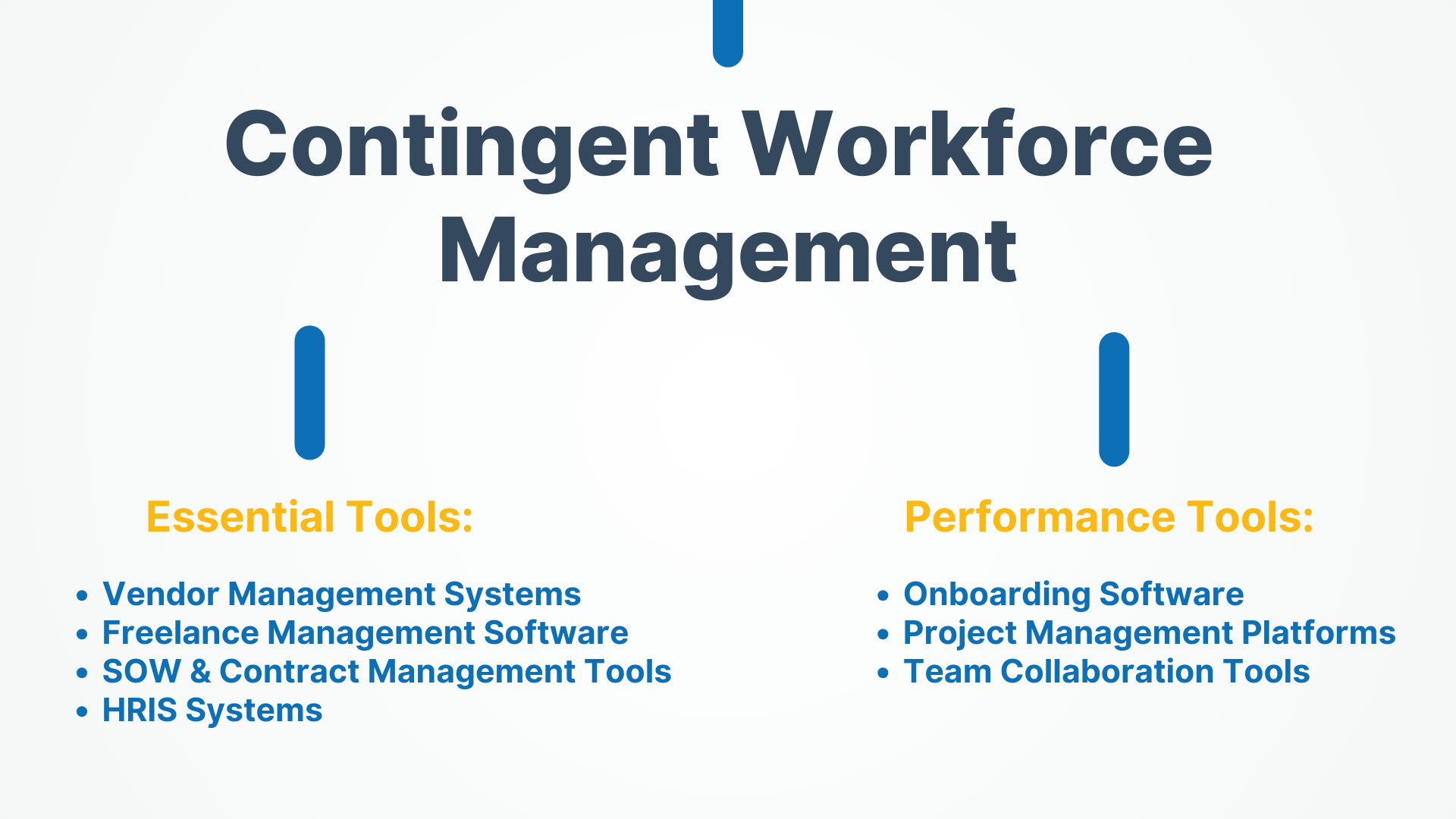
The following tools form the operational backbone of any contingent workforce function.
Temporary labor has historically been purchased as a service, which is a practice that continues to this day.
Staffing industry statistics show that around three million temporary and contract employees work for staffing firms during a typical week.
When these sources spread across multiple agencies, HR can easily lose control over who’s on the team and how well they’re integrated.
Emerging as a solution, a vendor management system is the primary tool for managing agency-supplied contingent workers.
It centralizes supplier communication, making it easier for companies to post job requisitions, receive candidate submissions from multiple agencies, and track approvals. Moreover, a VMS can also handle time tracking, invoicing, performance visibility, and compliance.
For companies that rely on multiple suppliers and high volumes of agency workers, this level of structure reduces risks and provides complete visibility into spending patterns and supplier performance.
Freelance management software manages contingent staff hired directly, without using agencies, such as independent consultants, contractors, freelancers, and other gig workers.
When hiring in-house, companies assume all risks and operational responsibilities for onboarding, classification, and contracting.
An FMS centralizes all of these processes, allowing companies to build talent pools and quickly rehire trusted contractors.
More importantly, it maintains compliance without overreliance on third-party companies, giving the employer greater control over its contingent workforce.
Since these workers are not on payroll, the FMS usually handles invoices, which are reconciled within the system, ensuring accurate and timely payment without manual intervention.
Project-based work necessitates a separate approach to structure and management.
For example, a company hiring a consultancy to overhaul its data infrastructure needs a way to monitor outcomes such as deliverables and acceptance criteria.
One solution is to use a statement of work, a legally binding document between the company and the external worker, along with a contract lifecycle management (CLM) system, which can manage deliverables, milestones, approvals, and invoicing tasks based on outcomes rather than time.
These contingent workforce solutions provide procurement and finance with a reliable audit trail, helping to avoid unplanned changes by making them visible in real-time.
SOW and CLM platforms are especially valuable in complex, multi-phase projects where oversight can’t depend on spreadsheets.
When employers manage full-time and contingent workers, keeping track of all data can quickly become a fragmented process.
HRIS addresses this by consolidating all information, including that of temporary employees, on a single platform. Reliable HRIS systems often integrate with other tools, including VMS and FMS, allowing data to flow seamlessly between platforms.
Therefore, this technology takes center stage as an enabling tool for contingent workforce management, ensuring that everything, from compliance to payment, is easily administered. It also provides greater visibility, which supports everything from workforce planning to audit readiness and reporting across departments.


Once contingent workers are set up and begin contributing, the focus shifts to delivery. This process depends on how well they integrate into projects and maintain consistent performance.
Unlike core systems, the following tools do not manage contracts or payments. Instead, their role is supportive and focuses on execution rather than administration, without blurring the legal boundaries between employers and contingent talent.
Effective onboarding is crucial in contingent work, where engagements are often brief and expectations are immediate.
Onboarding software helps companies prepare non-permanent workers to contribute from the first day by coordinating access to tools and information. Rather than relying on manual hand-offs between teams, these platforms create a structured process that aligns employees with managers and operations.
Tracking productivity and progress for contingent workers differs significantly from traditional performance assessments.
For example, while employee monitoring software or performance management tools track employee behavior and long-term development metrics, project management platforms with tasks and milestone tracking are better suited for monitoring progress against assigned deliverables.
Due to the temporary nature of these jobs, all contingent workers must quickly join teams and align with the company’s goals.
Therefore, team collaboration tools also play a supportive role in contingent talent management, allowing external workers to communicate directly with internal teams and stay aligned on goals without constant supervision.
The way companies manage their talent, especially when it’s diverse, is evolving rapidly under the influence of automation and artificial intelligence.
Routing administrative tasks, such as invoice approval or contract tracking, can now be automated, reducing errors and freeing managers to focus on other strategic priorities.
In addition to this, the growing use of AI in the workplace introduces a predictable dimension, analyzing workforce patterns to forecast demand for skills, flag compliance risks, or guide better decision-making.
For example, in recruitment, this emerging technology supports matching candidates to roles with precision, thereby speeding up the time-to-fill for critical projects. Josh Barsin’s data shows that almost 60% of recruiters now use AI for sourcing, screening, and nurturing candidates, demonstrating its growing adoption and reliance.
In contract management, natural language processing (a subfield of AI) can identify inconsistencies or legal gaps, enabling employers to act proactively rather than reactively.
There are many more use cases, but the bottom line is that these technologies enable contingent workforce management to be predictive and proactive.
Choosing the right technology should reflect how your company engages with external talent.
There are various contingent workforce solutions, ranging from core to supportive, but they may not fit every strategy or business need. Different hiring models, contract types, or volumes introduce different operational needs.
Therefore, the right tools should support oversight without adding unnecessary complexity or another layer of administration.
Tool selection begins with a clear understanding of who makes up your external workforce.
For example, a company that relies on staffing agencies typically requires strong vendor oversight and invoice approval workflows, as the agency remains the legal employer and usually bills for the hours worked.
In contrast, one that engages independent contractors or consultants directly will have different requirements, such as tools that support worker classification, contracts, and milestone tracking.
Moreover, consulting engagements introduce yet another set of needs, often centered on SOW oversight and deliverable acceptance rather than time tracking.
Engagement length, payment models, access requirements, and regulatory exposure all shape which tools are essential for a company. Without mapping these differences, the risk is adopting platforms that get underused or misapplied.
Once workforce needs are clear, functionality becomes more important than a feature list. The following core capabilities should take priority:
Supporting tools may enhance visibility of efficiency, but they shouldn’t duplicate the core processes. Overall, the goal is to ensure each system has a clear role rather than building a fragmented tool stack.
One final consideration when choosing tools for your contingent workforce management system is to ensure they are scalable.
Workforce needs rarely remain static. As hiring volumes increase, systems must be able to support this growth without introducing risk. This means every tool, from VMS or FMS to your supporting platforms, must be able to scale in a coordinated way.
Scalability also includes compliance readiness, ensuring that all processes remain consistent as regulations change or companies expand across different regions.
Contingent workforce management requires operational precision.
The right combination of core tools and supporting platforms brings clarity to the complex challenges of managing an external workforce. Companies that understand how to leverage these systems can maintain control without sacrificing the human judgment and hands-on coordination that ensure project success.
Content Writer at Shortlister
Browse our curated list of vendors to find the best solution for your needs.
Subscribe to our newsletter for the latest trends, expert tips, and workplace insights!
Uncover the relationship between talent acquisition and applicant tracking systems (ATS), gaining insight into how these components can streamline your recruitment efforts.

Unlock the secrets to crafting an ATS-friendly resume that stands out in the job market with valuable insights and tips to navigate applicant tracking systems effectively.

A company is only as good as its workers. Thus, its potential undoubtedly increases with a high-quality onboarding program.

Explore how HRIS streamlines HR operations while at the same time improving employee engagement, compliance, and organizational efficiency.
We're working hard to make it easy for you. Sign up for news, trends and insights.