
What’s a 147c Letter?
Explore the purpose and significance of a 147c letter, understand what it is, and when you should request one.

The One Big Beautiful Bill Act became law on July 4, 2025, and most of its benefit provisions started on January 1, 2026.
However, the guidance on these changes has arrived in stages, with Treasury issuing HSA guidance in December 2025 and paid leave credit guidance as recently as August 2026.
For these reasons, 2027 renewals are the first real decision point for most buyers.
The broker conversations happening through 2027 will determine whether the new limits and credits make it into plan design or wait another cycle.
The information in this article is general in nature and is not tax or legal advice.
Two of the law’s best-known provisions land on payroll providers first.
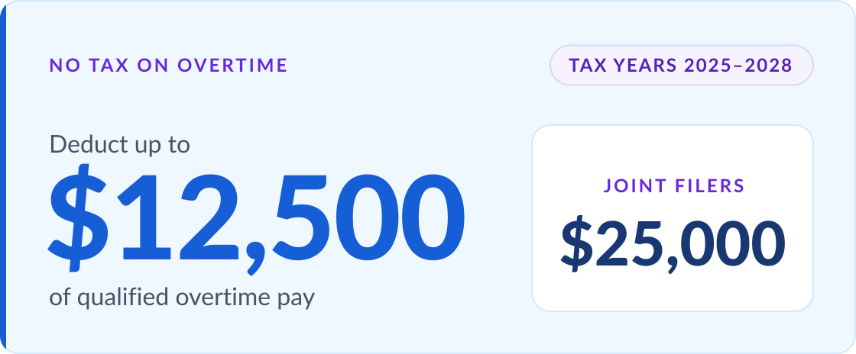
Under “no tax on overtime,” employees can deduct up to $12,500, or $25,000 for joint filers, of qualified overtime pay for tax years 2025 through 2028. Only overtime required by the Fair Labor Standards Act (FLSA), the federal wage-and-hour law, counts, and only the premium “half” of time-and-a-half.
“No tax on tips” works similarly. Workers in tipped occupations can deduct up to $25,000 a year of qualified tips for the same four tax years.
For 2025, employers were not required to report these amounts separately, though the IRS encouraged them to report the figures in W-2 Box 14, through an online portal or on a separate statement.
From the 2026 tax year, the figures move to new Box 12 codes:
A new Box 14b carries the employee’s tipped occupation code.
Contractor reporting changes as well.
The filing threshold for Forms 1099-NEC and 1099-MISC rises from $600 to $2,000 for payments made after December 31, 2025. Inflation indexing begins in 2027, when the threshold moves to $2,100.
What it means for 2027: The W-2s issued in January 2027 are the first with the new codes. Clients will have questions once employees start filing, so payroll vendors should send their guidance before year-end.
Since 1986, the most an employee could set aside in a dependent care flexible spending account (FSA) was $5,000. From 2026, the annual limit rises to $7,500, and from $2,500 to $3,750 for married taxpayers filing separately.
The FSA account lets employees use pre-tax money for expenses such as daycare and preschool. As a result, this makes the higher limit one of the law’s most visible changes for working parents.
The new limit is not indexed to inflation, so it will stay at $7,500 until Congress acts again.
While the higher limit is a welcome change, it may also complicate nondiscrimination testing. These tests check that a plan does not mainly benefit highly compensated employees (HCEs).
The toughest one, the 55% average benefits test, compares what lower-paid employees receive with what HCEs receive, and HCEs are often the employees most likely to contribute the full $7,500.
Proposed rules from Treasury, released on August 11, 2026, should make the test easier to pass. They count only employees who actually use the benefit when calculating averages, and employers can now rely on them even though the rules are not yet final.
Employers do not have to adopt the $7,500 limit, since each plan sets its own maximum.
What it means for 2027: Employers that held their limit at $5,000 in 2026 can revisit it for 2027 under friendlier testing rules. Dependent care FSA administrators should expect more employers to raise their limits and ask more questions about testing under the proposed rules.
Until this year, an employee who paid a monthly fee to a direct primary care practice could lose the right to contribute to a health savings account (HSA).
That’s because HSAs are tax-free accounts for medical costs, open only to people enrolled in a high-deductible health plan (HDHP), and most other coverage held alongside the HDHP ended eligibility.
The OBBA tax law loosens that rule in several places.
Direct primary care (DPC) is a membership model in which a patient pays a practice a flat periodic fee for primary care. As of January 2026, a DPC arrangement no longer makes an employee ineligible for an HSA, and HSA funds can pay the fees.
Fees must stay at or below $150 per month for an individual or $300 for a family, and although the limits are indexed, the IRS has kept both unchanged for 2027.
High-deductible plans can also cover telehealth before the deductible without breaking HSA eligibility. The relief is now permanent and applies to plan years beginning after December 31, 2024.
Bronze and catastrophic plans sold on the Affordable Care Act exchanges also count as HSA-eligible from 2026.
Interestingly, IRS guidance confirms the treatment applies when an employer’s individual coverage HRA (ICHRA) is used to purchase the plan, a useful detail for ICHRA administrators.
What it means for 2027: Direct primary care and virtual care vendors need a written HSA-compatibility statement, and onsite clinic operators should expect the same question. HSA administrators should explain the distinction between reimbursing a fee and remaining eligible to contribute.
The employer credit for paid family and medical leave, known as Section 45S, rewards employers that continue to pay employees while they’re on leave.
The 2025 tax law made it permanent.
Until 2026, employers could claim it only on wages paid during leave, worth 12.5% to 25% of those wages for up to 12 weeks a year.
From 2026, employers that purchase paid leave insurance can instead calculate the credit on their premiums.
Eligibility is wider, too:
Qualifying leave covers the same reasons as the Family and Medical Leave Act (FMLA), such as caring for a new child or recovering from a serious health condition.
When an insurance policy also covers other types of leave, or employees who don’t qualify, employers can claim the credit only on the qualifying share of the premium. The IRS explained how to split it in Notice 2026-28, interim guidance issued on August 5, 2026.
Treasury and the IRS still plan to publish proposed regulations, so the rules could change again.
What it means for 2027: Leave and disability vendors can help buyers assess the premium option at renewal, and show which coverage qualifies. Proposals should acknowledge that final rules remain pending.
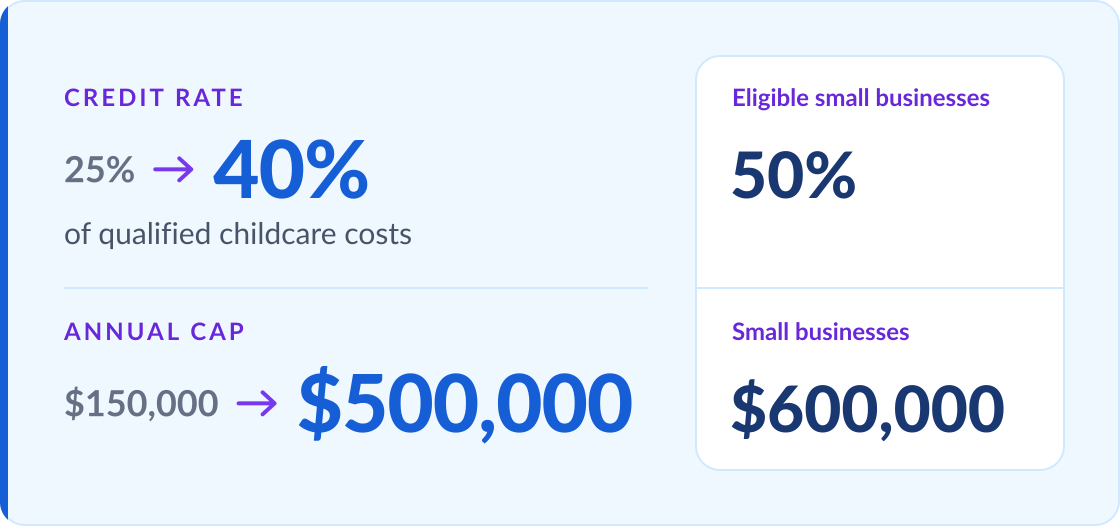
Section 45F gives employers a tax credit for helping employees pay for child care, and the 2025 tax law made it far more generous for amounts paid after December 31, 2025:
For tax years beginning in 2026, an eligible small business is one whose average annual gross receipts over the prior five years do not exceed $32 million.
In addition, costs of contracting with third-party intermediaries that work with child care centers now qualify, so an employer can earn the credit by buying from a child care provider instead of building a center.
Facilities owned or operated jointly by several employers qualify, while the separate credit for resource-and-referral services, which help employees find care, stays at 10%.
However, Treasury has placed regulations on the enhanced credit in its 2026–2027 Priority Guidance Plan, so the fine print on intermediary contracts may still change.
What it means for 2027: 2027 is the first year employers can budget for the larger, indexed credit from January. Child care and backup care providers can show buyers, in writing, how a contract with them counts toward the credit.
Since March 2020, employers have been able to pay down employees’ student loans tax-free, but only under a temporary rule scheduled to end on January 1, 2026. The 2025 tax law makes it permanent for payments after December 31, 2025.
The rule is in Section 127 of the tax code, which allows employers to provide up to $5,250 per year in tax-free educational assistance, including tuition.
That dollar limit moves for the first time as well. It is now indexed to inflation, and the IRS has set the 2027 figure at $5,400.
What it means for 2027: With the “it might expire” objection gone, student loan and tuition assistance vendors can retire any “expires 2025” language and pitch the benefit as a stable, long-term part of the package.
Employer contributions to Trump Accounts became possible on July 4, 2026, a year to the day after the law was signed.
The accounts are tax-favored retirement accounts for children under 18. Through a separate written plan, employers can contribute up to $2,500 per employee annually, excluding from the employee’s taxable income.
The allowance applies to per employee rather than per child. Programs must also meet nondiscrimination requirements.
Employer payments count toward the general $5,000 annual contribution cap per child, indexed after 2027.
Treasury’s one-time $1,000 pilot contribution for eligible U.S. citizen children born during 2025–2028 is exempt from that cap, as are certain other contributions.
What it means for 2027: 2027 will be the first full year of employer contributions. Recordkeepers and financial wellness firms can offer to handle plan documents and administration, while payroll providers will need to report contributions under the new TA code.
Two other provisions are worth a mention, though neither requires action from vendors.
The CHOICE arrangement provision, which would have written individual coverage HRAs into statute, did not make the final bill. ICHRAs continue under existing regulations.
In addition, the tax exclusion for bicycle commuting reimbursements is permanently repealed, a point that matters mainly to commuter benefits providers still fielding the question.
What it means for 2027: Neither item calls for new materials.
Each category has one or two pieces of material worth preparing before renewal meetings begin.
Senior Content Writer at Shortlister
Browse our curated list of vendors to find the best solution for your needs.
Subscribe to our newsletter for the latest trends, expert tips, and workplace insights!
Explore the purpose and significance of a 147c letter, understand what it is, and when you should request one.

Delve into the analysis of ADP’s payroll processing services and compare them against the biggest ADP competitors.
From behind-the-scenes support to the forefront of strategic HR innovation, payroll systems are evolving into indispensable tools for transforming the employee experience and driving organizational success.

Streamline your payroll processes and ensure accuracy with free payroll software solutions.
We're working hard to make it easy for you. Sign up for news, trends and insights.