Why Wellness Programs Get Bought in January?
A wellness program that goes live in January is chosen long before the holidays end. For a program that works in 2027, the real decision window opens in November.

Most employers sign next year’s benefits contracts well before open enrolment begins. By December, what’s left to decide is small, and buying slows until the calendar turns.
Wellness platforms, however, follow a different pattern.
Launches cluster around the new year, while research into them picks up in the fourth quarter.
For HR and benefits leaders planning a launch early in the year, November and December are an important window for turning that research into a buying decision.
What follows is a month-by-month guide to using that window, from assessing needs to a first-quarter launch.
Shortlister data covering four years of benefits projects shows one category keeping its own calendar.
Wellness platforms are disproportionately launched around the turn of the year, and research for them begins in Q4.
Interestingly, that pattern runs against the wider market.
Across most benefits categories, new launches drop sharply at the end of the year, as The Benefits Procurement Calendar showed.
Much of that fourth-quarter research also happens before any vendor hears about it.
As The Shrinking Shortlist explains, brokers and HR teams increasingly use AI assistants and comparison pages to decide which vendors to contact.
In other words, vendors hoping to compete for those early-year projects need to be visible well before the new year.
Several calendar pressures may help explain the timing.
The first is budgeting. For employers whose fiscal year begins in January, approved funding becomes available at the start of the year. That makes January a natural point to launch wellness programs planned during Q4.
Open enrollment also demands much of benefits teams’ attention in the fall, leaving less capacity to implement new programs until enrollment wraps up.
Incentives can reinforce that timing. According to KFF, 53% of large firms that offer a health risk assessment use incentives or penalties to encourage completion, and 62% do so for biometric screenings.
Most of those rewards follow the calendar year, so a late start forfeits part of the incentive year.
Employee interest and New Year’s resolutions may also help explain the appeal of a January campaign. In a YouGov poll, 31% of Americans planned to make a resolution for 2026, and 25% of all respondents named exercising more.
Programs that build on that January momentum help employees turn early intentions into lasting habits.
For employers working out how to start an employee wellness program, the groundwork begins with data HR already holds.
Before considering new options, employers should review how well their current benefits meet employees’ needs and where support is missing.
Each existing program should be judged on the employer’s own claims and engagement data, not on results a vendor reports across its whole client base, since those averages describe other employers’ workforces.
Low participation, however, does not necessarily mean a program is ineffective.
A benefit that improves health for a small group of high-risk employees may justify its cost, so decisions about what to cut should consider results alongside participation.
Claim themes, which a broker or carrier can provide in aggregate, show where health spending is concentrated.
For example, retirement data adds a money signal. Vanguard found that about 6% of eligible 401(k) participants took a hardship withdrawal in 2025, up from 5% in 2024.
Health costs can put pressure on employees’ finances, so it helps to review both sets of data together. An employee withdrawing retirement savings, for example, may be trying to cover a medical bill.
A needs assessment that looks only at medical claims will miss the money and work stress that drive many of them.
The strongest program ideas pair workforce data with what employees say they want.
In fact, a short pulse survey in November, asking which goals employees would welcome support with, gives the brief a second source of insight and builds early interest in the launch.
For example, here is how common need signals can translate into program design:
Narrowing the brief to two or three priorities also keeps the budget discussion focused, and a wellness platform that spans several dimensions can serve more than one of them.
The next step is to agree on what success looks like, so every vendor demonstration can be measured against the same goals.
A workable scorecard has two levels:
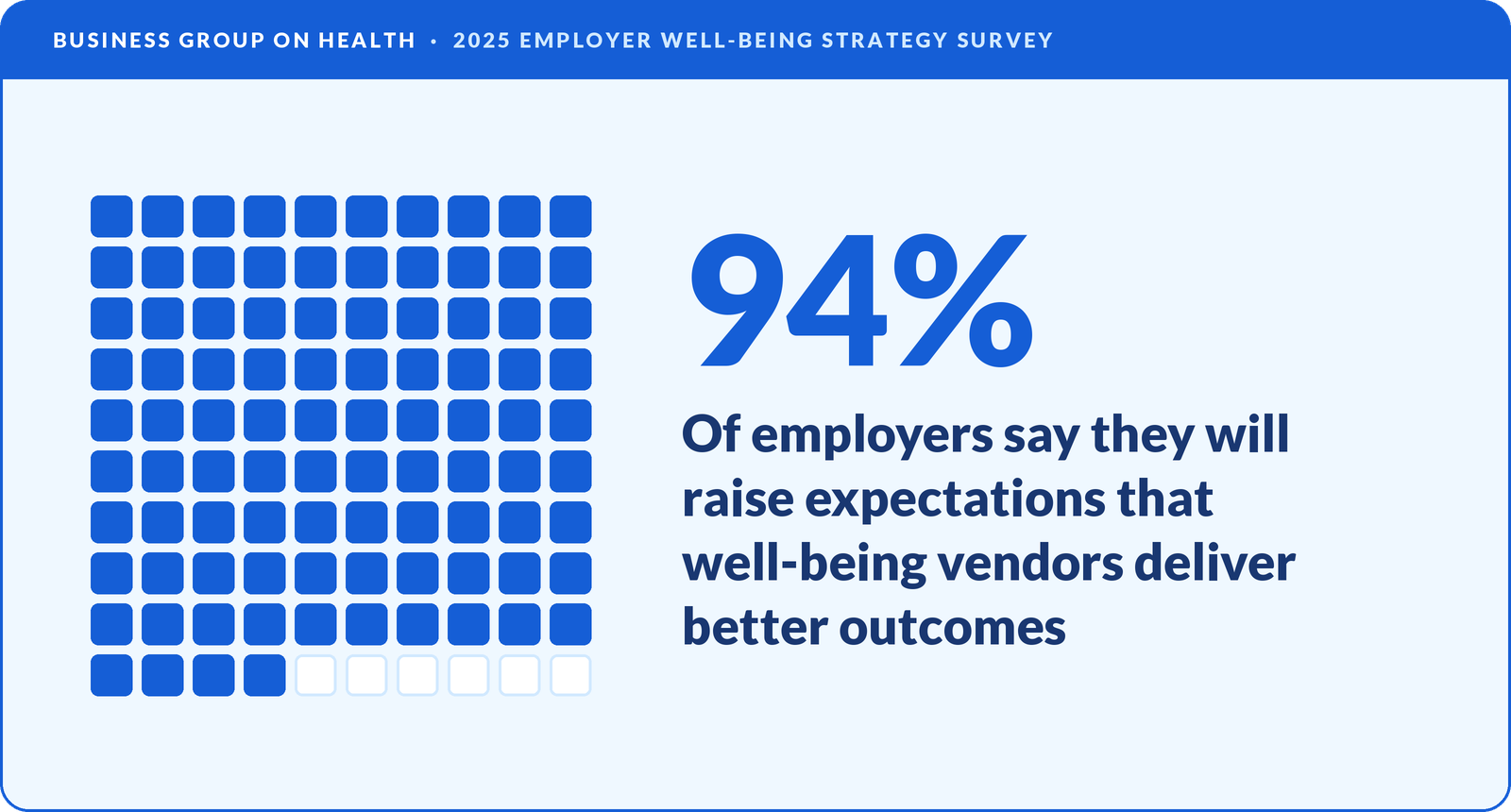
Employers are already moving in that direction when it comes to defining success. In Business Group on Health’s 2025 survey, 94% said they will raise expectations that well-being vendors deliver better outcomes.
According to the Peterson Health Technology Institute, 68% of employers now use performance-based contracts for digital health, tying part of a vendor’s fees to results.
December is evaluation month, and selection takes longer than many teams expect.
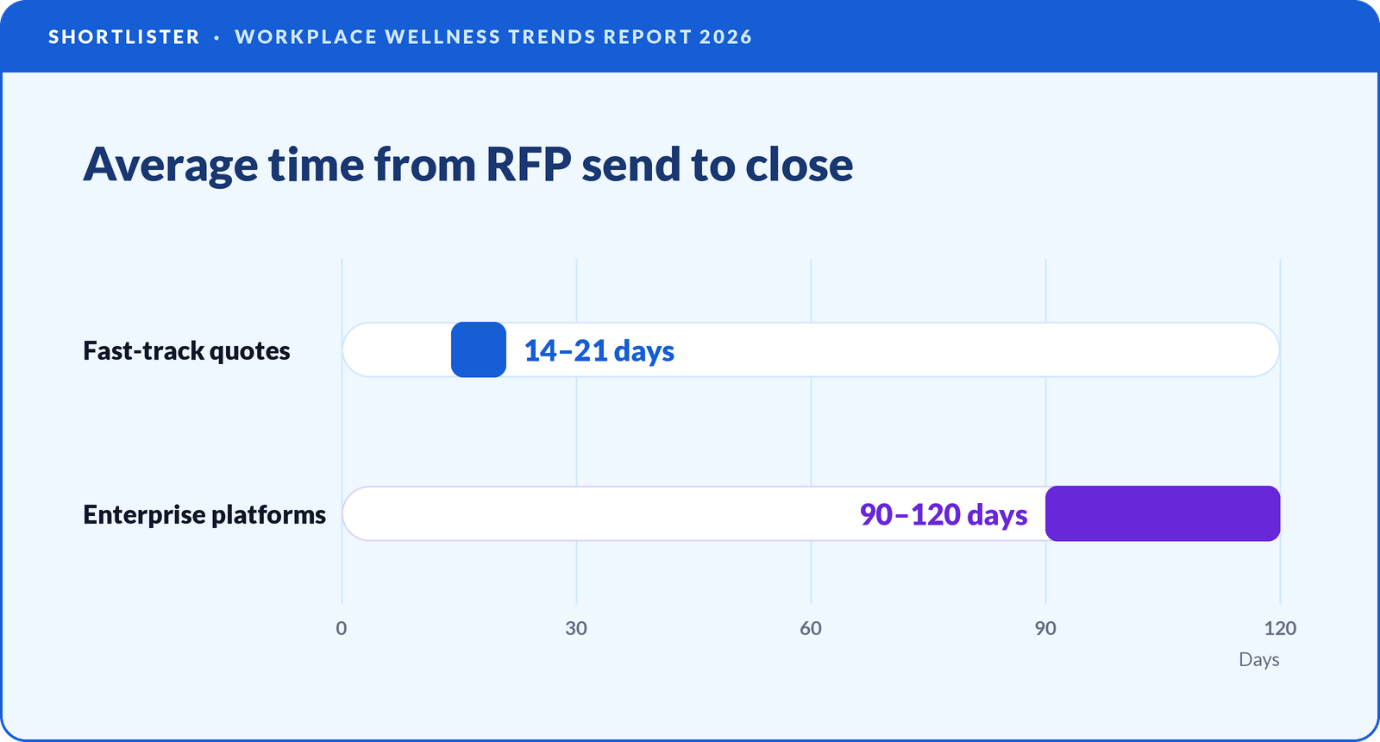
Shortlister’s Workplace Wellness Trends Report for 2026 found that the average time from RFP send to close runs from 14 to 21 days for fast-track quotes up to 90 to 120 days for enterprise platforms.
For these reasons, inviting five or six vendors and bringing two or three finalists to demos keeps pace with how employers buy today.
Shortlister’s directory of wellness platforms can help identify suitable providers, and the following five areas can guide their evaluation.
| Evaluation area | Questions to ask vendors |
|---|---|
| Participation | Who is counted in the participation rate, and who is excluded? Can workforce groups be compared without identifying individuals? |
| Engagement over time | How is useful activity tracked after launch rewards end? Do reports distinguish successful completion from withdrawal? |
| Employee data | What information reaches HR? What happens to employee data when the contract ends? |
| Savings claims | Are savings observed in claims or estimated from a model? What comparison group and costs are included? |
| AI features | Which recommendations are AI-driven, and can the vendor show them working on sample data? |
If the vendor search is already underway, use December to finalize the budget and contract terms. Account for the full cost of the first year, including platform fees, implementation costs, employee incentives, and the staff time needed to manage the program.
Shortlister’s guide to building a wellness program budget can help structure that discussion.
After selecting the vendor in December, use January to help employees get started.
Introduce the core features first, then add new activities or content in February to give employees a reason to keep participating.
For HR teams weighing how to increase participation in wellness programs, the employee’s first experience carries the most weight.
Before registration starts, test the full journey with people from different workforce groups, such as shift workers and remote staff, and confirm that every advertised support channel is live and that rewards record correctly.
Schedule the first review when the contract is signed, allowing enough time after launch for employees to use the service.
Use that review to identify any problems employees have accessing the service and decide who will resolve them. Assess longer-term outcomes according to the measurement schedule agreed in December.
The 2027 plan year opens under the heaviest cost pressure employers have faced in nearly two decades.
PwC’s Health Research Institute projects a 9% medical cost trend for employer plans, while Aon expects per-employee health costs to rise 9.5% to more than $19,000, the fourth consecutive year of near-double-digit growth.
Much of that growth is traced back to conditions that prevention can reach.
According to the CDC, people with chronic and mental health conditions account for 90% of the nation’s $5.3 trillion in annual health spending, and Aon names the mounting prevalence of chronic conditions among the main drivers of employer cost growth.
Therefore, the employers best placed for 2027 will have their wellness platform decisions on paper before the year begins.
Senior Content Writer at Shortlister
Browse our curated list of vendors to find the best solution for your needs.
Subscribe to our newsletter for the latest trends, expert tips, and workplace insights!

A wellness program that goes live in January is chosen long before the holidays end. For a program that works in 2027, the real decision window opens in November.

With half of all benefits contracts spanning three years, the stakes and long-term value of the outcome become much higher for buyers and vendors alike.

Over 290 categories later, the market is turning with more urgency to solutions whose primary function is to make sense of all the others.
Many benefits vendors already offer the expected product features. Shortlister data shows that security reviews and health care accreditation are moving to the top of their priority lists.
We're working hard to make it easy for you. Sign up for news, trends and insights.